
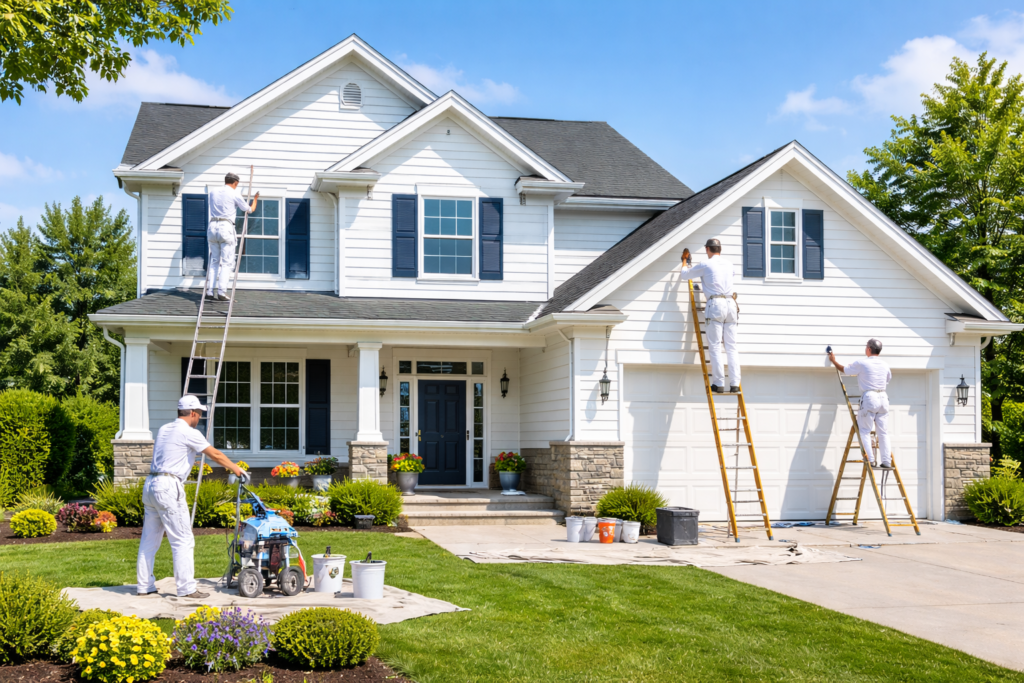
Quick Answer: Exterior House Painting Cost
Measure | Cost |
Per square foot of paintable area | $1.50 to $5.00 |
Typical mid-range repaint | $2.50 to $3.50 per sq ft |
Average 2,000 sq ft home (1,700 sq ft paintable) | $4,250 to $5,950 |
Full national range, all home sizes | $1,200 to $16,800 |
Painter hourly rate | $25 to $75 per painter |
Paint cost per gallon | $20 to $80, premium $100+ |
If you are researching exterior house painting cost, you are almost certainly weighing a four to five figure decision. Painting the outside of a home is not only cosmetic. It seals siding against moisture, slows UV degradation, prevents wood rot, and protects resale value.
Before you compare a single quote, read the next section. It is the reason most online painting estimates do not match the bids homeowners actually receive.
Paintable Area vs Home Square Footage
When a contractor quotes you “$3.00 per square foot,” they are almost never talking about your home’s listed square footage.
Painters price by paintable area: the actual exterior wall surface that will receive paint, minus windows, doors, and garage openings. That number is different from the floor area on your property listing, and confusing the two is the single most common budgeting error homeowners make.
As a working rule:
Paintable exterior area is roughly 80 percent of a single-story home’s floor area, and rises with additional stories, taller walls, and complex rooflines.
Home size (floor area) | Approximate paintable area | Full cost range | Typical mid-range cost |
1,000 sq ft | ~800 sq ft | $1,200 to $4,000 | $2,000 to $2,800 |
1,500 sq ft | ~1,200 sq ft | $1,800 to $6,000 | $3,000 to $4,200 |
2,000 sq ft | ~1,700 sq ft | $2,600 to $8,500 | $4,250 to $5,950 |
2,500 sq ft | ~2,100 sq ft | $3,200 to $10,500 | $5,250 to $7,350 |
3,000 sq ft | ~2,500 sq ft | $3,800 to $12,500 | $6,250 to $8,750 |
3,500 sq ft | ~2,900 sq ft | $4,400 to $14,500 | $7,250 to $10,150 |
4,000 sq ft | ~3,350 sq ft | $5,000 to $16,800 | $8,375 to $11,725 |
5,000 sq ft | ~4,200 sq ft | $6,300 to $21,000 | $10,500 to $14,700 |
How to Measure Your Own Paintable Area
- Measure the length of each exterior wall and multiply by wall height.
- Add gable ends at half the base times the height.
- Subtract windows, doors, and garage door openings.
- Add soffit, fascia, and trim separately if they are in scope.
A quick field check: total exterior wall perimeter times average wall height gives you a close working number in under ten minutes.
Every price in this guide is stated per square foot of paintable area unless noted otherwise.
Average Exterior House Painting Cost in the U.S.
Nationally, professional exterior painting runs $1.50 to $5.00 per square foot of paintable surface. Most standard repaints on homes in reasonable condition land between $2.50 and $3.50 per square foot.
The spread is wide for a reason. Two homes of identical size can differ by a factor of three depending on siding material, condition, height, and how much surface preparation the job requires.
The three variables that move the number most:
- Prep condition. On a badly weathered home, preparation alone can be 40 percent of the estimate.
- Height and access. Every story above the first adds scaffold, ladder, and safety time.
- Substrate. Brick and stucco drink paint. Vinyl and metal do not.
Exterior Painting Cost Per Square Foot by Prep Level
Preparation, not paint, is what separates a $2 per square foot job from a $5 per square foot job.
Tier 1: Basic Repaint, $1.50 to $2.50 Per Sq Ft
For homes in good condition with intact existing paint and minimal peeling.
Includes pressure washing, minor spot sanding, spot priming as needed, and two finish coats.
Tier 2: Standard Prep and Repaint, $2.50 to $3.50 Per Sq Ft
The most common scenario. Includes scraping peeling paint, filling cracks and nail holes, re-caulking seams and window perimeters, spot priming exposed substrate, and light wood repair.
Tier 3: Extensive Prep or Repairs, $3.50 to $5.00+ Per Sq Ft
For homes with widespread peeling, wood rot, damaged siding, mildew, or pre-1978 lead-based coatings. Adds containment, specialized materials, carpentry, and in the case of lead, certified handling procedures.
Cost by Number of Stories
Height is a cost multiplier, not an additive. Reaching a surface safely costs more than painting it.
Stories | Estimated paintable area | Typical total cost |
Single story | 800 to 1,500 sq ft | $2,000 to $5,250 |
Two stories | 1,500 to 2,500 sq ft | $3,750 to $8,750 |
Three stories | 2,500 to 3,500 sq ft | $6,250 to $14,000 |
Height Surcharges Contractors Apply
Working height | Typical surcharge |
Above 8 feet | Add 30% |
Above 13 feet | Add 60% |
Above 17 feet | Add 90% |
Above 19 feet | Add 120% |
Cost to paint a 2 story house exterior typically lands between $3,750 and $8,750, running 20 to 50 percent above a comparable single-story home. Dormers, steep grade changes around the foundation, and second-story overhangs push toward the top of that range because they require staging rather than simple ladder work.
Cost to Paint House Exterior by Siding Material
Substrate drives both paint consumption and prep labor. This is the table most homeowners actually need.
Siding material | Cost per sq ft | Notes |
Vinyl | $1.50 to $4.50 | Cheapest to paint, but check your warranty first |
Aluminum / metal | $2.00 to $4.50 | Requires self-etching or oil-based primer |
Wood (lap, shiplap, clapboard) | $1.50 to $5.00 | Highest prep variability, most maintenance |
Concrete / masonry | $1.00 to $3.50 | Porous, needs masonry primer |
Engineered wood (LP SmartSide) | $1.75 to $4.00 | Pre-primed from the factory, good adhesion |
Fiber cement (HardiePlank) | $1.75 to $4.25 | Excellent paint retention, 10 to 15 year cycles |
Cedar shake / shingle | $2.50 to $6.00 | Labor intensive, many edges and gaps |
T1-11 plywood siding | $1.75 to $3.75 | Grooves slow application |
Stucco | $2.00 to $5.50 | Texture increases paint consumption 20 to 40% |
Brick | $2.50 to $6.00 | Porous, requires masonry primer and breathable topcoat |
Vinyl Siding
The least expensive substrate to paint. Two cautions. First, painting vinyl siding can void the manufacturer warranty under some policies, so check before you commit. Second, never paint vinyl a color significantly darker than the original. Dark colors absorb heat and can warp the panels. Use paint formulated with vinyl-safe pigments.
Wood Siding
The widest cost range of any substrate because condition varies so much. Wood needs full or partial priming, especially when going lighter than the existing color. Expect ongoing maintenance every three to seven years.
Fiber Cement
HardiePlank and similar boards hold paint exceptionally well. If the boards are factory-primed and undamaged, the job is straightforward and lands mid-range. Repaint cycles of 10 to 15 years make this the best long-term value of any paintable siding.
Stucco
Stucco’s texture increases both paint consumption and labor time. Acrylic and elastomeric coatings both work, but fog coating is an alternative worth knowing: a thin cement-based spray that soaks into the surface, refreshes color, breathes better than paint, and resists fading longer. Fog coating runs $2.00 to $8.00 per square foot.
Elastomeric coatings, which flex with thermal movement and bridge hairline cracks, cost more per gallon but are common on stucco in hot climates.
Brick
Painting brick is popular and permanent. It is a one-way decision, since removing paint from brick is expensive and rarely fully successful.
Brick is porous and absorbs significantly more paint than smooth siding. It requires a masonry primer and a breathable topcoat, because trapping moisture behind a non-permeable film causes spalling.
Alternatives that let the brick texture show through:
- Limewashing: $2.50 to $6.00 per sq ft, uses hydrated lime, highly breathable
- Whitewashing: $2.50 to $5.00 per sq ft, uses diluted paint
- German schmear: $3.00 to $7.00 per sq ft, mortar-based, heavier texture
Labor Cost to Paint Exterior of a House
Labor is the dominant cost. Because exterior paint material is relatively inexpensive relative to the hours required, labor typically accounts for 70 to 85 percent of an exterior repaint total, higher than most other trades.
Labor pricing method | Rate |
Per square foot | $1.25 to $3.50 |
Per hour, per painter | $25 to $75 |
Specialty or historic work | $75 to $100 per hour |
Bureau of Labor Statistics Occupational Employment and Wage Statistics data for SOC 47-2141, Painters, Construction and Maintenance, is the underlying benchmark for regional labor rates. Crews in high cost-of-living metros price well above the national mean.
Factors that move labor:
- Geographic market and local wage floor
- Working height and access difficulty
- Prep scope, which is the single largest variable
- Architectural complexity: dormers, corbels, decorative trim, multiple rooflines
- Number of colors, which multiplies masking and cut-in time
- Seasonal demand, which peaks late spring through early fall
Paint and Material Costs
Material | Cost |
Standard exterior paint | $20 to $50 per gallon |
Premium exterior paint | $50 to $80 per gallon |
Ultra-premium | $100+ per gallon |
Exterior primer | $15 to $80 per gallon |
Elastomeric coating | $45 to $110 per gallon |
Masonry primer | $25 to $60 per gallon |
Caulk, tape, plastic, drop cloths | $150 to $400 per project |
Coverage Rates and How Many Gallons You Need
Standard exterior paint covers 350 to 400 square feet per gallon on smooth surfaces. Rough or porous surfaces cut that significantly.
Surface | Coverage per gallon |
Smooth vinyl or metal | 375 to 400 sq ft |
Smooth wood or fiber cement | 350 to 375 sq ft |
Textured stucco | 200 to 275 sq ft |
Unpainted brick | 150 to 250 sq ft |
Worked example. A 2,000 sq ft home with 1,700 sq ft of paintable smooth siding, painted with two coats:
1,700 × 2 = 3,400 sq ft of coverage needed 3,400 ÷ 350 = 10 gallons of finish paint
Add 2 to 4 gallons of primer if the substrate is bare, previously unpainted, or changing dramatically in color. Budget 12 to 14 gallons total.
Paint Brands Contractors Specify
Top-tier exterior lines by durability and color retention:
- Sherwin-Williams Duration and Emerald, known for crack and peel resistance
- Benjamin Moore Aura, known for fade resistance and color depth
- Behr Marquee, strong one-coat coverage and UV protection
- PPG Timeless and Valspar Duramax, competitive mid-tier options
- Kilz and Zinsser, the standard primers for stain blocking and bare substrate
Premium paint costs more per gallon and extends the repaint cycle by several years. On a job where labor is 80 percent of the total, saving $200 on paint to shorten the repaint cycle by three years is a losing trade.
Paint Types and Finishes
Paint type | Best for |
100% acrylic latex | The default for most exterior siding, flexible and breathable |
Oil-based / alkyd | Metal, high-wear trim, and stain-blocking situations |
Elastomeric | Stucco and masonry in high thermal movement climates |
Mineral / silicate | Historic masonry requiring maximum breathability |
Fog coat | Stucco color refresh without a film-forming coating |
Finish | Sheen level | Typical use |
Flat | Lowest | Hides surface imperfections, stucco and older wood |
Eggshell | Low | Siding on well-maintained homes |
Satin | Medium | The most common exterior siding choice |
Semi-gloss | High | Trim, shutters, doors |
High-gloss | Highest | Front doors, accent elements |
Glossier finishes cost more per gallon, clean more easily, and last longer, but they telegraph every surface flaw underneath.
Low-VOC and zero-VOC formulations are increasingly standard and are required in some jurisdictions, including much of California under regional air quality district rules.
Prep Work Costs, Itemized
This is where estimates diverge most, and where most homeowners fail to compare bids accurately.
Prep item | Cost |
Pressure washing | $240 to $400, or $0.15 to $0.40 per sq ft |
Paint stripping / scraping | $0.50 to $2.00 per sq ft |
Caulking home perimeter | $200 to $500 |
Recaulking windows | $50 to $70 per window |
Wood rot repair | $150 to $600 per affected area |
Siding repair or replacement | $2 to $50 per sq ft |
Mold and mildew treatment | $250 to $800 |
Full mold remediation | $1,100 to $3,400 |
Termite damage repair | $250 to $3,000+ |
Sanding and feathering | $0.30 to $1.00 per sq ft |
Landscaping protection and masking | $200 to $600 |
A bid that does not itemize prep is not a bid you can compare to another bid.
Lead Paint and the EPA RRP Rule
If your home was built before 1978, it may contain lead-based paint on exterior surfaces. This is not a footnote. It changes the legal and financial structure of the project.
Under the EPA Renovation, Repair and Painting (RRP) Rule, contractors disturbing painted surfaces in pre-1978 housing must be EPA Lead-Safe Certified and must follow specific containment, work practice, and cleanup requirements. Homeowners must receive the EPA’s lead hazard information pamphlet before work begins.
Lead-related item | Cost |
Lead test kit (DIY) | $10 to $30 |
Professional lead inspection | $250 to $700 |
Lead risk assessment | $350 to $1,000 |
Encapsulation | $4 to $8 per sq ft |
Full lead paint removal | $6 to $17 per sq ft |
RRP-compliant containment surcharge | 15 to 30% over standard pricing |
Two practical points. First, encapsulation, meaning sealing the lead paint under a specialized coating rather than removing it, is usually far cheaper than abatement and is often the correct choice. Second, hiring an uncertified contractor on a pre-1978 home creates liability exposure for you, not just for them.
Always verify EPA Lead-Safe certification before signing on a pre-1978 property.
Regional Cost Differences
Labor rates, insurance requirements, and climate all shift exterior painting cost by region. Typical total for a 1,500 sq ft home:
Region | Typical cost |
Far West (CA, WA, OR) | $4,200 to $4,800 |
New England | $4,400 to $4,900 |
Mideast (NY, NJ, PA) | $4,000 to $4,400 |
Southeast | $3,000 to $3,400 |
Great Lakes | $2,800 to $3,200 |
Rocky Mountains | $2,700 to $3,100 |
Southwest | $2,200 to $2,600 |
Plains | $2,100 to $2,500 |
Highest cost states are generally California, Washington, New York, Massachusetts, and Hawaii, driven by wage floors and contractor insurance requirements.
Lowest cost states cluster across the South Central and Plains regions, where labor markets are open-shop and cost of living is lower.
Climate also dictates specification. Gulf Coast and Southeast humidity demands mildew-resistant formulations. Southwest UV exposure shortens repaint cycles regardless of paint quality. Northern freeze-thaw cycles reward flexible acrylics over rigid films.
Exterior Painting Add-On Costs
Most exterior repaints include more than siding. Price these separately so they do not get buried in a lump sum.
Add-on | Cost |
Exterior trim | $1 to $4 per linear foot |
Soffit and fascia | $2.50 to $6.00 per linear foot |
Shutters | $50 to $150 per pair |
Window sashes | $100 to $200 each |
Exterior doors | $150 to $500 each |
Garage door | $1 to $4 per sq ft, or $100 to $680 |
Gutters and downspouts | $400 to $800 |
Porch or covered entry | $800 to $1,600 |
Deck | $2 to $5 per sq ft, or $600 to $2,000 |
Fence | $1 to $3 per sq ft, or $300 to $2,800 |
Metal roof | $1.50 to $4.00 per sq ft |
Foundation / skirting | $1.50 to $3.50 per sq ft |
Bundling add-ons into the main project usually earns a discount, because the crew is already mobilized, masked, and on site.
Permits, HOA Approval, and Insurance
- Permits. Most jurisdictions do not require a permit for routine repainting. Historic districts and some municipalities do. Where required, budget $200 to $300.
- HOA approval. If you are in an HOA, color selection almost always requires written approval before work begins. Painting without it can force a repaint at your expense.
- Historic districts. May restrict color palettes and require period-appropriate materials and review board approval.
- Contractor insurance. Verify general liability and workers’ compensation directly with the insurer, not from a PDF the contractor emails you. Painters work at height. If an uninsured crew member falls on your property, exposure can land on your homeowners policy.
- Licensing. Requirements vary by state. Some states license painting contractors, others do not. Verify locally.
How Long Does Exterior Painting Take?
Home size | Crew size | Duration |
Under 1,500 sq ft | 2 painters | 2 to 3 days |
1,500 to 2,500 sq ft | 2 to 3 painters | 3 to 5 days |
2,500 to 4,000 sq ft | 3 to 4 painters | 5 to 7 days |
Over 4,000 sq ft or 3 stories | 4+ painters | 7 to 12 days |
Heavy prep, wood rot repair, and weather delays extend these. Build two to three contingency days into any schedule tied to a closing date or an event.
Best Time of Year to Paint a House Exterior
Weather is not a preference here. It determines whether the coating cures properly.
Optimal conditions:
- Air and surface temperature between 50°F and 85°F
- Relative humidity between 40 and 70 percent
- Surface temperature at least 5°F above the dew point
- No rain forecast for 24 to 48 hours after application
- Avoid direct midday sun on the working elevation
Best seasons: late spring and early fall in most of the country. Late fall through winter works in the Southwest and Gulf South.
What goes wrong outside those ranges. Painting too cold prevents proper film formation and causes cracking. Painting too hot causes the surface to skin over before it levels, leaving lap marks. Painting near the dew point traps moisture and causes blistering.
Off-season scheduling is the single easiest way to save money. Contractors discount in slow months.
Spray, Roll, or Brush
Method | Speed | Best for | Trade-off |
Airless spray | Fastest | Large flat siding, stucco, fences | Requires extensive masking, thinner film |
Roll | Moderate | Flat siding, siding needing thicker build | Slower, better mil thickness |
Brush | Slowest | Trim, cut-ins, detail work | Most control, most labor |
Most professional crews spray and back-roll: spray for speed, then immediately roll to work the coating into the substrate. That combination gets spray productivity with roller adhesion, and it is what you want specified on a bid.
How Often Should You Repaint?
Siding type | Repaint cycle |
Vinyl | 5 to 10 years |
Aluminum | 5 to 10 years |
Wood | 3 to 7 years |
Cedar shake | 4 to 8 years |
Stucco | 5 to 7 years |
Fiber cement | 10 to 15 years |
Painted brick | 15 to 20 years |
Trim (all types) | 3 to 6 years |
South and southwest-facing elevations weather fastest because they take the most UV. It is common and completely reasonable to repaint one elevation on a shorter cycle than the rest of the house.
Inspect exterior paint every two years. Chalking, hairline cracking, and localized peeling are early signals. Once water gets behind the film into wood substrate, you are no longer buying a paint job, you are buying carpentry.
DIY vs Professional Exterior Painting
Factor | DIY | Professional |
2,000 sq ft home total | $800 to $2,500 | $4,250 to $5,950 |
Paint and primer | $400 to $1,000 | Included |
Sprayer rental | $80 to $150 per day | Included |
Ladder or scaffold rental | $50 to $200 per day | Included |
Pressure washer rental | $50 to $100 per day | Included |
Sundries | $150 to $400 | Included |
Time | 7 to 14 days | 3 to 5 days |
Warranty | None | 2 to 10 years typical |
DIY makes sense on a single-story home in good condition, on a fence, on a deck, or on a detached garage.
DIY does not make sense on a two-story or taller home, on a pre-1978 home where RRP rules apply, or on brick and stucco where substrate-specific coatings and primers matter. Falls from height are the leading cause of serious injury in residential construction work. The savings do not justify the risk on a second story.
A middle path many homeowners take: handle the prep yourself, meaning washing, scraping, sanding, and moving landscaping, then hire out application. Prep is unskilled labor billed at skilled rates, and removing it from scope can cut 20 to 30 percent off a bid.
Return on Investment and Resale Value
Exterior paint is consistently among the highest-return cosmetic improvements in residential real estate. A fresh exterior repaint influences the first impression that shapes every subsequent buyer judgment about the property.
Beyond curb appeal, paint is protective. A failing paint film on wood siding lets water into the substrate, and siding replacement costs several times what a repaint costs. Deferring a repaint past its cycle converts a maintenance expense into a capital one.
Neutral palettes, whites, greys, greiges, and soft blacks, consistently perform best for resale. Bold color choices are a personal preference decision, not a resale one.
How to Read an Exterior Painting Bid
A comparable bid states all of the following. If any is missing, request it before comparing.
- Total paintable square footage, and whether trim is included
- Number of coats on siding and on trim
- Paint brand, product line, and finish by surface
- Primer specification and where it is applied
- Prep scope, itemized: washing, scraping, sanding, caulking, priming
- Wood rot and repair allowance, and how overages are handled
- Surfaces excluded: gutters, soffit, fascia, doors, foundation
- Application method: spray, roll, brush, or spray and back-roll
- EPA RRP certification if the home predates 1978
- Warranty terms, covering both labor and coating
- Payment schedule and change order process
- Cleanup and landscaping protection
Red flags: a lump sum with no square footage stated, no paint product named, more than one third requested up front, no written insurance certificate, high-pressure same-day discounts, and a bid dramatically below the others.
Questions to Ask Before Hiring
- How many exterior repaints have you completed in the last 12 months?
- Can you provide addresses of jobs completed two or more years ago, so I can see how they held up?
- Are you licensed and insured, and can I get a certificate directly from your carrier?
- Are you EPA Lead-Safe Certified?
- Who supervises the crew, and will you be on site?
- How do you handle wood rot discovered mid-project?
- What is your weather delay policy?
- What exactly does the warranty cover, and what voids it?
Commercial Exterior Painting Cost
Everything above addresses residential work. Commercial exterior painting operates on a different structure.
Commercial scopes typically involve tilt-up concrete, EIFS, CMU block, structural steel, or metal panel systems rather than residential siding. Specifications frequently call for named coating systems with defined dry film thickness, surface profile requirements, and manufacturer-warranted assemblies rather than a simple two-coat finish.
Cost drivers unique to commercial work:
- Access equipment: boom lifts, swing stages, and scaffold systems rather than ladders
- Surface preparation to a specified standard, including power tool cleaning or abrasive blast
- Coating systems with primer, intermediate, and topcoat layers specified by product number
- Containment requirements, particularly over occupied space or public right-of-way
- Night and weekend work in occupied retail, medical, and hospitality settings
- Prevailing wage requirements on public work
Commercial exterior repainting generally runs $1.50 to $6.00 per square foot depending on substrate, coating system, and access, with high-access or high-specification work running well above that.
Bidding these scopes accurately means reading the specification section alongside the elevations, not measuring wall area and multiplying.
When to Use Professional Construction Estimating Services
Painting contractors face a structural squeeze. Bid volume determines revenue, but estimating capacity is fixed by the hours available to whoever prices the work, usually the owner, usually after hours.
Construction estimating services break that constraint. Instead of declining bid invitations or rushing a takeoff at midnight, contractors send drawings to a dedicated estimating team and receive a priced, itemized deliverable on a fixed turnaround.
What Construction Takeoff Services Deliver
Construction takeoff services produce the measured quantities underneath every bid. For a painting and coatings scope, a complete takeoff includes:
- Paintable wall area by elevation, separated by substrate type
- Trim, soffit, fascia, and railing quantified in linear feet
- Door, window, and louver counts with individual surface areas
- Deductions for openings, calculated rather than estimated
- Surface preparation quantities by required level
- Coating quantities by product, with coverage rates and spread loss accounted
- Access requirements flagged by working height, including lift and scaffold days
- Containment and masking quantities
Construction estimation takeoff services extend that further by attaching current regional labor and material pricing to the measured quantities, producing a bid-ready cost model rather than a raw quantity sheet.
Why Contractors Outsource Estimating Services
Three reasons hold across market cycles.
Cost. A full-time in-house estimator carries a loaded cost well into six figures once salary, benefits, takeoff software licensing, and overhead are included. When contractors outsource estimating services, that fixed cost becomes a variable per-project cost that scales with bid volume rather than sitting idle in slow quarters.
Speed. Bid windows are short and getting shorter. A dedicated team working parallel scopes returns a complete takeoff in days, letting a contractor respond to more invitations without adding headcount.
Accuracy. Estimators who do nothing but takeoffs catch what a working contractor pricing a job at 11pm will miss: the coating system change buried in Section 09 91 00, the soffit detail that adds 900 square feet, the elevation requiring a boom lift instead of a ladder. On painting scopes where labor is 70 to 85 percent of cost, a small quantity error is a large margin error.
Commercial Construction Estimating Services
Commercial construction estimating services address scopes where the specification, not the field condition, carries the risk. Painting and coatings scopes we routinely estimate include:
- Multi-family and apartment complex exteriors, including repeat building-type takeoffs
- Retail centers and shopping plaza repaints
- Medical and dental facilities with specified antimicrobial and cleanable coatings
- Educational and institutional buildings
- Industrial and warehouse structures, including structural steel coating systems
- Hospitality exteriors with high finish-level requirements
- Public and municipal work subject to prevailing wage
Each carries requirements that never appear in residential repainting, and each is priced from a drawing set that must be read as a whole.
How Digital Estimating Handles Painting Takeoffs
Digital Estimating provides construction estimating and takeoff services nationwide from our Houston headquarters, supporting contractors, developers, architects, and suppliers.
Our painting and coatings estimating process:
- Drawing and specification review. Elevations read against the finish schedule and coatings specification, with conflicts flagged before they become change orders.
- Digital takeoff. On-screen measurement with color-coded, auditable markups you can verify line by line against the drawings.
- Regional pricing. Labor and material rates applied by market, not by national average.
- Itemized deliverable. Excel and PDF output formatted to match your bid structure, with assumptions, inclusions, and exclusions documented explicitly.
- Bid support. Clarification and revision through the bid window.
We handle residential, commercial, and multi-family painting scopes, and coordinate painting takeoffs alongside related trades including drywall, interior finishes, and exterior envelope work.
How to Save on Exterior House Painting
- Schedule off-season. Late fall through early spring in most markets buys real leverage on price.
- Do your own prep. Washing, scraping, moving landscaping, and removing fixtures can cut 20 to 30 percent off a bid.
- Limit scope intelligently. If the trim is sound, paint the siding only. If only two elevations are sun-damaged, do those.
- Bundle exterior and interior. Contractors discount combined work because it fills their schedule.
- Buy better paint, not more paint. On a job where labor dominates, premium coating that adds three years to the cycle pays for itself several times over.
- Get three itemized bids with matching square footage, coat count, and product specification. Three lump sums cannot be compared.
- Fix the water problem first. Painting over a moisture source guarantees you are repainting within two years.
- Maintain between cycles. Annual washing and prompt touch-up of localized failures extends the interval significantly.
Frequently Asked Questions
What is the average cost to paint a house exterior in 2026?
$1.50 to $5.00 per square foot of paintable area. A typical 2,000 sq ft home with roughly 1,700 sq ft of paintable surface runs $4,250 to $5,950 for a standard repaint.
How much does it cost to paint a 2,000 sq ft house exterior?
$2,600 to $8,500 across the full range, with most homeowners paying $4,250 to $5,950. The wide spread reflects siding material, condition, and height.
Is paintable area the same as my home’s square footage?
No. Paintable area is the exterior wall surface minus windows and doors, and runs roughly 80 percent of floor area on a single-story home. Confusing the two is the most common budgeting error homeowners make.
How much does it cost to paint a 2 story house exterior?
$3,750 to $8,750 typically. Second stories add 20 to 50 percent over a comparable single-story home because of access and safety requirements.
How many gallons of paint do I need to paint my house?
About one gallon per 350 to 400 square feet on smooth siding. A 1,700 sq ft paintable area needing two coats requires roughly 10 gallons, plus primer.
Does brick cost more to paint?
Yes, 20 to 40 percent more than vinyl or wood. Brick is porous, absorbs more paint, and requires masonry primer plus a breathable topcoat.
Can I paint vinyl siding?
Yes, but check your warranty first, since painting can void it under some policies. Never go significantly darker than the original color, because heat absorption can warp the panels.
How much does labor cost to paint a house exterior?
$1.25 to $3.50 per square foot, or $25 to $75 per hour per painter. Labor represents 70 to 85 percent of a typical exterior repaint total.
What if my house was built before 1978?
It may contain lead-based paint. Under the EPA RRP Rule, your contractor must be EPA Lead-Safe Certified and follow specific containment and cleanup practices. Verify certification before signing.
How long does it take to paint a house exterior?
Three to five days for an average home with a crew of two to three. Larger or three-story homes run seven to twelve days.
When is the best time of year to paint a house exterior?
Late spring and early fall in most of the country. Target 50°F to 85°F, humidity between 40 and 70 percent, surface temperature at least 5°F above the dew point, and no rain for 24 to 48 hours after application.
How often should I repaint my house exterior?
Every 5 to 10 years for most siding. Wood runs 3 to 7 years, stucco 5 to 7, fiber cement 10 to 15, painted brick 15 to 20.
Is it better to spray or roll exterior paint?
Most professionals spray and back-roll, which combines spray speed with roller adhesion. Spraying alone is faster but produces a thinner film. Rolling alone gives better build but takes far longer.
Do I need a permit to paint my house?
Usually not for routine repainting. Historic districts and some municipalities require one, costing $200 to $300. If you are in an HOA, color approval is almost always required.
What is fog coating and should I use it on stucco?
Fog coating is a thin cement-based spray that soaks into stucco rather than forming a film. It costs $2 to $8 per square foot, breathes better than paint, and resists fading longer. It is a strong option for color refresh on sound stucco.
How much does commercial exterior painting cost?
$1.50 to $6.00 per square foot depending on substrate, specified coating system, and access requirements. High-access and high-specification work runs above that range.
What do construction takeoff services cost?
Pricing depends on scope, drawing complexity, and turnaround. Most painting takeoffs are priced per project rather than hourly. Contact us for a quote on your drawing set.
Methodology and Sources
Pricing in this guide is triangulated from:
- Bureau of Labor Statistics Occupational Employment and Wage Statistics, SOC 47-2141 (Painters, Construction and Maintenance)
- EPA Renovation, Repair and Painting Rule requirements for pre-1978 housing
- Manufacturer published coverage rates and technical data sheets from Sherwin-Williams, Benjamin Moore, and Behr
- Digital Estimating’s own 2026 painting takeoff and bid sampling across residential, commercial, and multi-family projects
All figures are budget-planning estimates. Individual quotes vary by scope, contractor, substrate condition, and local market. Always obtain written itemized bids.
Final Thoughts
Exterior house painting cost comes down to four variables: paintable area, substrate, condition, and access height. Most homeowners land between $2.50 and $3.50 per square foot for a standard professional repaint on a home in reasonable shape.
The most expensive mistake is not choosing the wrong contractor. It is budgeting against floor area instead of paintable area, then discovering the gap after the work has started.
If you are a contractor bidding painting work and need the quantities verified before you commit a number, that is what we do.