
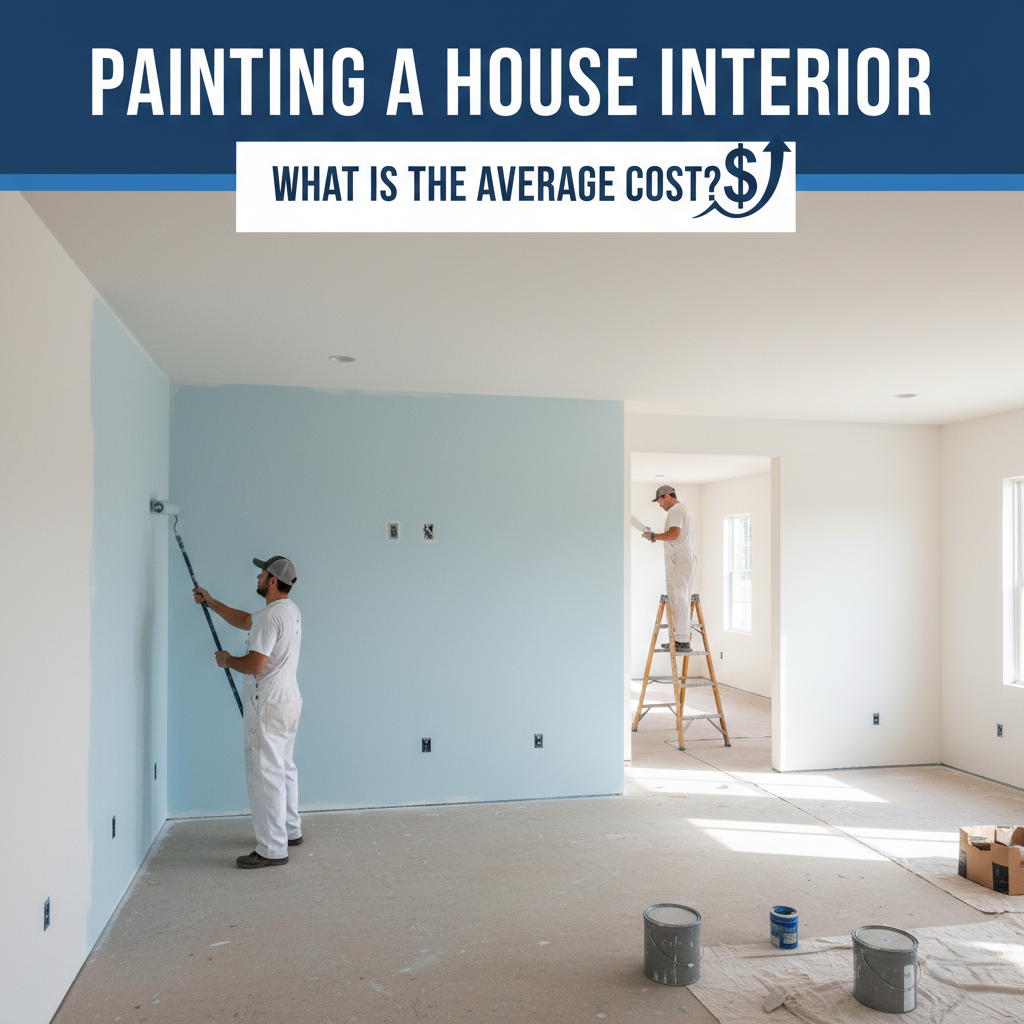
Quick Answer: Interior Painting Costs
Measure | Cost |
Per sq ft of paintable wall surface | $1.00 to $3.00 |
Per sq ft of home floor area, walls only | $2.50 to $4.00 |
Per sq ft of home floor area, all surfaces | $4.00 to $7.00 |
Average room | $350 to $850 |
Whole interior, 2,000 sq ft home | $5,000 to $14,000 |
Painter hourly rate | $20 to $50 |
Paint per gallon | $15 to $80 |
Minimum project charge | $250 to $500 |
Painting the inside of a home is the highest-return cosmetic improvement available and the easiest way to modernize a dated space.
But interior painting quotes confuse more homeowners than almost any other trade, because two completely different square footage numbers are in circulation and contractors rarely say which one they are using. Understanding that distinction is the difference between a budget that holds and a bid that blindsides you.
The Two Square Footage Numbers
When a painter says “$3 per square foot,” they could mean either of two things, and the difference is roughly threefold.
Paintable surface area is the actual wall and ceiling surface receiving paint, minus windows and doors. This is what the painter measures and what the paint covers.
Floor area is your home’s listed square footage. It is convenient shorthand but it is not what gets painted.
Paintable interior surface runs roughly 2.5 to 3 times a home’s floor area when walls and ceilings are both in scope.
Home floor area | Approximate paintable surface |
1,000 sq ft | 2,500 to 3,000 sq ft |
1,500 sq ft | 3,750 to 4,500 sq ft |
2,000 sq ft | 5,000 to 6,000 sq ft |
2,500 sq ft | 6,250 to 7,500 sq ft |
3,000 sq ft | 7,500 to 9,000 sq ft |
The Two Rates Are Not Interchangeable
Basis | Correct rate |
Per sq ft of paintable surface | $1.00 to $3.00 |
Per sq ft of floor area | $3.00 to $7.00 |
This is where budgets break. Applying the floor-area rate of $3 to $4 to a paintable surface number produces a figure two to three times too high. Applying the surface rate of $1 to $3 to floor area produces one far too low.
Both methods should arrive at the same total. If a bid does not state which basis it uses, that is the first question to ask.
Interior Painting Cost by Home Size
Home floor area | Paintable surface | Walls only | All surfaces (walls, ceilings, trim, doors) |
800 sq ft | 2,000 to 2,400 | $2,000 to $3,200 | $3,200 to $5,600 |
1,000 sq ft | 2,500 to 3,000 | $2,500 to $4,000 | $4,000 to $7,000 |
1,200 sq ft | 3,000 to 3,600 | $3,000 to $4,800 | $4,800 to $8,400 |
1,500 sq ft | 3,750 to 4,500 | $3,750 to $6,000 | $6,000 to $10,500 |
1,800 sq ft | 4,500 to 5,400 | $4,500 to $7,200 | $7,200 to $12,600 |
2,000 sq ft | 5,000 to 6,000 | $5,000 to $8,000 | $8,000 to $14,000 |
2,400 sq ft | 6,000 to 7,200 | $6,000 to $9,600 | $9,600 to $16,800 |
2,500 sq ft | 6,250 to 7,500 | $6,250 to $10,000 | $10,000 to $17,500 |
3,000 sq ft | 7,500 to 9,000 | $7,500 to $12,000 | $12,000 to $21,000 |
Walls only covers wall surfaces with standard prep and two coats. All surfaces adds ceilings, baseboards, trim, casings, and interior doors, which roughly doubles labor hours because those surfaces require brushwork rather than roller or spray.
The single most common source of quote confusion is a homeowner comparing a walls-only bid against an all-surfaces bid without realizing they cover different scopes.
Interior Painting Cost by Room
Most repaints are partial. Room-level pricing is what most homeowners actually need.
Room | Cost range |
Bathroom | $150 to $400 |
Primary bathroom | $250 to $650 |
Kitchen (walls only) | $150 to $250 |
Bedroom | $350 to $850 |
Primary bedroom | $650 to $1,400 |
Dining room or hallway | $300 to $1,000 |
Living room | $600 to $2,000 |
Open-plan basement | $800 to $2,500 |
Home office | $350 to $900 |
Interior door (each) | $75 to $150 |
By Room Dimensions
Room size | Cost range |
10 x 10 | $300 to $700 |
10 x 12 | $350 to $850 |
12 x 12 | $400 to $950 |
12 x 15 | $500 to $1,000 |
14 x 16 | $650 to $1,250 |
16 x 16 | $750 to $1,400 |
Low end reflects walls only. High end includes ceiling, baseboards, trim, and doors.
Why Kitchens and Bathrooms Price Oddly
Kitchens are the cheapest room to paint by wall area, because cabinets, backsplash, and appliances occupy most of the wall surface. There simply is not much wall left. Cabinet painting is a separate scope entirely, running $30 to $60 per linear foot or $900 to $3,800.
Bathrooms cost more per square foot than any other room despite being small, because of cut-in work around tubs, showers, and vanities, plus removing and reinstalling towel bars, mirrors, and fixtures. Use semi-gloss, satin, or eggshell in bathrooms for moisture resistance and cleanability.
Living Rooms by Size
Living room size | Cost |
Small (200 sq ft) | $600 to $1,000 |
Average (320 sq ft) | $900 to $1,600 |
Large (450 sq ft) | $1,200 to $2,000 |
Most painters carry a minimum project charge of $250 to $500. Painting a single small bathroom often costs the same as painting two, so bundle rooms where you can.
Cost by Bedroom Count
Home size | Cost range |
1 bedroom | $800 to $4,100 |
2 bedroom | $1,000 to $6,400 |
3 bedroom | $1,200 to $8,500 |
4 bedroom | $2,000 to $10,000 |
5 bedroom | $3,000 to $12,000 |
Low end is walls only. High end covers walls, ceilings, baseboards, doors, and trim.
Apartments and Condos
Unit type | Cost |
Studio | $700 to $1,600 |
1 bedroom apartment | $900 to $2,500 |
2 bedroom apartment | $1,100 to $3,000 |
2 bedroom condo (~1,200 sq ft) | $1,300 to $3,500 |
Check your HOA or building management before painting a condo interior. Many require approval, and some restrict colors in shared-visibility areas like entryways.
How to Estimate Your Own Interior Painting Cost
This is the method painters use. It takes five minutes per room.
Example: a 10 x 12 bedroom with an 8-foot ceiling, one door, and one window.
- Measure the perimeter. Add all four wall lengths: 10 + 12 + 10 + 12 = 44 feet
- Calculate gross wall area. Perimeter times ceiling height: 44 × 8 = 352 sq ft
- Subtract openings. Deduct about 21 sq ft per door and 16 sq ft per window: 352 − 21 − 16 = 315 sq ft of coverage area
- Apply the rate. At $1 to $3 per sq ft of coverage: 315 × $1 = $315, and 315 × $3 = $945. Estimated cost: $315 to $945
- Calculate paint needed. One gallon covers up to 400 sq ft. For two coats: (315 ÷ 400) × 2 = 1.6 gallons, so buy two.
To add the ceiling, multiply length by width (10 × 12 = 120 sq ft) and add $1 to $2 per sq ft, or $120 to $240.
To add trim, measure baseboard and casing linear footage and apply $1 to $4 per linear foot.
Repeat per room and total. If your result is wildly different from a contractor’s bid, one of you is measuring the wrong thing.
Cost by Surface Type
Surface | Cost |
Walls only | $1.00 to $2.00 per sq ft |
Walls with texture | Add $0.80 to $2.00 per sq ft |
Ceilings | $1.00 to $2.00 per sq ft |
Baseboards and trim | $1 to $4 per linear foot |
Crown molding | $2 to $6 per linear foot |
Wainscoting | $3 to $8 per sq ft |
Interior doors | $75 to $150 each |
Window sashes and casings | $50 to $150 each |
Accent wall | $80 to $200 |
Decorative mural or trompe l’oeil | $35 to $150 per sq ft |
Kitchen cabinets | $30 to $60 per linear foot |
Closet interiors | $100 to $300 each |
Ceilings by Room
Ceiling | Cost |
Bathroom | $50 to $170 |
Primary bathroom | $80 to $300 |
Bedroom | $150 to $300 |
Primary bedroom | $300 to $600 |
Kitchen | $100 to $500 |
Living room | $250 to $1,000 |
Open-plan basement | $500 to $2,000 |
Stairwells
Stairwells price by height because reaching them requires ladders, plank staging, or scaffold.
Stairwell height | Cost per linear foot |
8 to 13 feet | $16 |
13 to 17 feet | $20 |
17 to 19 feet | $24 |
Over 19 feet | $30 |
Vaulted and cathedral ceilings follow the same logic and are among the most labor-intensive interior painting work in a house.
Labor Costs
Labor represents 70 to 85 percent of an interior painting total. Paint is cheap relative to the hours required, which is why cutting paint quality to save money is almost always the wrong trade.
Pricing method | Rate |
Per sq ft of coverage area | $1 to $3 |
Per sq ft of floor area | $3 to $7 |
Per room | $180 to $650 |
Per hour | $20 to $50 |
Specialty work (murals, faux finish) | $70 to $100 per hour |
Bureau of Labor Statistics Occupational Employment and Wage Statistics data for SOC 47-2141, Painters, Construction and Maintenance, is the underlying benchmark for regional labor rates.
Painter Production Rates
Most painters cover 80 to 120 square feet of flat surface per hour once furniture is out and prep is complete. Use that to sanity-check any hourly quote.
Task | Hours |
Prep work and masking | 0.5 to 2 per room |
Moving furniture out | 1 to 2 |
Painting walls | 0.5 to 1 per coat |
Painting ceiling and trim | 1 to 2 per coat |
Painting windows | 0.5 each |
Cleanup | 0.5 to 1 |
Moving furniture back | 1 to 2 |
Paint and Material Costs
Material | Cost |
Standard interior paint | $15 to $50 per gallon |
Premium interior paint | $40 to $80 per gallon |
Primer | $10 to $30 per gallon |
Stain-blocking primer | $20 to $45 per gallon |
Supplies (tape, cloths, brushes) | $50 to $200 per project |
Paint Prices by Brand and Sheen
Brand | Flat | Eggshell | Satin | Semi-gloss |
Valspar | $15 to $55 | $23 to $49 | $27 to $50 | $25 to $52 |
Glidden | $18 to $40 | $20 to $40 | $23 to $29 | $22 to $30 |
Behr | $15 to $42 | $18 to $44 | $31 to $45 | $20 to $46 |
Sherwin-Williams | $36 to $43 | $38 to $45 | $39 to $46 | $40 to $47 |
Benjamin Moore | $43 to $80 | $43 to $80 | $40 to $80 | $43 to $80 |
Professional painters typically receive contractor pricing of up to 50 percent off retail, which is one reason letting the contractor supply paint often costs less than buying it yourself.
For most homeowners, mid-tier products like Sherwin-Williams SuperPaint or Benjamin Moore Regal hit the best balance of cost and durability. Premium lines like Duration, Emerald, and Aura are worth it in high-traffic areas and rooms that get cleaned often.
How Much Paint Do You Need?
One gallon covers up to 400 square feet. Plan two coats.
Space | Coverage area | Gallons (two coats) |
Average bathroom | 400 sq ft | 1 |
Average room | 800 sq ft | 2 |
Large room | 1,200 sq ft | 3 |
Living room or several rooms | 1,600 sq ft | 4 |
Porous, textured, or previously unpainted surfaces reduce coverage significantly. Dramatic color changes may require a third coat or a tinted primer.
Paint Types
Type | Best for |
Latex / acrylic | Walls and ceilings. Fast drying, easy cleanup, low odor |
Oil-based / alkyd | Trim and doors. More durable, better stain resistance, slower drying |
Sheen Selection
Sheen | Where to use | Hides flaws |
Flat | Ceilings, low-traffic bedrooms | Best |
Eggshell | Bedrooms, hallways, living rooms | Good |
Satin | Family rooms, kids’ rooms, hallways | Moderate |
Semi-gloss | Trim, doors, kitchens, bathrooms | Poor |
High-gloss | Accent trim, cabinets | Worst |
Glossier finishes clean more easily and last longer, but they highlight every imperfection in the wall beneath. Flat and eggshell forgive drywall flaws that semi-gloss will broadcast.
Primer matters when covering a dramatic color change, painting over wallpaper residue or texture, sealing new drywall, or blocking stains. Match the primer base to the paint base.
Prep Work and Related Costs
Prep is where bids diverge most and where the finish quality is actually determined.
Service | Cost |
Sanding and patching | $1 to $3 per sq ft |
Drywall repair | $150 to $325 per repair |
Wallpaper removal | $1 to $3 per sq ft |
Popcorn ceiling removal | $1 to $2 per sq ft |
Skim coating | $1 to $3 per sq ft |
Plastering walls | $2 to $10 per sq ft |
Baseboard and trim installation | $4 to $8 per linear foot |
Furniture moving | $35 to $60 per hour |
Drywall installation | $1.60 to $2.35 per sq ft |
Light prep, meaning filling nail holes, spot sanding, and taping, is normally included in a quote. Heavy prep is not. If your walls have significant damage, wallpaper, or texture that needs removal, that is a separate line item and it should appear as one.
Homes built before 1978 may contain lead-based paint. Sanding or scraping it releases lead dust. Under the EPA Renovation, Repair and Painting Rule, contractors disturbing painted surfaces in pre-1978 housing must be EPA Lead-Safe Certified and follow specific containment practices. Verify certification before work begins.
Regional Cost Differences
Region | Cost per sq ft of floor area |
South Central (TX, OK, AR, LA) | $2.25 to $4.50 |
Southeast (GA, AL, SC, TN) | $2.50 to $4.75 |
Midwest (OH, IN, IA, KS, MO) | $2.75 to $5.00 |
Mountain West (CO, UT, AZ, NV) | $3.00 to $5.75 |
Mid-Atlantic (VA, MD, PA, NJ) | $3.25 to $6.00 |
Northeast (NY, MA, CT, NH) | $3.75 to $7.00 |
West Coast (CA, WA, OR) | $4.00 to $7.50 |
California, Washington, New York, and Massachusetts run highest, driven by wage floors and contractor insurance requirements. Rural markets across the South Central and Plains regions run lowest.
Seasonality matters more than most people expect. Interior painting demand peaks in spring and summer alongside general construction and real estate activity. Booking in late fall or winter frequently earns better pricing and more attentive scheduling, and unlike exterior work, interior painting is unaffected by weather.
How Long Does Interior Painting Take?
Room | Hours |
Bathroom | 2 to 3 |
Primary bathroom | 3 to 4 |
Bedroom | 4 to 5 |
Primary bedroom | 5 to 6 |
Kitchen | 4 to 5 |
Living room | 5 to 7 |
Open-plan basement | 6 to 12 |
Add trim and baseboards | +1 to 2 per room |
A whole 2,000 sq ft interior typically takes a two to three person crew 3 to 5 working days. Heavy prep, wallpaper removal, or multiple color changes extend that.
Every color change costs time. A single color throughout is the most efficient way to paint a house, and every additional color adds cut-in work, cleanup between colors, and staging.
DIY vs Hiring a Professional
Factor | DIY | Professional |
Single room | $100 to $300 | $300 to $850 |
2,000 sq ft interior | $600 to $1,800 | $5,000 to $14,000 |
Time, per room | 1 to 2 days | 4 to 7 hours |
Supplies | $50 to $200 | Included |
Paint | Retail price | Contractor pricing |
Finish quality | Variable | Consistent |
Warranty | None | 1 to 3 years typical |
DIY Supply Costs
Item | Cost |
Paint roller kit | $10 to $25 |
Brushes | $2 to $15 each |
Paint tray | $2 to $5 |
Painter’s tape | $3 to $10 |
Drop cloth | $5 to $30 |
Sandpaper | $5 to $15 |
Scraper | $6 to $20 |
Patching compound | $10 to $20 |
Ladder | $80 to $300 |
Sprayer rental | $30 to $50 per day |
DIY makes sense for single rooms, standard 8-foot ceilings, walls in good condition, and anywhere a small imperfection will not bother you.
Hire out for whole-house repaints, ceilings, vaulted or two-story spaces, stairwells, heavy prep or wallpaper removal, and any surface getting a gloss finish that will reveal every flaw underneath.
The hybrid approach saves the most. Handle the prep yourself, meaning moving furniture, cleaning walls, removing outlet covers, laying drop cloths, and doing the cleanup afterward. Prep and cleanup are unskilled labor billed at skilled rates, and removing them from scope can cut 20 to 30 percent off a bid.
New Construction Interior Painting
New construction prices differently from repainting. $2 to $5 per square foot of floor area is typical.
It costs less per square foot because the house is empty, walls are new and undamaged, there is no furniture to move or protect, and crews can spray the entire interior one color in a continuous production run rather than cutting in room by room.
Builders typically specify a flat or eggshell sheen throughout with semi-gloss on trim and doors. Upgrades to multiple colors, accent walls, or higher sheens are priced as options against that baseline.
Commercial Interior Painting
Commercial interior painting runs $2 to $6 per square foot and operates on different terms from residential.
Commercial scopes typically involve specified coating systems with defined dry film thickness rather than a simple two-coat finish, cleanable and antimicrobial products in medical and food service settings, fire-rated and intumescent coatings where specified, ADA-compliant color contrast requirements in some occupancies, night and weekend scheduling in occupied retail and hospitality space, and prevailing wage requirements on public work.
Multi-family repaint programs carry their own structure: repeat unit-type takeoffs across dozens or hundreds of units, turn schedules measured in days, and per-unit costing where a small error compounds across the whole property.
Bidding these accurately means reading the finish schedule and specification alongside the floor plans, not just measuring wall area.
When to Use Professional Construction Estimating Services
Painting contractors face a structural squeeze. Revenue depends on bid volume, but estimating capacity is capped by the hours available to whoever prices the work, usually the owner, usually at night.
Construction estimating services remove that ceiling. Rather than declining bid invitations or rushing a takeoff after hours, contractors send drawings to a dedicated estimating team and receive a priced, itemized deliverable on a fixed turnaround.
What Construction Takeoff Services Deliver
Construction takeoff services produce the measured quantities every bid rests on. For an interior painting scope, a complete takeoff includes:
- Wall area by room, net of door and window openings
- Ceiling area by room, with height flagged where staging is required
- Trim, baseboard, casing, and crown molding in linear feet
- Door and window counts with individual surface areas
- Surface preparation quantities separated by required level
- Coating quantities by product and sheen, with coverage rates and spread loss accounted
- Substrate types identified where they change primer or product requirements
- Access requirements flagged by ceiling height, including staging and lift days
- Masking, protection, and containment quantities
- Waste factors documented rather than assumed
Construction estimation takeoff services extend that by attaching current regional labor and material pricing to those quantities, producing a bid-ready cost model rather than a raw quantity sheet.
Why Contractors Outsource Estimating Services
Cost. A full-time in-house estimator carries a loaded cost well into six figures once salary, benefits, takeoff software licensing, and overhead are counted. When contractors outsource estimating services, that fixed cost becomes a variable per-project cost that scales with bid volume rather than sitting idle in slow quarters.
Speed. Bid windows keep shrinking. A dedicated team working parallel scopes returns a complete takeoff in days, letting a contractor respond to more invitations without adding headcount.
Accuracy. Estimators who do nothing but takeoffs catch what a working contractor pricing a job at 11pm will miss: the ceiling height change on one elevation that turns a roller job into a staging job, the sheen change buried in the finish schedule, the 900 square feet of stairwell nobody measured. On painting scopes where labor is 70 to 85 percent of cost, a quantity error is a margin error with nowhere to hide.
Commercial Construction Estimating Services
Commercial construction estimating services address scopes where the specification, not the field condition, carries the risk. Interior painting and coatings scopes we routinely estimate include:
- Multi-family and apartment interior programs, including unit turn packages
- Medical and dental facilities with cleanable and antimicrobial coating requirements
- Retail and restaurant tenant improvements
- Educational and institutional buildings
- Hospitality interiors with high finish-level specifications
- Office and corporate fit-outs
- Senior living and assisted living facilities
Each carries requirements that never appear in residential repainting, and each is priced from a drawing set read as a whole.
How Digital Estimating Handles Painting Takeoffs
Digital Estimating provides construction estimating and takeoff services nationwide from our Houston headquarters, supporting contractors, developers, architects, and suppliers.
Our painting and coatings estimating process:
- Drawing and specification review. Floor plans read against the finish schedule and coatings specification, with conflicts flagged before they become change orders.
- Digital takeoff. On-screen measurement with color-coded, auditable markups you can verify against the drawings line by line.
- Regional pricing. Labor and material rates applied by market, not by national average.
- Itemized deliverable. Excel and PDF output formatted to match your bid structure, with assumptions, inclusions, and exclusions documented explicitly.
- Bid support. Clarification and revision through the bid window.
We provide dedicated painting estimating services and coordinate painting takeoffs alongside related trades including drywall, interior finishes, flooring, and insulation.
How to Read an Interior Painting Bid
A comparable bid states all of the following:
- Which square footage basis the price uses, coverage area or floor area
- Total measured area, room by room
- Which surfaces are included: walls, ceilings, trim, baseboards, doors, closets
- Number of coats on each surface type
- Paint brand, product line, and sheen by surface
- Primer specification and where it is applied
- Prep scope itemized: patching, sanding, caulking, wallpaper removal
- Furniture moving and protection, included or excluded
- Number of colors and any surcharge for additional ones
- Cleanup and touch-up scope
- Warranty terms on labor and coating
- Payment schedule and change order process
Red flags: a lump sum with no square footage stated, no paint product named, “walls only” not clarified, more than one third requested up front, no written insurance certificate, and a bid dramatically below the others.
Questions to Ask
- How many jobs like this did you complete in the last year?
- Can I see addresses of work completed two or more years ago?
- Are you licensed and insured, and can I get the certificate from your carrier directly?
- Are you EPA Lead-Safe Certified if my home predates 1978?
- What paint do you recommend for these rooms, and why that product?
- How many coats, and is primer included?
- Who moves the furniture?
- What happens if you find damage behind the furniture or wallpaper?
- What does the warranty cover and what voids it?
- Will subcontractors do the work, or your own crew?
How to Reduce Interior Painting Costs
- Do the prep and cleanup yourself. The largest single saving available, worth 20 to 30 percent.
- Bundle rooms. Painters carry $250 to $500 minimums, so one room at a time is the most expensive way to buy.
- Use one color throughout. Every color change adds cut-in time, cleanup, and staging.
- Paint accent walls only when you want a change without a full repaint. An accent wall runs $80 to $200.
- Schedule off-season. Interior painting is weather-independent, so winter booking earns discounts with no downside.
- Let the contractor supply paint. They receive up to 50 percent off retail and will generally specify better products than a homeowner buys.
- Skip walls-only if the trim is sound. Trim on a separate cycle from walls is normal and sensible.
- Buy better paint, not more paint. On a job where labor is 70 to 85 percent of cost, a premium coating that adds years to the repaint cycle pays back several times over.
- Fix moisture problems first. Painting over a moisture source guarantees a repaint within two years.
Frequently Asked Questions
What is the average cost to paint the interior of a house in 2026?
$1 to $3 per square foot of paintable wall surface, or $3 to $7 per square foot of floor area. A 2,000 sq ft home runs $5,000 to $8,000 for walls only and $8,000 to $14,000 including ceilings, trim, and doors.
What is the difference between coverage area and floor area?
Coverage area is the actual wall and ceiling surface being painted, minus openings. Floor area is your home’s listed square footage. Paintable interior surface runs roughly 2.5 to 3 times floor area. Applying a floor-area rate to a coverage-area number inflates a budget two to three times over, which is the most common quoting error in this trade.
How much does it cost to paint a room?
$350 to $850 for an average bedroom, $150 to $400 for a bathroom, $600 to $2,000 for a living room, and $150 to $250 for kitchen walls. Most painters have a $250 to $500 project minimum, so bundling rooms lowers the per-room cost.
How much does it cost to paint a 12×12 room?
$400 to $950 depending on whether the ceiling, doors, and trim are included. It takes roughly three gallons for two coats.
How much does it cost to paint a 2,000 sq ft house interior?
$5,000 to $8,000 for walls only, or $8,000 to $14,000 for walls, ceilings, trim, and doors. That home has roughly 5,000 to 6,000 square feet of paintable surface.
How much of the cost is labor?
70 to 85 percent. Paint is inexpensive relative to the hours required, which is why downgrading paint quality to save money rarely works out.
How much paint do I need?
One gallon covers up to 400 square feet. Plan two coats. An average room needs 2 gallons, a large room 3. Textured, porous, or previously unpainted surfaces reduce coverage significantly.
Which paint sheen should I use where?
Flat for ceilings and low-traffic bedrooms, eggshell for bedrooms and living rooms, satin for hallways and family rooms, semi-gloss for trim, doors, kitchens, and bathrooms. Glossier finishes clean better and last longer but highlight every wall imperfection.
How much does it cost to paint ceilings?
$1 to $2 per square foot, so $150 to $300 for a bedroom ceiling and $250 to $1,000 for a living room. Adding ceilings to a walls-only quote roughly doubles the labor on that room.
How much does it cost to paint trim and baseboards?
$1 to $4 per linear foot for baseboards and trim, $2 to $6 for crown molding, and $75 to $150 per interior door. Trim is brushwork, which is why it costs disproportionately more than wall area suggests.
How long does interior painting take?
A bedroom takes 4 to 5 hours, a bathroom 2 to 3, a living room 5 to 7. A whole 2,000 sq ft interior takes a crew of two or three about 3 to 5 working days.
Is it cheaper to paint before or after moving in?
Before, and by a meaningful margin. An empty house eliminates furniture moving and protection, lets crews spray rather than cut in, and removes the scheduling constraints of working around occupants.
Should I DIY or hire a painter?
DIY works for single rooms with 8-foot ceilings and walls in good shape, at $100 to $300 per room versus $300 to $850 professionally. Hire out whole-house repaints, ceilings, vaulted spaces, stairwells, heavy prep, and any gloss finish. The hybrid option, doing prep and cleanup yourself, saves 20 to 30 percent with minimal risk.
What if my house was built before 1978?
It may contain lead-based paint. Under the EPA Renovation, Repair and Painting Rule, contractors disturbing painted surfaces in pre-1978 housing must be EPA Lead-Safe Certified and follow specific containment and cleanup practices. Verify certification before signing.
How much does new construction interior painting cost?
$2 to $5 per square foot of floor area. It costs less than repainting because the house is empty, walls are undamaged, and crews spray the whole interior one color in a continuous run.
How much does commercial interior painting cost?
$2 to $6 per square foot, depending on the specified coating system, occupancy type, and whether work must happen outside business hours.
When is the cheapest time to paint interior?
Late fall through winter. Interior painting is weather-independent, so off-season booking earns discounts with no trade-off in quality or schedule risk.
What do construction takeoff services cost?
Pricing depends on scope, drawing complexity, and turnaround. Most painting takeoffs are priced per project rather than hourly. Contact us for a quote on your drawing set.
Methodology and Sources
Figures in this guide are triangulated from:
- Bureau of Labor Statistics Occupational Employment and Wage Statistics, SOC 47-2141 (Painters, Construction and Maintenance)
- EPA Renovation, Repair and Painting Rule requirements for pre-1978 housing
- Manufacturer published coverage rates and technical data sheets from Sherwin-Williams, Benjamin Moore, Behr, and Valspar
- Digital Estimating’s own 2026 painting takeoff and bid sampling across residential, commercial, and multi-family projects
All figures are budget-planning estimates. Individual quotes vary by surface condition, ceiling height, prep scope, product selection, and local market. Always obtain written itemized bids that state which square footage basis they use.
Final Thoughts
The average cost to paint a house interior comes down to four variables: paintable surface area, which surfaces are in scope, prep condition, and market. Most homeowners land at $3 to $7 per square foot of floor area, or $1 to $3 per square foot of actual painted surface.
The most expensive mistake is not choosing the wrong paint. It is comparing a walls-only bid against an all-surfaces bid, or applying a floor-area rate to a surface-area measurement, and budgeting against a number that was never describing the same job.
If you are a contractor bidding painting work and need the quantities verified before you commit a number, that is what we do.
Get a Painting Takeoff for Your Project