
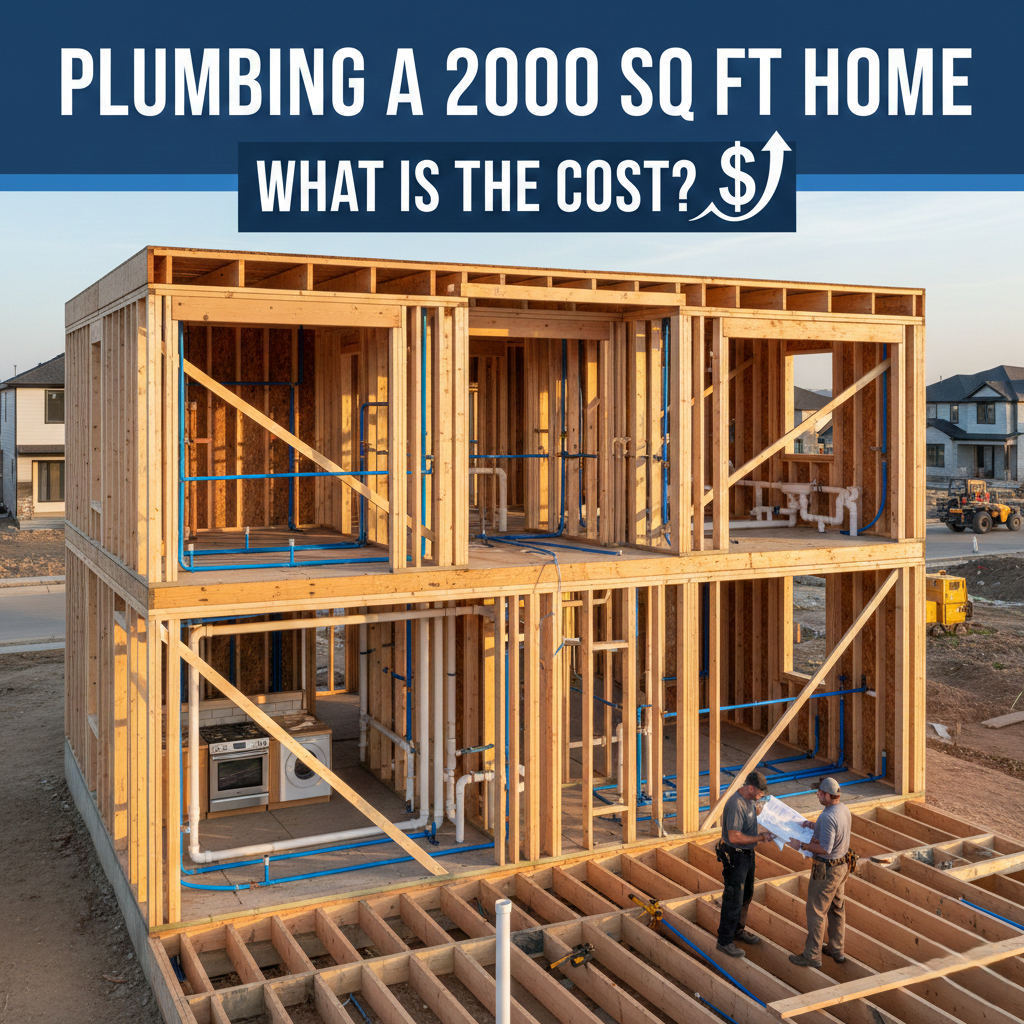
Quick Answer: 2000 Sq Ft Plumbing Costs
Scope | Cost |
New construction, standard 2 to 3 bath | $8,000 to $12,000 |
Industry benchmark rate | $4.50 per square foot |
Full per sq ft range | $4.00 to $10.00 |
Rough-in stage only | $4,000 to $8,000 |
PEX repipe | $4,000 to $10,000 |
Copper repipe | $8,000 to $20,000 |
Per fixture, rough-in | $250 to $500 |
Plumber hourly rate | $75 to $200 |
Plumbing is one of the most critical systems in a home and one of the hardest to price from a square footage number alone.
Most 2,000 square foot homes with two to three bathrooms land at $8,000 to $12,000 for complete new construction plumbing. The number that gets quoted across the industry is $4.50 per square foot, which puts a 2,000 sq ft home at roughly $9,000 as a starting point.
But square footage is the weakest predictor in the equation. Read the next section before you budget against it.
Why Square Footage Is the Wrong Way to Price Plumbing
Two 2,000 square foot homes can differ by $8,000 in plumbing cost. Square footage does not run through pipe. Fixtures do.
A plumber bidding your house is not measuring floor area. They are counting fixtures, mapping drain runs, sizing vents, and checking how far the kitchen sits from the laundry. A 2,000 sq ft ranch with two bathrooms stacked over a crawlspace is a fundamentally cheaper job than a 2,000 sq ft two-story with three and a half baths spread across opposite corners on a slab.
What the Per Square Foot Range Actually Means
Rate | What it describes |
$4.00 to $5.00 per sq ft | Single story, 2 baths, PEX, simple layout, low-cost labor market |
$5.00 to $8.00 per sq ft | The typical range. 2 to 3 baths, standard fixtures, conventional layout |
$8.00 to $10.00+ per sq ft | Multi-story, 3+ baths, premium fixtures, copper, complex layout, high-cost metro |
Use the per square foot number to sanity-check a bid, not to build a budget. The fixture count method below is what plumbers actually use.
The Fixture Count Method
This is how a plumbing bid is built.
A standard 2,000 square foot home typically includes one kitchen, one laundry room, two full bathrooms, and one powder room. That configuration produces roughly 14 to 16 plumbing fixtures.
Fixture | Typical count |
Toilets | 3 |
Bathroom sinks (lavatories) | 3 |
Tub or shower units | 2 |
Kitchen sink | 1 |
Dishwasher hookup | 1 |
Washing machine box | 1 |
Water heater connection | 1 |
Hose bibs | 2 |
Refrigerator water line | 1 |
Total | ~15 fixtures |
Worked calculation. At $250 to $500 per fixture for rough-in, 15 fixtures produce $3,750 to $7,500 in rough-in cost. Add trim-out labor, fixtures themselves, the water heater, and the service connection, and you arrive at the $8,000 to $12,000 all-in figure.
Cross-check against the square foot method: 2,000 × $4.50 = $9,000. The two methods converge, which is how you know a bid is reasonable.
Cost by Bathroom Count
Bathroom count is the single largest cost driver on a plumbing bid. Each additional bathroom adds a drain stack, vent, supply branches, and three to four fixtures.
Configuration | Fixture count | |
1 bathroom | ~9 | $6,000 to $9,000 |
2 bathrooms | ~13 | $8,000 to $12,000 |
2.5 bathrooms | ~15 | $9,000 to $13,500 |
3 bathrooms | ~17 | $10,500 to $15,000 |
3.5 bathrooms | ~19 | $12,000 to $17,000 |
4 bathrooms | ~21 | $13,000 to $19,000 |
Layout matters as much as count. Bathrooms stacked vertically on a two-story, or placed back-to-back sharing a wet wall, cost significantly less than the same number scattered across the floor plan. Each isolated fixture group needs its own drain stack and vent penetration through the roof.
If you are still in design, moving a bathroom to share a wall with another wet area is one of the cheapest cost reductions available on the whole house.
The Three Stages of Residential Plumbing
Most cost guides only cover rough-in, which is why homeowners get surprised. Residential plumbing runs in three distinct, separately scheduled and separately priced stages.
Stage | What happens | Share of cost | 2,000 sq ft cost |
Underground / rough-in | Under-slab DWV, sewer lateral, water service entry | 30 to 35% | $2,500 to $4,500 |
Top-out | Supply lines, drain and vent piping through walls and ceilings, before drywall | 25 to 30% | $2,200 to $3,800 |
Trim-out | Fixture setting, faucets, toilets, water heater, final connections | 35 to 40% | $3,000 to $5,000 |
Why this matters when comparing bids. A quote of “$5,000 for plumbing” is meaningless without knowing which stages it covers. Some builders bid rough-in and top-out together and price trim separately. Others quote all three. Ask explicitly.
The underground stage is also the one you cannot revisit. Once the slab is poured, moving a drain means cutting concrete.
Plumbing Cost by Individual Fixture
Fixture | Rough-in cost | Installed cost (rough + trim + fixture) |
Toilet | $250 to $500 | $400 to $1,200 |
Bathroom sink | $250 to $450 | $350 to $1,000 |
Bathtub | $350 to $700 | $800 to $3,500 |
Shower (standard) | $350 to $650 | $700 to $2,500 |
Tub/shower combo | $400 to $750 | $900 to $3,000 |
Kitchen sink | $300 to $550 | $500 to $1,500 |
Dishwasher hookup | $200 to $400 | $250 to $600 |
Washing machine box | $200 to $400 | $250 to $550 |
Water heater connection | $300 to $600 | $1,200 to $5,500 |
Hose bib | $150 to $300 | $200 to $450 |
Refrigerator water line | $150 to $350 | $200 to $500 |
Utility / bar sink | $250 to $500 | $400 to $1,200 |
Cost by Room
Room | Complete plumbing cost |
Full bathroom | $2,000 to $5,000 |
Half bathroom (powder room) | $1,000 to $2,500 |
Primary bathroom (double vanity, separate tub and shower) | $3,500 to $9,000 |
Kitchen | $1,500 to $4,000 |
Laundry room | $600 to $1,800 |
Wet bar | $800 to $2,200 |
Pipe Material Costs and Lifespan
Material selection affects both the bid and the next 50 years of ownership.
Material | Cost per linear foot installed | Lifespan | Use |
PEX-A | $0.60 to $2.00 | 40 to 50 years | Supply. Most flexible, best freeze resistance |
PEX-B | $0.40 to $1.75 | 40 to 50 years | Supply. Most common, lowest cost |
PEX-C | $0.40 to $1.60 | 30 to 40 years | Supply. Least flexible of the three |
CPVC | $0.50 to $2.00 | 50 to 75 years | Supply. Rigid, handles hot water |
Copper Type M | $2.00 to $5.00 | 40 to 60 years | Supply. Thinner wall |
Copper Type L | $3.00 to $8.00 | 50 to 70+ years | Supply. Standard for residential |
PVC (DWV) | $0.50 to $2.00 | 50 to 80 years | Drain, waste, vent |
ABS (DWV) | $0.50 to $2.00 | 50 to 80 years | Drain, waste, vent |
Cast iron (DWV) | $5.00 to $15.00 | 75 to 100 years | Drain. Best sound dampening |
PEX vs Copper
PEX installs faster, requires far fewer fittings, tolerates freezing without splitting, and costs a fraction of copper. It is the default in new residential construction. Drawbacks: it degrades under prolonged UV exposure and cannot be used outdoors above ground.
Copper lasts longer, is naturally antimicrobial, handles high temperatures, and holds resale appeal in some markets. Drawbacks: cost, installation labor, and vulnerability to pinhole corrosion in acidic water.
Manifold (home-run) versus trunk-and-branch. PEX allows a manifold system where each fixture gets a dedicated line from a central distribution point. It costs 10 to 20 percent more up front and delivers faster hot water, better pressure balance, and the ability to shut off one fixture without affecting the rest. On a house you intend to keep, it is usually worth it.
Legacy Materials to Replace
- Polybutylene, installed roughly 1978 to 1995. Grey or blue flexible pipe. Fails without warning. Many insurers will not write a policy on a home that still has it. Replace it.
- Galvanized steel, common pre-1960. Corrodes internally, restricting flow and discoloring water. Replace it.
- Lead service lines. See the code section below.
Repiping Cost for a 2000 Sq Ft Home
Repiping is priced by material and access, not by square footage.
Repipe type | 2,000 sq ft cost |
PEX repipe | $4,000 to $10,000 |
CPVC repipe | $4,500 to $11,000 |
Copper repipe | $8,000 to $20,000 |
Galvanized replacement (includes demo) | $8,000 to $18,000 |
Polybutylene replacement | $6,000 to $15,000 |
Partial repipe | $2,000 to $6,000 |
Cost drivers specific to repiping:
- Wall access. Every opening cut is drywall repair, texture matching, and paint afterward.
- Foundation type. Slab foundations are the most expensive, because under-slab lines often get abandoned and rerouted overhead rather than jackhammered.
- Occupied versus vacant. Working around a family living in the house adds time and protection.
- Drywall repair responsibility. Confirm in writing whether the plumber patches and finishes or leaves open walls.
Ask specifically whether drywall repair is in the bid. It is the most common exclusion in repiping quotes and can add $1,500 to $5,000.
Foundation Type and Its Cost Impact
Foundation | New construction impact | Repipe impact |
Slab on grade | Standard. Under-slab DWV set before pour | Highest cost. Overhead reroute or slab cutting |
Crawlspace | Slightly lower. Easier access, less under-slab work | Lowest cost. Direct access from below |
Basement | Moderate. May need ejector pump for below-grade fixtures | Low. Excellent access |
Pier and beam | Similar to crawlspace | Low to moderate |
Slab leaks are the expensive scenario. Repair runs $2,000 to $6,000 for a single leak, and once a slab home has had two or more, most plumbers recommend a full overhead repipe rather than continuing to chase individual failures.
Homes on slab in expansive clay soil regions, including much of Texas, Oklahoma, and the Front Range, see more slab leaks because foundation movement stresses the lines.
Water Heater Costs
Type | Installed cost | Lifespan |
Tank, gas, 40 to 50 gal | $1,200 to $2,800 | 8 to 12 years |
Tank, electric, 40 to 50 gal | $1,000 to $2,500 | 10 to 15 years |
Tankless, gas | $2,500 to $5,500 | 20+ years |
Tankless, electric | $1,500 to $3,500 | 15 to 20 years |
Heat pump / hybrid | $2,500 to $5,000 | 13 to 15 years |
Recirculation pump (add-on) | $400 to $1,500 | 10 to 15 years |
Tankless units cost more up front and frequently require a gas line upgrade and a dedicated vent, which many quotes omit. Verify whether the bid includes the gas line resize.
A 2,000 sq ft home with three or more bathrooms should be sized carefully. An undersized water heater is the most common comfort complaint in a new build.
Additional Plumbing Costs
Item | Cost |
Water service line from meter | $50 to $200 per linear foot |
Sewer lateral connection | $1,500 to $6,000 |
Septic system (rural) | $6,000 to $20,000 |
Well installation | $5,000 to $20,000 |
Tap fee / water meter connection | $500 to $8,000 depending on municipality |
Plumbing permit | $200 to $1,000 |
Water softener | $1,200 to $3,500 |
Whole-house filtration | $1,000 to $4,500 |
Pressure reducing valve | $300 to $800 |
Expansion tank | $200 to $500 |
Backflow preventer | $300 to $1,000 |
Sump pump | $800 to $2,500 |
Sewage ejector pump | $1,200 to $3,500 |
Gas line runs (CSST or black iron) | $15 to $30 per linear foot |
Plumbing stack replacement | $1,000 to $4,000 |
Rerouting pipes | $1,500 to $6,000 |
Rerouting through attic | $2,000 to $8,000 |
Tap fees deserve attention. Municipal water and sewer connection fees vary enormously by jurisdiction, from a few hundred dollars to well over $8,000, and they are almost never included in a plumber’s bid. Call your water utility directly before finalizing a build budget.
Plumbing Codes, Permits, and Inspections
Plumbing is one of the most heavily code-regulated trades in residential construction, and none of it is optional.
IPC vs UPC
Jurisdictions adopt one of two model codes:
- IPC (International Plumbing Code), published by the ICC, used across most of the eastern and central United States
- UPC (Uniform Plumbing Code), published by IAPMO, used across much of the West and in several other states
The two differ on venting methods, approved materials, and fixture requirements. A plumber licensed and experienced in an IPC state does not automatically know the UPC rules. This matters if you are building outside your usual market.
Drainage Fixture Units (DFU)
Plumbers size drain and vent systems using drainage fixture units, a code-assigned value per fixture type. A toilet carries a higher DFU value than a lavatory. Total DFU load determines pipe diameters and vent sizing.
This is why fixture count, not square footage, drives cost. Adding fixtures raises DFU load, which can push a drain line up a pipe size across the whole run.
Permits and Inspections
Item | Typical cost or requirement |
Plumbing permit | $200 to $1,000 |
Underground / rough-in inspection | Required before slab pour or cover |
Top-out inspection | Required before drywall |
Final inspection | Required before occupancy |
Hydrostatic or pressure test | Required at rough-in in most jurisdictions |
Most states require a licensed plumber for new construction and repiping. Verify master versus journeyman licensing and confirm the license covers your jurisdiction. Unpermitted plumbing work commonly surfaces during resale inspection and can force costly retroactive correction.
EPA Lead and Copper Rule Improvements
Under the EPA’s Lead and Copper Rule Improvements, water systems are required to inventory and replace lead service lines nationwide. If your home was built before 1986, the service line from the street may be lead.
- Lead service line replacement typically costs $2,500 to $8,000, though many municipalities now subsidize or fully fund it
- Contact your water utility before paying out of pocket, since replacement programs vary by system
- Lead lines are a health issue first and a cost issue second
Plumbing Cost by Region
Region | Cost per sq ft | 2,000 sq ft total |
South Central (TX, OK, AR, LA) | $3.50 to $5.50 | $7,000 to $11,000 |
Southeast (GA, AL, SC, TN) | $3.75 to $5.75 | $7,500 to $11,500 |
Midwest (OH, IN, IA, KS, MO) | $4.00 to $6.00 | $8,000 to $12,000 |
Mountain West (CO, UT, AZ, NV) | $4.50 to $7.00 | $9,000 to $14,000 |
Mid-Atlantic (VA, MD, PA, NJ) | $5.00 to $7.50 | $10,000 to $15,000 |
Northeast (NY, MA, CT, NH) | $6.00 to $9.50 | $12,000 to $19,000 |
West Coast (CA, WA, OR) | $6.50 to $10.50 | $13,000 to $21,000 |
Regional drivers beyond wages: frost-depth burial requirements for service lines in northern states, seismic bracing in California, hurricane-zone requirements along the Gulf, and code differences between IPC and UPC jurisdictions.
Bureau of Labor Statistics Occupational Employment and Wage Statistics data for SOC 47-2152, Plumbers, Pipefitters, and Steamfitters is the underlying benchmark for regional labor rates.
Labor Costs
Pricing method | Rate |
Hourly, journeyman | $75 to $150 |
Hourly, master plumber | $100 to $200 |
Emergency or after-hours | $150 to $350 |
Service call minimum | $75 to $250 |
Per fixture, rough-in | $250 to $500 |
Labor accounts for 50 to 65 percent of a residential plumbing project. On repiping it runs higher, because the work is largely demolition, access, and reassembly rather than material.
On new construction, most plumbers bid the job as a lump sum rather than hourly, priced from the fixture schedule on the plans.
Plumbing Timeline in a New Build
Stage | When it happens | Duration |
Underground rough-in | After excavation, before slab pour | 2 to 4 days |
Slab pour and cure | Not plumbing, but gates the next stage | 7 to 14 days |
Top-out | After framing, before insulation and drywall | 3 to 5 days |
Rough-in inspection | Before drywall | 1 day |
Drywall and finish work | Not plumbing | Several weeks |
Trim-out | Near end of construction | 2 to 4 days |
Final inspection | Before occupancy | 1 day |
Total plumber days on site for a 2,000 sq ft home: roughly 7 to 13 working days, spread across a build lasting several months.
Missing the underground rough-in window is the most expensive scheduling error in residential construction. Once concrete is poured, changes mean cutting slab.
Signs You Need Repiping
- Water discoloration, rust tint, or metallic taste
- Pressure dropping across multiple fixtures
- Repeated pinhole leaks, especially more than one per year
- Visible corrosion, green staining on copper, or flaking on galvanized
- Home built before 1960 with original galvanized supply
- Home built 1978 to 1995 with grey or blue flexible polybutylene
- Two or more slab leaks
- Insurance carrier declining coverage or excluding water damage
Two or more of these together usually means repiping is cheaper than continuing repairs.
How to Read a Plumbing Bid
A comparable bid states all of the following.
- Fixture schedule, listing every fixture by type and location
- Which stages are included: underground, top-out, trim-out
- Pipe material and type for supply and for DWV separately
- Manifold or trunk-and-branch distribution
- Water heater make, model, capacity, and whether gas line upgrade is included
- Fixtures supplied by whom, plumber or owner
- Permit responsibility and whether fees are included
- Service line and tap fees, included or excluded
- Drywall repair on repipe work, included or excluded
- Warranty on labor and on materials, stated separately
- Payment schedule tied to inspection milestones
- Change order process
Red flags: a lump sum with no fixture schedule, no pipe material named, permits described as “owner responsibility” with no cost noted, a bid dramatically below others, and any request for more than one third up front.
Questions to Ask
- Are you licensed in this jurisdiction, and is that master or journeyman?
- Does this jurisdiction follow IPC or UPC?
- Are permits and inspection coordination included?
- What pipe material are you specifying, and why that one?
- Is this a manifold or trunk-and-branch system?
- Which stages does this number cover?
- Who pays the tap fee?
- On the repipe, who patches and finishes the drywall?
- What is your warranty on labor, and how long?
How to Reduce Plumbing Costs
- Group your wet areas at the design stage. Stacking bathrooms and placing the kitchen near the laundry is the largest single saving available, and it costs nothing to do on paper.
- Choose PEX unless you have a specific reason for copper. It typically saves 40 to 60 percent on supply piping.
- Keep fixture locations as drawn. Relocating a drain after rough-in is one of the most expensive change orders in the build.
- Supply your own fixtures if you can source better pricing, but confirm the plumber will warranty installation on owner-supplied fixtures.
- Bundle the water heater into the plumbing contract rather than buying separately.
- Schedule off-season. Plumbers are busiest in spring and summer alongside general construction.
- Get three itemized bids with matching fixture schedules and stages.
- Confirm tap fees with the utility directly before you finalize the budget. Do not assume the plumber’s number includes them.
Commercial and Multi-Family Plumbing
Everything above addresses single-family residential. Commercial and multi-family plumbing operates on a different structure entirely.
Commercial scopes involve engineered systems designed to specification rather than to prescriptive residential code: sized main risers, grease interceptors, backflow prevention assemblies with annual testing requirements, roof drainage and storm systems, ADA-compliant fixture heights and clearances, code-mandated fixture counts based on occupancy load, and frequently fire protection coordination.
Multi-family carries its own demands. Repeat unit-type takeoffs across dozens or hundreds of units mean a small per-unit error compounds into a large aggregate one. Stacked plumbing chases, sound isolation between units, individual unit metering, and central versus in-unit water heating all change the cost model substantially.
On these scopes, quantity accuracy is the margin. A two percent takeoff error on a 300-unit project is not a rounding issue.
When to Use Professional Construction Estimating Services
Plumbing contractors face a structural squeeze. Revenue depends on bid volume, but estimating capacity is capped by the hours available to whoever prices the work, usually the owner, usually after hours.
Construction estimating services remove that ceiling. Rather than declining bid invitations or rushing a takeoff at midnight, contractors send drawings to a dedicated estimating team and receive a priced, itemized deliverable on a fixed turnaround.
What Construction Takeoff Services Deliver
Construction takeoff services produce the measured quantities every bid rests on. For a plumbing scope, a complete takeoff includes:
- Complete fixture schedule by type, quantity, and location
- Supply piping by material and diameter in linear feet
- DWV piping by material and diameter in linear feet
- Fitting counts by type, including elbows, tees, couplings, and cleanouts
- Valve schedules including isolation, pressure reducing, and backflow devices
- Water heater and equipment schedules with capacity and connection requirements
- Underground versus above-slab quantities separated by stage
- Insulation quantities for hot water and exposed lines
- Sleeve, hanger, and support counts
- Excavation quantities for service and sewer lateral runs
- Waste factors documented rather than assumed
Construction estimation takeoff services go further and attach current regional labor and material pricing to those quantities, producing a bid-ready cost model rather than a raw measurement sheet.
Why Contractors Outsource Estimating Services
Cost. A full-time in-house estimator carries a loaded cost well into six figures once salary, benefits, takeoff software licensing, and overhead are counted. When contractors outsource estimating services, that fixed cost becomes a variable per-project cost that scales with bid volume rather than sitting idle in slow quarters.
Speed. Bid windows are short. A dedicated team working parallel scopes returns a complete takeoff in days, letting a contractor respond to more invitations without adding headcount.
Accuracy. Estimators who do nothing but takeoffs catch what a working contractor pricing a job late at night will miss: the fixture on sheet P-102 that changes the DFU load and pushes a drain up a pipe size, the copper requirement buried in the specification, the tap fee nobody carried. On plumbing scopes, where labor is 50 to 65 percent of cost and where a missed under-slab line means cutting concrete, catching those items before submission is the difference between profit and a change-order fight.
Commercial Construction Estimating Services
Commercial construction estimating services address scopes where the specification and the engineered design carry the risk. Plumbing and MEP scopes we routinely estimate include:
- Multi-family and apartment developments
- Medical and dental facilities with specialty gas and waste requirements
- Restaurants and food service with grease interceptors and specialty venting
- Retail and hospitality tenant improvements
- Educational and institutional buildings
- Industrial facilities with process piping
- Senior living and assisted living
Each is priced from a drawing set read alongside the specification and the engineered riser diagrams, not measured line by line in isolation.
How Digital Estimating Handles Plumbing Takeoffs
Digital Estimating provides construction estimating and takeoff services nationwide from our Houston headquarters, supporting contractors, developers, architects, and suppliers.
Our plumbing estimating process:
- Drawing and specification review. Plumbing plans read against riser diagrams, fixture schedules, and the applicable code, whether IPC or UPC, with conflicts flagged before they become RFIs or change orders.
- Digital takeoff. On-screen measurement with color-coded, auditable markups you can verify against the drawings line by line.
- Regional pricing. Labor and material rates applied by market, not by national average.
- Itemized deliverable. Excel and PDF output formatted to your bid structure, with assumptions, inclusions, and exclusions stated explicitly.
- Bid support. Clarification and revision through the bid window.
We provide dedicated plumbing estimating services and full MEP estimating, and coordinate plumbing takeoffs alongside related trades including earthwork, concrete, framing, and drywall.
Frequently Asked Questions
How much does it cost to plumb a 2000 sq ft house?
$8,000 to $12,000 for standard new construction with two to three bathrooms. The industry benchmark rate is $4.50 per square foot, and the full range runs $4 to $10 per square foot depending on bathroom count, layout, materials, and market.
What is the rough-in plumbing cost for a 2000 sq ft house?
$4,000 to $8,000, or roughly $250 to $500 per fixture. A typical 2,000 sq ft home has about 15 plumbing fixtures. Rough-in covers underground and in-wall piping before drywall, not the fixtures themselves.
Why do plumbers price by fixture instead of square footage?
Because square footage does not run through pipe. Plumbers size drain and vent systems using drainage fixture units (DFU), a code-assigned value per fixture. Fixture count and layout determine pipe sizing, drain stacks, and vent penetrations. Two identical 2,000 sq ft homes can differ by $8,000 based on bathroom count and placement.
What are the three stages of plumbing a house?
Underground rough-in (30 to 35% of cost), top-out (25 to 30%), and trim-out (35 to 40%). When comparing bids, confirm which stages a quote covers, because builders split them differently.
How much does it cost to repipe a 2000 sq ft house?
PEX runs $4,000 to $10,000 and copper runs $8,000 to $20,000. Galvanized replacement including demolition runs $8,000 to $18,000. Always confirm whether drywall repair is included, since it can add $1,500 to $5,000.
Is PEX or copper better?
PEX for most new construction: faster to install, freeze-resistant, and 40 to 60 percent cheaper. Copper for longer lifespan, high-temperature tolerance, and resale appeal in some markets. PEX cannot be used outdoors above ground due to UV degradation.
What is a manifold plumbing system?
A home-run configuration where each fixture receives a dedicated line from a central distribution manifold. It costs 10 to 20 percent more than trunk-and-branch and delivers faster hot water, better pressure balance, and per-fixture shutoff. Usually worth it on a house you intend to keep.
How much do plumbers charge per hour?
$75 to $150 for a journeyman and $100 to $200 for a master plumber. Emergency and after-hours work runs $150 to $350. Most new construction is bid as a lump sum from the fixture schedule rather than hourly.
How much of plumbing cost is labor?
50 to 65 percent on new construction, and higher on repiping, where the work is mostly access, demolition, and reassembly rather than material.
Do I need a permit for plumbing work?
Yes for new construction and repiping in nearly every jurisdiction. Permits cost $200 to $1,000 and require inspections at underground rough-in, top-out, and final. Unpermitted plumbing commonly surfaces during resale inspection.
What is the difference between IPC and UPC?
Two model plumbing codes. IPC is published by the ICC and used across most of the eastern and central US. UPC is published by IAPMO and used across much of the West. They differ on venting methods, approved materials, and fixture requirements. Confirm which your jurisdiction adopts.
How does foundation type affect plumbing cost?
Slab is the most expensive for repiping, since under-slab lines are usually abandoned and rerouted overhead. Crawlspace and basement are cheapest, thanks to direct access. Slab leak repair runs $2,000 to $6,000 per occurrence, and after two or more, a full overhead repipe usually makes more sense.
Do I have polybutylene or galvanized pipes?
Polybutylene is grey or blue flexible pipe installed roughly 1978 to 1995. It fails without warning and many insurers will not cover a home that still has it. Galvanized is dull grey threaded steel, common before 1960, and corrodes internally. Both should be replaced.
What is the EPA Lead and Copper Rule?
A federal requirement for water systems to inventory and replace lead service lines. Homes built before 1986 may have a lead line from the street. Replacement runs $2,500 to $8,000, but many municipalities subsidize or fully fund it. Contact your water utility before paying out of pocket.
What is a tap fee and is it in my plumber’s bid?
A municipal water and sewer connection fee, ranging from a few hundred dollars to over $8,000 depending on jurisdiction. It is almost never included in a plumber’s quote. Call your water utility directly before finalizing a budget.
How long does plumbing take in a new build?
Roughly 7 to 13 plumber days on site for a 2,000 sq ft home, spread across the build: 2 to 4 days underground, 3 to 5 days top-out, and 2 to 4 days trim-out, with inspections between each.
What does a water heater cost installed?
$1,000 to $2,800 for a standard tank unit, $2,500 to $5,500 for tankless gas, and $2,500 to $5,000 for a heat pump. Tankless frequently requires a gas line upgrade and dedicated vent that many quotes omit.
How can I lower my plumbing cost?
Group wet areas at the design stage, which is free to do on paper and the largest single saving available. Choose PEX over copper. Keep fixture locations as drawn. Confirm tap fees with the utility directly. Get three itemized bids with matching fixture schedules.
What do construction takeoff services cost?
Pricing depends on scope, drawing complexity, and turnaround. Most plumbing takeoffs are priced per project rather than hourly. Contact us for a quote on your drawing set.
Methodology and Sources
Figures in this guide are triangulated from:
- Bureau of Labor Statistics Occupational Employment and Wage Statistics, SOC 47-2152 (Plumbers, Pipefitters, and Steamfitters)
- International Plumbing Code (IPC) and Uniform Plumbing Code (UPC) requirements for fixture units, venting, and materials
- EPA Lead and Copper Rule Improvements for service line replacement requirements
- Manufacturer published specifications for PEX, CPVC, and copper piping systems
- Digital Estimating’s own 2026 plumbing takeoff and bid sampling across residential, commercial, and multi-family projects
All figures are budget-planning estimates. Individual quotes vary by fixture count, layout, foundation type, jurisdiction, and local market. Always obtain written itemized bids with a full fixture schedule, and verify code requirements with your local building department.
Final Thoughts
The cost to plumb a 2,000 square foot house comes down to four variables: fixture count, layout, pipe material, and market. Most standard builds with two to three bathrooms land at $8,000 to $12,000, which tracks the $4.50 per square foot industry benchmark.
The most expensive mistake is not choosing the wrong pipe material. It is scattering wet areas across a floor plan during design, then discovering the cost after the drawings are stamped.
If you are a contractor bidding plumbing work and need the fixture schedule and quantities verified before you commit a number, that is what we do.
Get a Plumbing Takeoff for Your Project