
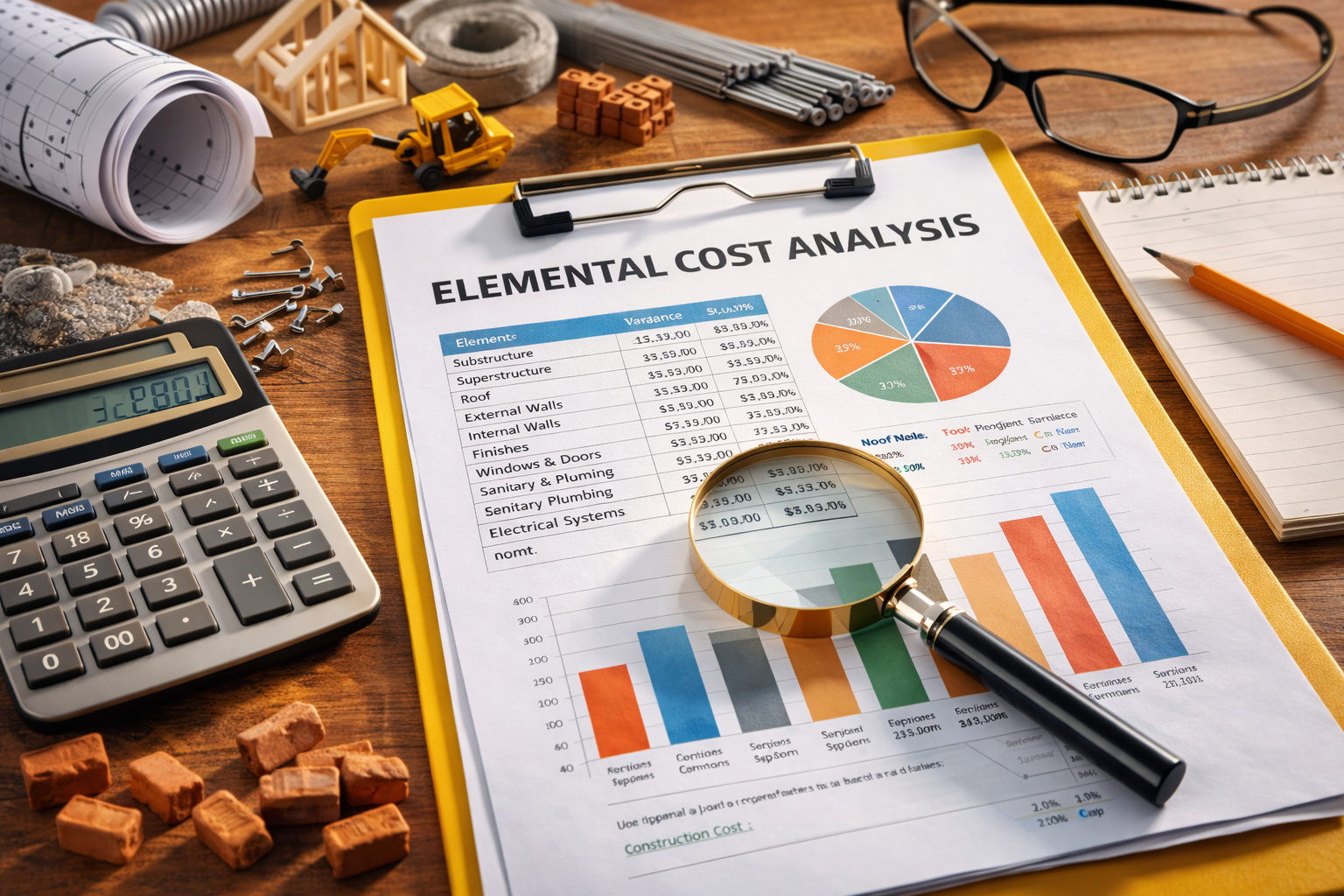
Cost planning is a critical part of any construction project because it helps ensure that the project can be completed within the available budget. Construction professionals such as quantity surveyors, architects, and project managers rely on structured methods to estimate and manage project costs effectively. One of the most widely used techniques for cost planning in the construction industry is elemental cost analysis.
Elemental cost analysis helps break down the total cost of a building into its main functional components, allowing professionals to better understand where money is being spent. By organizing costs into building elements, it becomes easier to control budgets, compare projects, and make informed design decisions.
What Is Elemental Cost Analysis?
Elemental cost analysis is a method of analyzing construction costs by dividing the total cost of a project into different building elements. These elements represent the major physical and functional components of a building, such as the foundation, structure, roof, finishes, and building services.
Unlike traditional cost estimation methods that classify costs according to construction trades (for example masonry, carpentry, plumbing, or electrical work), elemental cost analysis focuses on the functional parts of a building. This approach allows project teams to evaluate how much each component contributes to the total cost of the project.
The main goal of elemental cost analysis is to provide a clear understanding of cost distribution within a building so that better cost planning and cost control decisions can be made throughout the project lifecycle.
The Concept of an Elemental Budget
An elemental budget is a cost planning tool that allocates the total project budget across different building elements. It is usually prepared during the early stages of the design process and serves as a financial guideline for the project.
The elemental budget ensures that each element of the building is assigned a specific cost limit. For example, a certain percentage of the budget may be allocated to the substructure, while another portion is allocated to finishes or building services. By establishing these limits early, the project team can monitor costs and prevent overspending in any particular area.
Elemental budgets are particularly useful during design development because they allow designers to evaluate how design changes affect the overall project cost.
Main Elements in Elemental Cost Analysis
Elemental cost analysis divides a building into several key elements based on its functional structure.
Substructure
The substructure includes all construction work below ground level. This element typically consists of excavation, foundations, basement construction, and ground floor slabs. The substructure forms the base of the building and plays a crucial role in structural stability.
Superstructure
The superstructure refers to the main structural components above ground level. This includes columns, beams, walls, structural frames, and upper floors. The superstructure usually represents one of the largest portions of the building cost.
Roof
The roof element includes all components related to roof construction, such as the roof structure, insulation, waterproofing systems, and roof coverings.
Finishes
Finishes refer to materials and works that determine the building’s interior and exterior appearance. These include floor finishes, wall finishes, ceilings, painting, and decorative elements.
Services
Building services include mechanical and electrical systems that allow the building to function effectively. Examples include heating and ventilation systems, plumbing installations, electrical wiring, fire protection systems, and elevators.
External Works
External works cover construction activities outside the main building structure. This may include landscaping, roads, parking areas, drainage systems, boundary walls, and site development works.
Importance of Elemental Cost Analysis
Elemental cost analysis plays a significant role in improving construction cost management. One of its main advantages is that it allows project teams to identify which elements of a building consume the largest share of the budget. This information helps professionals focus on areas where cost reductions may be possible.
Another important benefit is improved cost comparison between projects. Because costs are organized according to standardized building elements, professionals can compare the cost performance of similar buildings and use historical data to improve future cost estimates.
Elemental cost analysis also supports value engineering, which involves optimizing the design to achieve the best balance between performance, quality, and cost. By understanding the cost distribution of building elements, designers can explore alternative materials or construction methods that reduce costs without compromising functionality.
Advantages of Elemental Cost Analysis
Elemental cost analysis provides several important advantages for construction project management.
Improved Cost Planning
By identifying cost distribution across building elements, project teams can create more accurate budgets.
Better Design Decisions
Designers can modify expensive elements without affecting other parts of the building.
Easier Cost Comparisons
Costs can be compared between different projects using standardized elements.
Effective Cost Control
Cost overruns can be detected early during the design process.
Supports Value Engineering
Engineers and architects can optimize building performance while reducing unnecessary costs.
Limitations of Elemental Cost Analysis
Despite its advantages, elemental cost analysis has some limitations.
Requires Accurate Data
Reliable cost data from previous projects is essential for meaningful analysis.
Time-Consuming
Breaking down costs into detailed elements requires significant effort.
Not Always Precise
Costs allocated to elements may sometimes involve assumptions.
Variation in Standards
Different countries and organizations may use different elemental classifications.
Elemental Cost Analysis vs Traditional Cost Estimation
Traditional cost estimating methods generally classify costs based on construction trades or activities. While this approach is useful during the construction phase and tender preparation, it does not always provide a clear understanding of how costs are distributed across the building itself.
In contrast, elemental cost analysis organizes costs according to building elements. This functional approach makes it easier to evaluate design decisions and manage costs during the early stages of a project. As a result, elemental cost analysis is particularly valuable for cost planning and feasibility studies.
Role of Elemental Cost Analysis in Construction Management
In modern construction management, elemental cost analysis plays a major role in:
- Quantity surveying
- Project cost control
- Feasibility studies
- Budget planning
- Value engineering
- Lifecycle cost planning
Quantity surveyors frequently prepare elemental cost analyses to help clients understand how project funds are distributed across different building components.
Practical Example of Elemental Cost Analysis
Consider a residential apartment building project costing $5 million.
An elemental cost analysis might reveal:
- Substructure: 12%
- Superstructure: 35%
- Roof: 6%
- Finishes: 22%
- Services: 20%
- External works: 5%
If the services cost exceeds typical benchmarks, engineers may revise the HVAC or electrical design to reduce expenses.
Conclusion
Elemental cost analysis is an essential tool in modern construction cost management. By dividing the total project cost into functional building elements, it provides a clear and structured understanding of how construction costs are distributed. This method helps professionals prepare accurate elemental budgets, monitor project spending, and make informed design decisions.
For quantity surveyors and construction managers, understanding what is elemental cost analysis is crucial for effective cost planning and financial control. As construction projects continue to grow in complexity, the use of elemental cost analysis will remain an important technique for achieving efficient and well-managed project budgets.