
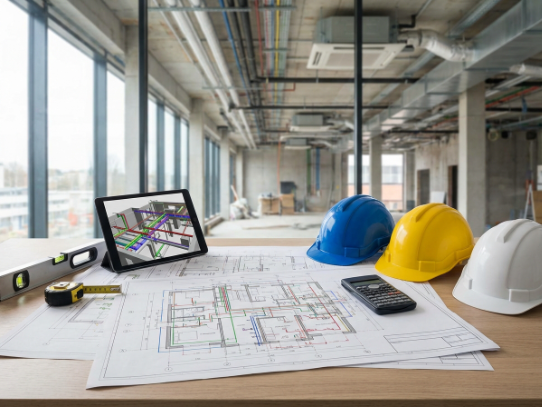
Mechanical, electrical, and plumbing (MEP) systems are among the most essential components of any building in the modern U.S. construction industry. Accurate planning and budgeting for MEP systems is crucial for everything from major industrial projects in Texas to healthcare buildings in California to high-rise commercial skyscrapers in New York City. MEP estimating services are useful in this situation because they give contractors, developers, and project managers accurate cost estimates that guarantee projects stay on schedule and within budget.
MEP estimating involves more than just counting items; it requires an extensive understanding of labor rates, local codes, design criteria, and market factors unique to the United States This article will discuss the importance of MEP estimating services, how they enhance project results, and actual examples of their application in the US construction industry.
What Is MEP Estimating?
MEP estimating is the process of figuring out how much a construction project’s mechanical, electrical, and plumbing systems will cost.
It comprises the assessment of:
- HVAC systems
- Fixtures and electrical wiring
- Piping and plumbing systems
- Systems for safety and fire protection
To create a thorough cost estimate, a qualified MEP estimator examines project designs, requirements, and local market prices. This guarantees smooth integration of MEP systems with other building components and helps stakeholders in budgetary planning.
Why MEP Estimating Services Are Critical in the U.S.
1. Complex MEP Systems
In the United States, complex mechanical, electrical, and plumbing systems are essential to modern structures. For instance, commercial high-rises in Chicago require complex electrical and fire protection systems, whereas hospitals in California need complex HVAC systems for infection control. MEP estimation services guarantee correct accounting for every component.
2. Labor and Material Costs
The cost of materials and labor varies greatly around the United States due to supply chain variations, municipal codes, and regional labor markets. Contractors can prevent cost overruns and account for these variances with the use of accurate MEP estimation.
3. Regulatory Compliance
Local building codes, safety rules, and sustainability standards (such LEED certification) must all be met by MEP systems. These elements are incorporated into cost planning by MEP estimating services in order to avoid penalties.
4. Project Budgeting and Risk Management
MEP estimators lower financial risk and assist in obtaining project financing from lenders or investors by offering accurate cost estimates.
Components of MEP Estimating
A detailed MEP estimate typically includes:
1. Mechanical Systems
- Pipes, ducting, and HVAC units
- Boilers, pumps, and chillers
- Air quality and ventilation systems
2. Electrical Systems
- Wiring and power distribution
- Lighting controllers and fittings
- Integration of renewable energy sources with backup generators
3. Plumbing Systems
- Drainage and water supply
- Systems for preventing fires (sprinklers, hydrants)
- Specialty pipework for industrial or medical projects
4. Labor Costs
Rates for qualified MEP technicians and installers vary by region.
5. Material Costs
Includes equipment, piping, wiring, fixtures, and insulation. Costs fluctuate based on U.S. market trends and material quality.
Benefits of MEP Estimating Services
1. Accurate Budget Planning
Contractors can set realistic budgets with an accurate MEP estimate, preventing construction-related surprises.
Example:
A healthcare facility in Texas used professional MEP estimating services to forecast costs for HVAC and plumbing systems. The project averted a potential 15% cost overrun, which could have delayed occupancy.
2. Efficient Resource Allocation
Contractors can effectively schedule labor and procure materials with realistic estimates, reducing downtime and wastage.
3. Reduced Errors and Rework
MEP estimating helps detect design conflicts early. For instance, a clash between ductwork and electrical conduits in a Chicago commercial building could be identified and corrected before installation.
4. Better Decision Making
Project owners and contractors can make well-informed design decisions and assess substitute materials or systems without compromising quality by being aware of costs up front.
Real-World Examples in the U.S.
Example 1: High-Rise Residential Building in New York
Complex HVAC, plumbing, and electrical systems were required for a 40-story residential skyscraper. The contractor used MEP estimating services to properly estimate labor and material costs, which led to prompt completion and minimal change orders.
Example 2: Industrial Facility in Houston, Texas
MEP estimating was used to arrange the purchase and installation of equipment in a large-scale industrial plant with specialized piping systems for chemical processes. Despite strict deadlines, accurate calculations avoided cost overruns.
Example 3: Healthcare Facility in California
A new hospital in Los Angeles required state-of-the-art MEP systems, including energy-efficient HVAC and advanced electrical systems. The project team was able to align costs with LEED standards and sustainability goals by utilizing MEP estimate services.
How MEP Estimating Services Work
Professional MEP estimating services follow a structured process:
- Review of Design and Specifications: Architectural and MEP drawings are examined by estimators.
- Quantity Takeoff: Each fixture, cable, and pipe is counted.
- Material Costing: For accuracy, current U.S. market prices are used.
- Labor Costing: Certifications and labor rates in the area are taken into account.
- Contingency Planning: Unforeseen costs are factored into the estimates.
- Report Generation: Stakeholders receive detailed, itemized estimates.
To increase accuracy, contemporary techniques like cost databases and BIM (Building Information Modeling) are frequently utilized.
Challenges in MEP Estimating
1. Complex Project Designs
Estimation can be challenging with highly technical systems, particularly in high-rise, industrial, or healthcare projects.
2. Regional Market Variability
Local market information is important as construction costs in the United States vary greatly by state and city.
3. Design Changes
Estimates can be impacted by late-stage changes to MEP systems, emphasizing the need of adaptable estimating services.
Why Choose Professional MEP Estimating Services
There are various advantages to outsourcing MEP estimating:
- Access to professionals skilled in labor, material trends, and U.S. codes
- Quicker turnaround times compared to internal estimating
- reduced likelihood of costly mistakes and project delays
- Precise, data-driven project budgeting
Instead of wasting time on cost calculations, contractors can concentrate on efficient project execution by utilizing expert services.
Future Trends in MEP Estimating
The construction industry in the United States is heading toward the following:
- Integrating MEP estimate with BIM
- Smart and energy-efficient building systems
- AI-powered automated cost estimation with digital tools
For complex projects, these trends enable MEP estimating services to offer even more precise and useful insights.
Conclusion
For mechanical, electrical, and plumbing projects in the U.S. for the construction industry to be successful, accurate MEP estimation is crucial. Expert MEP estimating services guarantee that projects are completed on schedule and within budget, offer comprehensive cost estimates, and assist in risk management.
MEP estimates facilitate more intelligent decision-making, improved resource management, and cost-effective construction for everything from high-rise residential towers to industrial facilities and healthcare complexes.
Looking to accurately estimate your MEP project costs?
For professional MEP estimating services designed for the US construction industry, contact digitalEstimating.com.