
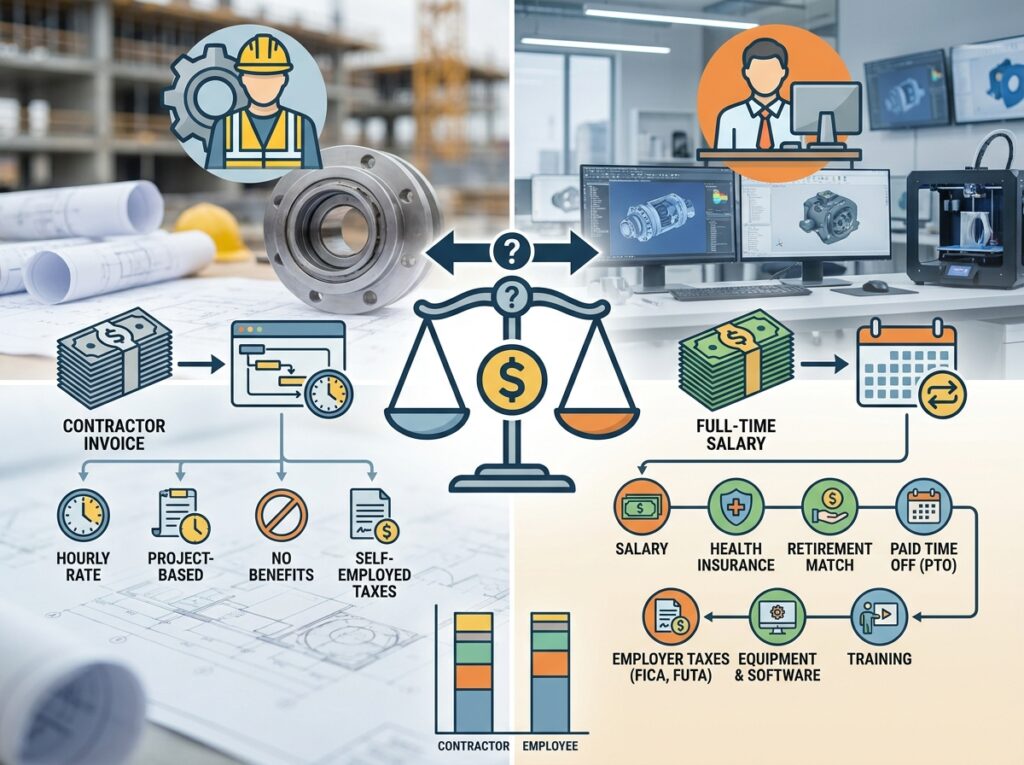
At first glance, choosing between a mechanical engineering contractor and a full-time employee may not seem like a major decision.
But in reality?
It can significantly impact your project budget, speed, and overall efficiency.
Some companies save thousands by hiring contractors for short-term projects, while others benefit more from building an in-house engineering team.
In fact, reports suggest that some businesses can save up to $100,000 annually by hiring contractors instead of permanent staff.
But here’s the catch:
Contractors are not always the better choice.
For certain projects, full-time employees provide more control, consistency, and long-term value.
So, which option makes more sense for your next construction project?
Let’s compare both in simple terms so you can make the right decision.
Understanding Freelance Mechanical Engineering Contractors
Freelance work is growing fast across nearly every industry — and engineering is no exception.
Today, more professionals are choosing flexible contract work instead of traditional full-time jobs.
A mechanical engineering contractor typically works on:
- Fixed-term contracts
- Project-based agreements
- Renewable service contracts
Unlike full-time employees, contractors are not involved in daily company operations.
Instead, they focus only on the work they’re hired to complete.
Why Companies Hire Contractors
Although contractors usually charge higher hourly rates, they can actually become more cost-effective over time.
Why?
Because businesses avoid many long-term employment expenses.
For example, with contractors, companies usually don’t pay for:
- Recruitment costs
- Employee benefits
- Insurance contributions
- Bonuses
- Retirement plans
- Long onboarding processes
And since contractors are already experienced, work can often begin immediately.
No lengthy training required.
Advantages of Hiring a Mechanical Engineering Contractor
Here’s why many construction firms prefer contractors for specific projects:
Lower Long-Term Employment Costs
No annual bonuses, retirement contributions, or employee benefits.
Faster Project Start
Most contractors can begin work immediately.
Less Administrative Hassle
You avoid payroll taxes, insurance management, and HR overhead.
Flexible Hiring
Need help for one project only?
No long-term commitment required.
Cost-Effective for Specialized Work
For short-term or highly technical projects, contractors often provide better value.
Challenges of Hiring Contractors
Of course, contractors also come with trade-offs.
Higher Hourly Rates
Contractors often charge more per hour than salaried employees.
Limited Daily Supervision
Since they work independently, real-time monitoring becomes harder.
Less Schedule Control
You may not always have full control over their availability.
For businesses needing constant internal coordination, this can sometimes become a challenge.
Understanding Full-Time Mechanical Engineering Employees
A full-time mechanical engineer works directly under company supervision.
In simple terms, employers control:
- Work schedules
- Processes
- Priorities
- Daily responsibilities
Unlike contractors, full-time employees become part of the company’s long-term operations.
At first glance, hiring a permanent engineer may seem cheaper because their hourly equivalent is often lower than a contractor’s rate.
But that’s only part of the picture.
The real cost of full-time employees includes much more than salary.
Companies also pay for:
- Health insurance
- Payroll taxes
- Paid leave
- Retirement contributions
- Bonuses
- Training costs
- Equipment and software
These hidden expenses can significantly increase total employment costs.
Advantages of Hiring a Full-Time Employee
Better Team Collaboration
Employees work closely with different departments and internal teams.
Real-Time Supervision
Managers can monitor progress and adjust priorities quickly.
Consistency & Reliability
Long-term employees often provide stable support across multiple projects.
Challenges of Hiring Full-Time Employees
Higher Overall Cost
Benefits and overhead expenses increase total spending.
Management Responsibility
Employees require supervision, training, and performance monitoring.
Additional Resource Costs
Companies must provide tools, insurance, software, and workstations.
Mechanical Engineering Contractor vs Full-Time Employee: Quick Comparison
Here’s a simplified comparison to help you decide which option fits your needs best.
Factor | Mechanical Engineering Contractor | Full-Time Employee |
Insurance | Usually self-covered | Employer responsibility |
Payroll Taxes | Not required | Paid by employer |
Retirement Contributions | Not included | Employer contribution required |
Bonuses | Not required | Commonly expected |
Schedule Control | Limited | Full supervision possible |
Benefits | Not included | Employer responsibility |
Hiring Costs | Minimal | Recruitment costs apply |
Flexibility | High | Lower |
Quick Summary
Contractors = flexibility + lower long-term commitments
Full-time employees = control + long-term consistency
The better option depends entirely on your project needs.
Real Cost Breakdown of Hiring a Mechanical Engineering Contractor
Hiring a contractor sounds simple:
Find an engineer. Agree on an hourly rate. Start the work.
But there’s more to consider.
The key is finding someone experienced enough to deliver quality work without delays or expensive revisions.
This becomes especially important for:
- Mechanical design work
- HVAC planning
- CAD drawings
- Equipment layouts
- Construction blueprints
Delays in engineering deliverables can slow permits and create budget overruns.
Important Tax Note for Employers
Contractors are generally responsible for handling their own taxes.
However, employers in the U.S. typically need to issue a:
1099 Form
for contractor payments.
This is part of standard independent contractor reporting requirements.
Average Mechanical Engineering Contractor Rates (2025)
Contractor pricing varies significantly depending on location and market demand.
Here’s a look at estimated contractor rates across major U.S. states and cities:
State / City | Avg Hourly Rate | Avg Annual Equivalent |
Washington | $53.83/hr | $111,900+ |
Alaska | $52/hr | $108,100+ |
New York | $52/hr | $108,100+ |
Massachusetts | $52/hr | $108,100+ |
Sitka, Alaska | $53/hr | $110,300+ |
Atherton, California | $53.36/hr | $110,900+ |
Berkeley, California | $54/hr | $112,100+ |
California | $54.50/hr | $113,000+ |
Keep in mind:
Rates vary depending on:
- Experience level
- Project complexity
- Urgency
- Technical specialization
Hidden Costs of Hiring Freelance Contractors
Many businesses assume contractor costs are simple:
Hourly rate × hours worked
But real-world costs can be more complicated.
Here are a few hidden expenses people often overlook.
1. Project Delays
Since contractors often manage multiple clients, timelines can occasionally shift.
For example:
If you’re waiting on mechanical engineering drawings for permits, delays may create:
- Permit hold-ups
- Scheduling issues
- Construction delays
- Budget overruns
Reliable communication becomes essential.
2. Company-Specific Training
Contractors are experienced professionals.
They usually don’t need technical training.
However, they may still need time to understand:
- Your company standards
- Internal workflows
- Documentation requirements
- Approval processes
Without clear onboarding, revisions may increase.
3. Limited Niche Experience
Choosing the cheapest contractor sometimes creates bigger problems later.
A lower-priced engineer may have:
- Less experience in your niche
- Limited technical expertise
- Higher chances of revisions
For example:
Someone experienced in industrial HVAC may not be the best fit for residential mechanical systems.
Saving money upfront sometimes increases project risks later.
Understanding the Real Cost of a Full-Time Mechanical Engineer
At first glance, hiring a full-time mechanical engineer may seem cheaper than bringing in a contractor.
After all, contractors often charge higher hourly rates.
But here’s what many companies overlook:
Salary is only part of the total cost.
When you hire a full-time employee, the real expense goes far beyond their paycheck.
You also need to account for:
- Payroll taxes
- Health insurance
- Retirement contributions
- Training costs
- Software and equipment
- Administrative overhead
Once all these hidden expenses are included, the total cost of a full-time engineer can become significantly higher than expected.
In many cases, companies end up paying almost double the employee’s base salary.
The Hidden Formula Behind Full-Time Hiring Costs
To estimate the true cost of hiring a permanent employee, businesses often use something called a cost multiplier.
Think of it as a shortcut for calculating all the extra expenses that come with employment.
Older workforce studies suggested a multiplier between:
1.35× to 1.75×
of an employee’s salary.
But more recent industry reports estimate that the real multiplier is closer to:
1.99×
That means:
A full-time engineer earning $100,000 annually could actually cost the company nearly $200,000 per year once benefits and overhead are included.
That number surprises a lot of employers.
Real Hiring Costs of Full-Time Mechanical Engineers (By State)
Below is a practical look at average salaries and estimated total employment costs using today’s cost multiplier.
State | Average Base Salary | |
Washington | $116,500 | $231,835 |
Alaska | $106,800 | $212,532 |
$112,500 | $223,857 | |
Massachusetts | $112,300 | $223,477 |
As you can see, the actual cost of hiring a full-time engineer is often much higher than salary alone suggests.
Hidden Costs of Hiring Full-Time Mechanical Engineers
This is where the numbers start adding up.
Unlike contractors, full-time employees come with several ongoing expenses that many businesses underestimate.
Let’s break down the biggest ones.
1. Retirement Contributions (KiwiSaver / Similar Plans)
In some countries, employers are legally required to contribute a percentage of an employee’s salary toward retirement savings.
For example:
Employers may need to contribute at least:
3% of total salary
to retirement programs.
It may sound small, but over time it adds a noticeable amount to total employment costs.
2. Workplace Compensation Costs (ACC)
Employee protection programs also increase costs.
For example, workplace compensation systems charge employers based on salary levels.
Typical costs range between:
$0.30 to $2.00 for every $100 earned
depending on industry risk and region.
For engineering-related roles, this can add thousands annually.
3. Employee Insurance
One of the biggest hidden expenses is health coverage.
Many employers are expected to provide:
- Medical insurance
- Dental coverage
- Vision plans
Recent estimates suggest employer-sponsored insurance can cost:
$20,000+ per employee annually
That’s often one of the largest hidden costs businesses forget to calculate.
4. Payroll Taxes
Taxes are another major expense tied to full-time employment.
Employers don’t just pay salaries — they also contribute to government tax programs.
Common Employer Taxes Include:
Tax Type | Purpose |
FICA Taxes | Supports Social Security & Medicare |
FUTA / SUTA | Unemployment tax programs |
State Payroll Taxes | Vary by state regulations |
For example:
Employers typically contribute:
- 6.2% toward Social Security
- 1.45% toward Medicare
State unemployment taxes can add even more depending on location.
These percentages may seem small individually, but together they make a major difference.
5. Training Costs
Even experienced engineers need onboarding.
Every company has its own:
- Workflows
- Standards
- Processes
- Software systems
Training costs usually fall between:
1%–5% of annual salary
depending on the role and complexity of work.
And during training?
Productivity is often lower.
6. Equipment & Software Expenses
Mechanical engineers rely on specialized tools.
That means employers often pay for:
- CAD software licenses
- Engineering simulation tools
- High-performance workstations
- Technical equipment
These costs vary widely depending on the engineer’s responsibilities.
For advanced engineering roles, software alone can cost thousands annually.
Contractor vs Full-Time Mechanical Engineer: Real Cost Comparison
When deciding who to hire, salary alone doesn’t tell the full story.
You need to compare the total cost of ownership.
Here’s a practical breakdown:
Category | Full-Time Mechanical Engineer | Contract Mechanical Engineer |
Base Cost | Around $95K–$120K salary | Typically $50–$80/hr (mid-level) |
Senior-Level Cost | Higher long-term cost | $100–$200/hr specialists |
Taxes & Benefits | Employer pays | Contractor covers their own |
Insurance | Employer responsibility | Usually self-covered |
Equipment & Tools | Company provides | Contractor often brings own setup |
Admin Costs | HR, payroll, office overhead | Minimal admin |
Flexibility | Fixed payroll commitment | Scale up or down as needed |
Hiring Speed | Slower onboarding | Fast project start |
A Simple Rule of Thumb
For projects shorter than:
6–8 months
contractors are often more cost-effective.
For long-term, ongoing work?
A full-time employee may provide better value.
When Contractors Make the Most Sense
Some projects are perfect for contractors.
Here’s where they usually shine.
Rapid Prototyping & One-Off Projects
Need something designed quickly?
Contractors are ideal for turning ideas into working models fast.
They’re used to jumping into unfamiliar projects and delivering results without lengthy onboarding.
Simulation & Specialized Engineering
Tasks like:
- Finite Element Analysis (FEA)
- Computational Fluid Dynamics (CFD)
- Vibration analysis
require niche expertise.
Instead of training an internal team, companies often hire specialists who already know the tools inside out.
Product Redesign & Troubleshooting
Need to fix performance issues or improve designs?
Contractors bring fresh perspectives and targeted expertise.
They’re especially useful for:
- Reverse engineering
- Design improvements
- Tolerance adjustments
Temporary Team Support
When internal teams are overloaded, contractors can help reduce pressure and keep deadlines on track.
Instead of burning out your staff, you add short-term expertise when needed.
When Full-Time Engineers Are the Better Choice
Sometimes long-term stability matters more than flexibility.
Here’s where full-time employees deliver the most value.
Long-Term Product Development
Building a product that will evolve over years?
A permanent engineer keeps knowledge inside the company.
They understand:
- Product history
- Design changes
- Internal systems
That continuity matters.
Manufacturing Support
Manufacturing environments need consistent attention.
Full-time engineers help:
- Improve processes
- Fix recurring issues
- Reduce inefficiencies
They become part of the long-term operation.
R&D & Intellectual Property Projects
Working on proprietary technology?
Keeping engineering talent in-house often makes more sense.
Permanent employees are usually better for:
- Research & development
- Patent-related work
- Sensitive innovations
It helps protect intellectual property and long-term strategy.
Common Hiring Mistakes to Avoid
Even experienced companies make hiring mistakes.
Here are some costly ones to watch for:
Hiring Full-Time for Short-Term Work
This often creates unnecessary long-term costs.
Underestimating Total Employee Costs
Salary alone doesn’t tell the whole story.
Always calculate:
- Taxes
- Benefits
- Software
- Training
Ignoring Equipment Expenses
Engineering software and tools add up quickly.
Delaying Hiring Decisions
Waiting too long can slow projects and overload your current team.
Skipping Trial Projects
Testing a contractor first can reduce hiring risks.
Underestimating Ramp-Up Time
Even great hires need time to learn systems and processes.
Overlooking Contract Details
Always review:
- IP ownership
- Exit clauses
- Confidentiality terms
before hiring contractors.
Final Thoughts: Which Option Is Right for You?
There’s no universal answer here.
The best choice depends entirely on your project.
Choose a Contractor If:
✔ Your project is short-term
✔ You need specialized expertise
✔ Speed matters
✔ You want flexibility
Choose a Full-Time Engineer If:
✔ You need long-term support
✔ Collaboration is essential
✔ You’re building core products
✔ Ongoing improvements matter
At the end of the day, hiring isn’t just about filling a role.
It’s about finding the right fit for where your business is headed — not just today, but months down the line.
And if you’re still unsure?
Start small.
Testing short-term support first can help you make smarter long-term hiring decisions without unnecessary risk.