
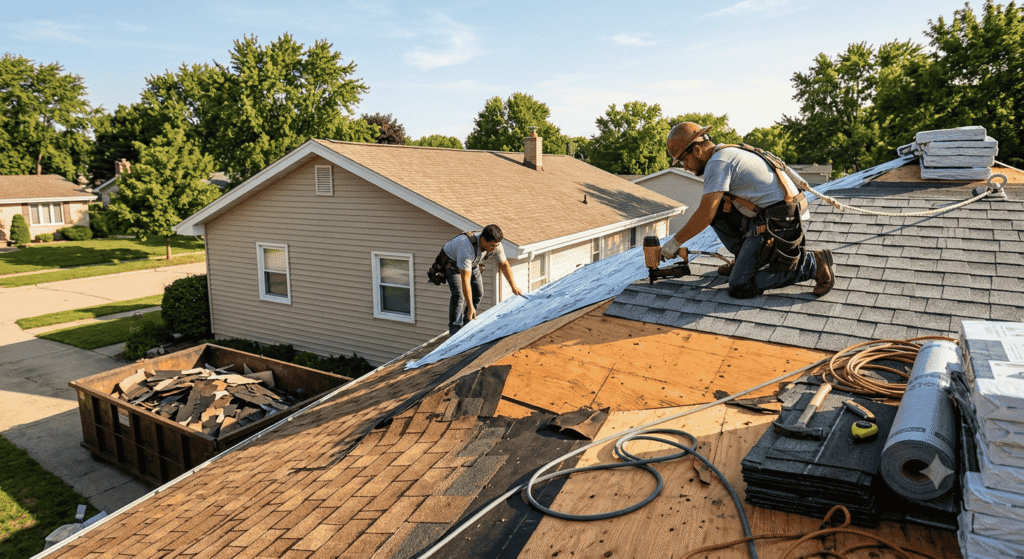
A roof replacement is one of those projects where the sticker shock usually comes from not knowing what’s actually included. Homeowners tend to price it out by shingles alone, then get surprised when the final bid includes tear-off, underlayment, flashing, disposal, and permits on top of the material cost.
As a construction estimating team, we build these numbers out for homeowners and contractors every week. For a typical 1200 sq ft roof replacement cost, most homes land somewhere between $5,700 and $16,000, with the number shifting heavily based on material choice, roof pitch, and how complicated the roofline is. This guide breaks down exactly where that range comes from, what drives it up or down, and how the numbers change for larger and smaller homes too.
Average Cost to Replace a Roof on a 1200 Sq Ft House
For a straightforward job, expect to pay somewhere around $4 to $8 per square foot installed, covering both materials and labor. On the low end (basic asphalt shingles, simple roofline), you’re closer to $5,700; on the high end (premium materials, steep or complex design), costs climb well past $12,000–$16,000.
Roofers don’t actually price by your home’s floor area — they measure in roofing squares, where one square equals 100 square feet of actual roof surface. Because of roof pitch, overhangs, and material waste, the roof surface is always larger than the footprint below it. Contractors typically add 10–15% on top of the house size to account for this.
Here’s how that math plays out for a 1200 sq ft home:
House footprint: 1,200 sq ft
Waste/pitch allowance (15%): +180 sq ft
Total roofing area: 1,380 sq ft ≈ 14 roofing squares
At $4–$8 per square foot:
Low-end estimate: 1,380 × $4 = $5,520
High-end estimate: 1,380 × $8 = $11,040
So for a mid-range asphalt shingle job, a new roof cost for a 1200 sq ft house typically settles between roughly $5,500 and $11,000 — before factoring in premium materials, structural repairs, or a particularly steep roofline.
Cost to Replace a Roof by Square Footage
Not everyone is working with exactly 1,200 square feet. Here’s roughly how total project cost scales for nearby home sizes, using the same $4–$8 per sq ft range (adjusted for the standard waste factor):
House Size | Estimated Roof Area | Total Cost Range |
1,000 sq ft | ~1,150 sq ft | $4,600 – $9,200 |
1,100 sq ft | ~1,265 sq ft | $5,060 – $10,120 |
1,200 sq ft | ~1,380 sq ft | $5,520 – $11,040 |
1,300 sq ft | ~1,495 sq ft | $5,980 – $11,960 |
1,400 sq ft | ~1,610 sq ft | $6,440 – $12,880 |
1,600 sq ft | ~1,840 sq ft | $7,360 – $14,720 |
1,700 sq ft | ~1,955 sq ft | $7,820 – $15,640 |
These figures assume standard asphalt shingles on a moderately pitched roof. Premium materials or a complex design push every one of these ranges higher — sometimes considerably so, as the material breakdown below shows.
Cost Per Square Foot by Roofing Material
Roof Type | Cost per Sq Ft | Approx. Total (1,200 sq ft) |
3-tab asphalt shingles | $4.00 | ~$4,800 |
Architectural shingles | $4.39 – $5.95 | $5,270 – $7,140 |
Metal roofing | $9.00 – $14.50 | $10,800 – $17,400 |
Flat roof (membrane) | $2.50 – $9.00 | $3,000 – $10,800 |
Concrete tile | $6.27 – $8.49 | $7,520 – $10,190 |
Clay tile | $9.09 – $12.29 | $10,910 – $14,750 |
Wood shakes | $6.47 – $9.12 | $7,760 – $10,940 |
Wood shingles | $6.02 – $8.14 | $7,220 – $9,770 |
Asphalt Shingles: Still the most common and most budget-friendly option for most homes. 3-tab shingles are the basic, entry-level product, typically lasting 15–20 years. Architectural shingles cost more but offer thicker, more dimensional construction with better wind and impact resistance, and generally last longer.
Metal Roofing: Metal is the material homeowners increasingly search for when they want something that outlasts a typical shingle roof by decades. A well-installed metal roof can last 40 to 70 years, resists fire and severe weather far better than asphalt, and reflects heat rather than absorbing it — a real energy-efficiency advantage in hot climates, and part of why Energy Star-rated metal roofing has become popular for reducing cooling costs.
Steel vs. aluminum roofing: steel is the more common residential choice — strong, relatively affordable, and available in a wide range of coatings and profiles. Aluminum costs more but doesn’t rust, which makes it a common pick in coastal or high-humidity regions where steel corrosion is a bigger concern.
Advantages of metal roofing: exceptional lifespan, strong fire resistance, energy efficiency, low maintenance, and better performance in high wind or heavy snow than most other materials.
Disadvantages of metal roofing: higher upfront cost than shingles, can be noisier during rain without proper underlayment/insulation, and installation requires specialized skill — a poorly installed metal roof is prone to seam leaks, so it’s worth confirming a contractor has real metal-roofing experience rather than treating it as an asphalt job with different material.
Copper roofing sits at the very top of the metal category in both cost and lifespan — often exceeding $20–$40+ per square foot — chosen almost entirely for its distinctive appearance and century-plus durability rather than budget.
Slate Roofing
The most expensive common roofing material, typically ranging from $22,000 to $70,000 for a full replacement, or roughly $18–$58 per square foot. In exchange, slate can last over 100 years and offers a look few other materials can match — but the weight and specialized installation requirements make it impractical for a lot of homes without additional structural reinforcement.
Flat Roofs
Flat and low-slope roofs are generally the cheapest to install, since there are fewer angles and less material waste. Expect $2.50 to $9 per square foot. The tradeoff is more frequent maintenance, particularly in regions with heavy rain or snow load, since flat membranes are more prone to ponding water over time.
Tile Roofing
Tile delivers excellent noise dampening against rain and wind, along with strong curb appeal. Concrete tile ($6.27–$8.49/sq ft) mimics clay’s look at a somewhat lower cost. Clay tile ($9.09–$12.29/sq ft) can last 50–100 years but becomes more brittle with age, making periodic inspection important as the roof gets older.
Wood Shakes and Shingles
Cedar, pine, and spruce shakes and shingles bring a natural look that other materials often try to imitate, typically running $6.02–$9.12 per square foot. They require more regular maintenance than most alternatives — without it, rot, mold, and algae growth can shorten the roof’s lifespan significantly.
What Drives Roof Replacement Cost Up or Down
Material choice is the single biggest lever, as the table above shows — the gap between a basic asphalt job and a metal or slate roof can be tens of thousands of dollars on the same house.
Tear-off complexity. Removing an old roof — especially one with multiple existing layers, or heavier materials like tile or metal — adds real labor time and disposal cost before installation can even begin.
Structural repairs. If the roof deck underneath has rot, sagging, or weakened trusses, that has to be fixed before new material goes down, and hidden deck damage is one of the most common reasons a project runs over its original estimate.
Permits and inspections. Most municipalities require a permit for a full roof replacement, and fees vary by location; some also require a follow-up inspection once work is complete.
Labor rates. Regional labor costs vary meaningfully, and a multi-level or steep roof takes longer to work on safely than a simple gable or hip design — both of which push the final labor bill up.
Disposal fees. Old shingles, underlayment, and fasteners all need proper disposal, and the fee scales with the volume of material removed.
Roof complexity/design. Simple gable and hip roofs are the cheapest to build and replace. Steeper, more architecturally complex designs — mansard, multi-level, heavy dormers — take substantially more time, skill, and material cutting, which shows up directly in the labor line of your estimate.
Regional Cost Differences
Roofing costs aren’t uniform across the country. Urban markets generally carry higher labor rates and stronger contractor demand, which pushes prices up; rural markets tend to run cheaper on labor but may have fewer material and contractor options to choose from.
Climate plays a role too — homes in heavy snow regions need roofs engineered to handle greater structural load, while hot, sun-heavy climates often see more homeowners opting for reflective materials like metal specifically to cut cooling costs. A roofing estimate built for a home in one region won’t necessarily transfer cleanly to another, which is part of why a location-specific estimate matters more than a national average.
When to Repair vs. Replace
Water damage. Leaks, missing shingles, or visible water staining inside the home are signs that shouldn’t wait — moisture intrusion compounds quickly into structural damage.
Roof age. Asphalt shingle roofs generally last 20 to 30 years. If yours is approaching or past that range, it’s worth starting to plan for replacement before a failure forces the timeline.
Repair vs. full replacement. Isolated damage on an otherwise sound, younger roof is often worth repairing. A roof that’s old and already showing multiple problem areas is usually more cost-effective to replace outright than to keep patching.
Hidden Costs Homeowners Often Miss
Many roofing budgets only account for shingles and installation labor. These are the extra line items that tend to show up once the old roof comes off and the deck is exposed:
Damaged roof decking replacement
Chimney flashing repair
Ventilation upgrades
Gutter removal and reinstallation
Ice and water shield in cold climates
Structural reinforcement for a weakened frame
Budgeting a contingency of roughly 10–15% above your base estimate is a reasonable way to absorb these surprises without derailing the project.
Ways to Save on Roof Replacement Costs
Get multiple estimates. Pricing and scope both vary between contractors — a detailed, itemized quote is easier to compare than a single lump-sum number.
Choose materials wisely. Architectural shingles cost more upfront than 3-tab but typically last longer, which can be the better value over time even at a higher initial price.
Handle simple prep work yourself. Clearing landscaping or debris around the house ahead of time can shave labor hours off the job.
Ask about financing. Many roofing contractors offer payment plans that spread the cost over time rather than requiring it all upfront.
Frequently Asked Questions
How much does it cost to re-roof a house?
For a standard-size home, most re-roofing projects fall between $4 and $8 per square foot for materials and labor combined, with the total scaling directly with house size, material choice, and roof complexity.
How much does a metal roof cost installed?
Expect roughly $9 to $14.50 per square foot for standard steel roofing installed, or $10,800–$17,400 for a 1,200 sq ft home. Premium metals like copper run significantly higher.
How long does a roof replacement take for a 1200 sq ft house?
A straightforward job typically takes 1 to 3 days. Complex rooflines, tear-off of multiple existing layers, or poor weather can extend that timeline.
Can I install a new roof over the old one to save money?
Yes — this is called a “roof-over,” and it saves on tear-off cost. It’s only appropriate when the existing roof is in good condition and meets local code, and it generally won’t last as long as a full tear-off and replacement, since any hidden deck damage stays covered up.
How many bundles of shingles do I need for a 1200 sq ft roof?
One bundle typically covers about 33 square feet. For a 1,200 sq ft roof (roughly 1,380 sq ft of actual roof area with waste factored in), plan for around 40–42 bundles of standard asphalt shingles, plus a small buffer for cutting waste.
How often should a roof be replaced?
Asphalt shingle roofs typically last 20–30 years; metal roofs can last 40–70 years or more. Regular inspections every few years help catch problems early, often extending the practical life of the roof before a full replacement becomes necessary.
Final Thoughts
The cost to replace a roof on a 1,200 sq ft house typically lands between $5,700 and $16,000, with the biggest swing factors being your material choice, roof complexity, and local labor rates. Asphalt keeps the project affordable; metal, tile, and slate cost more upfront but deliver decades of extra service life in return.
Because roofing square footage, waste factors, and material pricing all shift the total so much, the most reliable way to budget is a detailed, itemized estimate built around your actual roof — not a national average. Digital Estimating can put together that breakdown for your home’s size, pitch, and material choice, so you know exactly what you’re paying for before a crew ever shows up.