
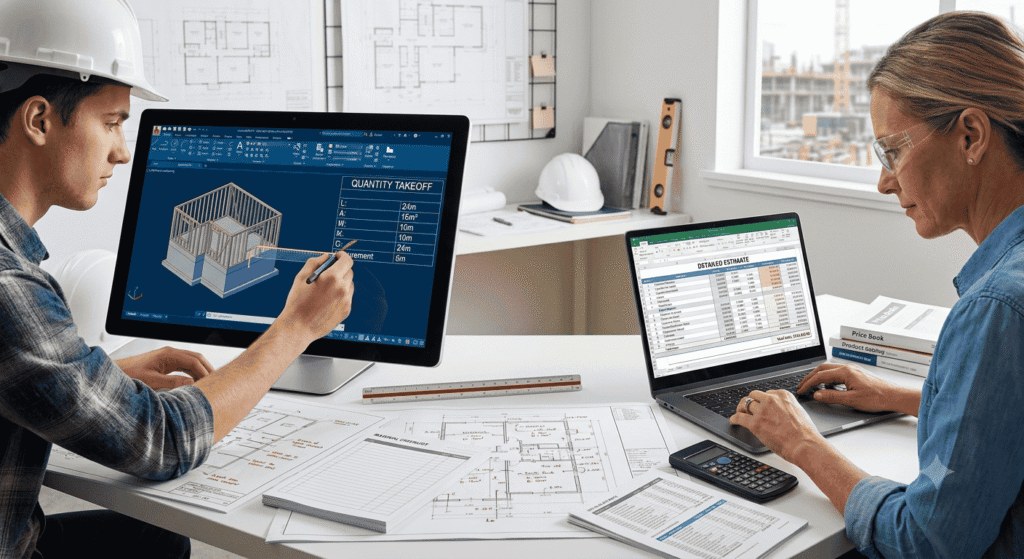
Two terms get used almost interchangeably in construction planning, and it causes more confusion than it should: quantity takeoff and detailed estimate. They’re related, they usually happen back-to-back on the same project, and one genuinely can’t produce an accurate result without the other — but they’re not the same deliverable, and mixing them up is how budgets go sideways.
At Digital Estimating, this is one of the most common questions we get from both first-time builders and experienced project managers: is this a takeoff, or do I need a full estimate? Short answer — you almost always need both, just in the right order. Here’s exactly what each one covers, how they differ, and how they fit together on a real project.
What Is Quantity Takeoff in Construction?
Quantity takeoff (QTO) is the process of measuring and counting every material a project requires, pulled directly from blueprints or digital drawings. It answers purely physical questions: how many square feet of drywall, how many linear feet of framing lumber, how many cubic yards of concrete, how many bundles of shingles.
A quantity takeoff doesn’t touch pricing, labor hours, or overhead — it’s strictly about quantities. Think of it as an extremely precise, itemized shopping list generated straight from the plans, with nothing added on top.
What Is a Detailed Estimate?
A detailed estimate takes that material list and turns it into an actual cost projection for the whole project. It layers in everything the takeoff doesn’t cover: labor rates, equipment rental, permit fees, taxes, waste factors, delivery costs, and overhead.
If the quantity takeoff tells you how many bricks a wall needs, the detailed estimate tells you what it will actually cost to buy those bricks, pay the crew to lay them, rent any equipment involved, and close out the job — start to finish, in dollars.
Quantity Takeoff vs. Detailed Estimate: Key Differences
Purpose
A quantity takeoff exists to answer one question: how much material does this project need? It’s a measurement exercise, not a financial one.
A detailed estimate exists to answer a broader question: what will this project cost, total? It uses the takeoff as its starting input, then builds outward into a complete financial picture — the estimation total a project owner actually needs before committing to a budget.
Scope
Quantity takeoff has a narrow, well-defined scope. It’s concerned only with materials — how many tiles for a floor, how much rebar for a footing, how many linear feet of trim. It doesn’t touch labor, scheduling, or overhead at all.
A detailed estimate has a much wider scope. It rolls in labor wages, equipment rental, disposal and cleanup, permitting, taxes, and contingency — everything that turns a material count into a real project budget a manager can actually plan around.
Complexity
Quantity takeoff methods are comparatively straightforward. You’re measuring length, area, or volume directly from the plans — it’s precise, but it’s a fairly mechanical process that doesn’t require weighing external variables like labor market rates or weather delays.
Detailed estimates are inherently more complex. They require accounting for fluctuating material prices, regional labor rate differences, equipment availability, and scheduling risk — which is why detailed estimating is often handled by someone with real cost-estimation experience rather than treated as a simple extension of the takeoff.
Tools Used
Quantity takeoff methods span both manual and digital approaches. Smaller projects, or anyone working from paper blueprints, can still measure with a scale ruler and do the math by hand. Most professionals today, though, use digital takeoff software — tools like PlanSwift or Bluebeam — which measure directly off digital plan sets and dramatically cut down on manual counting errors.
Detailed estimates typically run on dedicated estimating platforms — ProEst and Buildertrend are common examples — that combine the takeoff quantities with labor rates, equipment costs, and overhead in one model. Smaller projects sometimes get by with a well-built spreadsheet template, but larger or more complex jobs generally benefit from software built specifically for cost estimation, plus an estimator who can sanity-check the output.
Quantity Takeoff vs. Detailed Estimate at a Glance
Aspect | Quantity Takeoff | Detailed Estimate |
Core Question | How much material is needed? | What will the whole project cost? |
Scope | Materials only | Materials + labor + equipment + permits + overhead |
Output | An itemized material quantity list | A complete project cost estimate/total |
Complexity | Straightforward measurement | Multi-variable financial modeling |
Common Tools | PlanSwift, Bluebeam, manual scales | ProEst, Buildertrend, spreadsheets |
Typical User | Estimator, material supplier | Project manager, general contractor, owner |
When to Use Each Process
Use a quantity takeoff when the question in front of you is purely about materials — you’re ordering supplies, checking whether a bid quoted the right quantities, or need to confirm a subcontractor isn’t over- or under-buying for a scope of work. This is also exactly the kind of service used for large residential or commercial quantity takeoff services for subdivisions, where dozens or hundreds of similar units need consistent, accurate material counts before any pricing gets attached.
Use a detailed estimate when you need the full financial picture — securing financing, comparing contractor bids apples-to-apples, or setting a project budget you can actually hold a build to. A detailed estimate is what turns quantity and estimation data into a number a bank, an owner, or a project manager can commit to.
How Quantity Takeoff and Detailed Estimates Work Together
These aren’t competing processes — they’re sequential stages of the same planning pipeline.
Quantity takeoff comes first. It’s the foundation everything else is built on. An estimator works through the plans and produces exact quantities: linear feet of framing, square feet of roofing, cubic yards of concrete, count of fixtures. Without this raw, verified data, there’s nothing accurate to price against.
The detailed estimate builds on top of it. Once quantities are locked in, the estimator applies current material pricing, adds labor hours and rates, factors in equipment and rental costs, and layers in permits, taxes, and overhead. What comes out the other end is a complete total estimate — the number that actually drives budgeting decisions.
Skip the takeoff and go straight to estimating off rough guesses, and the whole downstream number is shaky — you’re pricing quantities nobody verified. Do a careful takeoff but never turn it into a full estimate, and you know exactly what materials you need but have no real sense of what the project will cost to build. Done together, in the right order, you get a budget that’s both materially accurate and financially complete — which is what keeps a project from running out of material halfway through, or running out of money before it’s finished.
Best Practices for Getting Both Right
Double-check every measurement. A small error at the quantity takeoff stage doesn’t stay small — it compounds through every cost calculation that follows in the detailed estimate.
Build in contingency. Material prices shift, labor availability changes, and schedules slip. A reasonable buffer in the detailed estimate protects the project from going over budget when (not if) something changes mid-build.
Use the right tool for the job. Digital takeoff software cuts measurement error dramatically compared to manual methods, and dedicated estimating platforms make it far easier to keep a detailed estimate organized and auditable than a patchwork of spreadsheets.
Bring in a professional for anything complex. Simple, small-scope projects can often be takeoff-and-estimated in-house. Larger residential builds, commercial projects, or multi-unit subdivisions benefit substantially from an experienced estimator who can catch quantity errors and pricing assumptions before they turn into budget overruns.
Frequently Asked Questions
What is quantity takeoff in construction, in simple terms?
It’s the process of measuring a project’s plans to calculate exactly how much of each material — lumber, concrete, tile, wiring, and so on — is needed to complete the build.
Is a detailed estimate the same as a total estimate?
Essentially, yes — a detailed estimate is what produces the final total estimate: the complete cost figure covering materials, labor, equipment, permits, and overhead, built on top of an accurate quantity takeoff.
Do I need both a quantity takeoff and a detailed estimate?
For anything beyond the smallest project, yes. The takeoff gives you accurate material quantities; the detailed estimate turns those quantities into a real budget you can plan and finance around.
What quantity takeoff methods are most common today?
Manual measurement from paper blueprints is still used on very small projects, but most professionals now use digital takeoff software that measures directly from digital plan sets, reducing human error and speeding up the process significantly.
Who typically performs quantity takeoff and estimating services?
Professional construction estimators handle both, often using specialized software. For larger projects — including subdivision-scale quantity takeoff services — many builders and developers outsource this work to estimating firms to ensure accuracy across large volumes of similar units.
Final Thoughts
Quantity takeoff and detailed estimating aren’t rival processes — they’re two stages of the same job. The takeoff answers “how much material do we need,” measured directly and precisely from the plans. The detailed estimate answers “what will this actually cost,” building labor, equipment, permits, and overhead on top of that material data to produce a number you can budget and build against.
Get the takeoff wrong, and your entire estimate is built on shaky numbers. Skip the detailed estimate, and you know your material list but have no real financial plan. Done together — accurately and in the right order — they’re what keeps a construction project on schedule, on budget, and free of expensive surprises.
If you’d rather have that accuracy handled for you, Digital Estimating provides both quantity takeoff and full detailed estimating services, from single custom homes to large-scale residential subdivisions, so your numbers are solid before the first shovel hits the ground.