
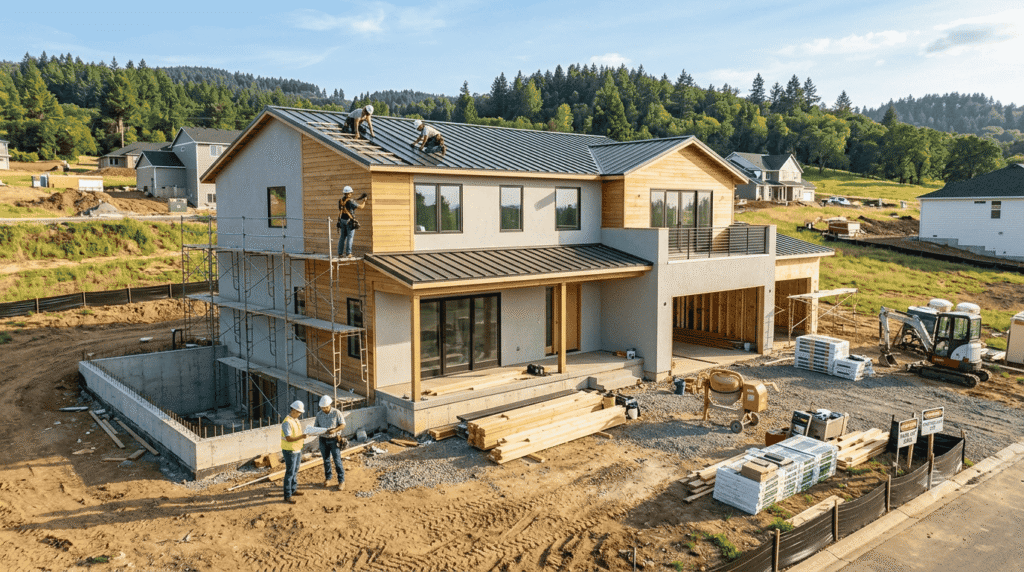
A four-bedroom home is the sweet spot for a lot of growing families — enough room for kids, guests, or a home office, without tipping into mansion-sized budgets. But “how much does a 4-bedroom house cost” doesn’t have one clean answer, because building one and buying one are two very different financial paths, and both swing hard based on where you live.
In 2026, building a 4-bedroom home in the U.S. typically runs $200,000 to $500,000, excluding land. Buying an existing 4-bedroom house, meanwhile, averages closer to $475,000 nationally, though that number hides enormous regional variation. This guide breaks down what actually drives that range, how floor plan and size affect your number, and how building compares to buying once all the real costs are on the table.
How Much Does It Cost to Build a 4 Bedroom House?
At a national level, the average price to build a four-bedroom house lands between $200,000 and $500,000 before you factor in land. Where you fall in that range depends heavily on three things: your location, your square footage, and the materials and finishes you choose.
Building in a high-cost state like California or New York pushes you toward the top of that range fast, once permits, land prep, and elevated labor rates get added in. Building in the South or Midwest generally keeps costs closer to the lower end, thanks to cheaper land and more available skilled labor.
For comparison, buying an existing 4-bedroom home nationally averages around $475,424 as of 2026 — though in smaller towns or less competitive markets, comparable homes can be found for under $200,000, while high-demand metros regularly push well past $800,000.
Cost Per Square Foot to Build a 4 Bedroom House
Market Type | Cost per Sq Ft |
Low-cost states | $120 – $180 |
Average markets | $150 – $250 |
High-cost cities | $250 – $400 |
Most 4-bedroom homes fall between 2,000 and 2,500 square feet — that’s the typical square footage of a 4 bedroom house in the U.S. — though custom or luxury builds regularly exceed 3,000 square feet. As a working example: a 2,400 sq ft home at $200 per square foot lands around $480,000 in construction cost alone, before land or permits.
Regional Cost Variations
Location is the single biggest swing factor in any 4-bedroom house cost estimate. High-cost states — California, Massachusetts, Hawaii — consistently sit well above the national average, driven by land scarcity, high demand, and elevated labor and permitting costs. States like Mississippi, West Virginia, and Arkansas sit at the opposite end, offering some of the most affordable 4-bedroom housing markets in the country.
Urban centers amplify this further: a 4-bedroom home in New York City or Los Angeles can cost double or triple the price of an equivalent home in a rural Midwest town, purely due to land availability and local labor markets.
What Drives 4 Bedroom House Pricing
Location. Urban land scarcity, local demand, and higher permitting and labor costs push city prices well above rural and suburban markets.
Market conditions. Local job growth, population trends, and zoning policy all shape regional pricing, on top of raw supply and demand.
Square footage. More square footage means more materials, more labor hours, and more finishing work — cost scales close to linearly with size once you’re comparing similar quality levels.
Floor plan. This is where a lot of buyers underestimate cost. An open-concept 4 bedroom floor plan generally needs more structural steel and larger HVAC systems to condition the open space evenly, while a more segmented, traditional layout can be more material-efficient. Vaulted ceilings, extra bathrooms, and complex rooflines all add cost on top of the base square footage.
Type of construction. Fully custom homes cost more due to architect fees and specialized, one-off material choices. Production or “tract” homes — built from a builder’s existing plan library — are typically more affordable since they benefit from repeatable designs and bulk material purchasing, though customization is limited. Prefabricated and modular 4 bedroom homes are a growing middle path: much of the construction happens off-site in a controlled factory setting, which usually means real cost and time savings, though local zoning and land-use rules still apply and should be checked early.
Land costs. Land alone can exceed $100,000 in desirable or metro areas. Rural land is usually cheaper to buy but may come with higher site development costs to make it buildable.
Site preparation. Grading, soil testing, access roads, and utility hookups (water, sewer, gas, electrical) can add thousands to tens of thousands of dollars, particularly on undeveloped lots. Permit fees and approval timelines vary by municipality and need to be budgeted alongside construction itself.
Material costs. Premium finishes — hardwood flooring, stone countertops, high-efficiency windows — raise both the look and the price tag. Standard-grade materials keep a build on budget while still delivering solid, functional results.
Labor costs. Labor availability varies by region; markets with skilled-trade shortages or a high cost of living see labor eat up a larger share of the total budget. Regardless of region, working with licensed, experienced tradespeople is worth the premium for long-term build quality.
Floor Plan Options for a 4 Bedroom House
Floor plan choice affects both upfront cost and how efficiently your square footage is used.
Single-story (one-story) 4 bedroom house plans keep everything on one level — no staircase, generally simpler framing, and easier accessibility, though they need a larger building footprint (and more foundation and roof area) for the same square footage compared to a two-story design.
Two-story 4 bedroom house plans stack the square footage vertically, which usually means a smaller footprint, less foundation and roofing cost per square foot of living space, and often a lower price per square foot overall — a common reason many builders default to two-story designs on smaller lots.
Open-concept 4 bedroom floor plans combine living, dining, and kitchen space into one large area — popular for natural light and flow, but as noted above, it typically requires more structural support and a more capable HVAC system than a segmented plan.
L-shaped and rectangular 4 bedroom house plans are generally the most cost-efficient shapes to build, since simpler exterior wall geometry reduces framing complexity and material waste compared to more elaborate footprints.
4 bedroom cottage house plans favor a compact, efficient layout with traditional detailing — often a good fit for smaller lots or a lower overall budget while still delivering four full bedrooms.
Small and tiny 4 bedroom house plans compress bedrooms down to a smaller overall footprint (sometimes under 1,800 sq ft), trading larger common areas for a leaner build cost — a practical option for buyers who want four bedrooms without four-bedroom-sized square footage.
Whichever plan you’re drawn to, getting 4 bedroom house plans with cost to build already estimated — rather than pricing blind off a stock floor plan — is what keeps the design phase from creating budget surprises later.
Buying vs. Building a 4-Bedroom Home
Buying an existing home is generally faster — you can close and move in within weeks if inspections go smoothly — and it comes with more upfront cost predictability, since you know the purchase price before committing. The tradeoff is compromise: you may settle for a layout that isn’t ideal, or need to budget for renovations to bring the home up to your standard. In competitive markets, bidding wars can also push the final price well past your original budget.
Building a new home gives you full control over layout, finishes, and systems — floor plan, energy efficiency, smart home features, all customizable from the start. New construction also typically means lower maintenance costs in the first several years, since everything is new and under warranty. The tradeoff is time: builds commonly take 6 to 12 months or longer, and you’re managing permits, potential delays, and often a higher total cost once land and site work are factored in.
Neither option is objectively better — it comes down to your timeline, your tolerance for the building process, and whether a truly custom layout matters enough to justify the extra time and cost.
Don’t Forget: Furnishing and Moving Costs
Two costs buyers and builders alike tend to underbudget for:
Cost to furnish a 4 bedroom house. Fully furnishing a home this size — bedrooms, living areas, kitchen, dining — typically runs anywhere from $15,000 for budget-conscious furnishing to $50,000+ for higher-end pieces throughout. New construction in particular often means furnishing every room from scratch, since there’s no existing furniture to work around.
Cost to move into or out of a 4 bedroom house. A local move for a home this size commonly runs $2,000–$5,000 depending on how much you’re moving and whether you hire full-service movers; a long-distance move can run considerably higher. It’s a cost that’s easy to forget when you’re focused on the build or purchase price itself, but worth including in your total moving-day budget.
Budgeting Tips for Buyers and Builders
- Account for full purchase costs if buying: down payment, closing costs (typically 2–5% of the purchase price), inspections, and any immediate repairs.
- Budget recurring costs — property taxes, insurance, and HOA fees if applicable — not just the one-time purchase or build price.
- Include every build-related cost if building: land, permits, site prep, utility hookups, and architectural/design fees, not just construction labor and materials.
- Plan for upgrades separately. High-end finishes and energy-efficiency features can meaningfully raise the total beyond a base estimate.
- Add a contingency fund. Set aside 10–15% of your total budget to absorb price changes, delays, or the unexpected issues that show up on nearly every project.
- Use estimating tools as a starting point, not a final answer. Online calculators are useful for a ballpark, but a location-specific estimate from a professional is what actually protects your budget.
Frequently Asked Questions
How much does it cost to build a 4-bedroom house?
Nationally, expect $200,000 to $500,000 excluding land, with the final number driven mainly by location, square footage, and material/finish quality.
How much is a 4-bedroom house to buy?
The U.S. average purchase price for an existing 4-bedroom home is around $475,000, though this varies enormously — from under $150,000 in the most affordable markets to well over $800,000 in high-demand metros.
What is the average square footage of a 4-bedroom house?
Most fall between 2,000 and 2,500 square feet, with luxury or custom designs often exceeding 3,000 square feet.
Is it cheaper to build or buy a 4-bedroom house?
Buying is generally faster and offers more upfront cost certainty; building is usually more expensive and takes longer but delivers a fully customized home. Land prices and local construction rates heavily influence which option actually ends up cheaper in your specific market.
Are prefabricated 4-bedroom homes cheaper than site-built homes?
Often yes — modular and panelized construction typically brings cost and time savings since much of the work happens off-site in a factory setting. Local zoning and land-use requirements still need to be checked, since they apply to prefab homes just as they do to traditional builds.
What is the cheapest state to buy or build a 4-bedroom house?
States like West Virginia, Mississippi, and Arkansas consistently rank among the most affordable for 4-bedroom homes, with some smaller cities offering homes under $150,000.
Do 4-bedroom house prices change with the seasons?
Yes — spring and summer typically see higher prices due to increased buyer competition, while fall and winter markets often allow more room to negotiate.
Final Thoughts
Whether you’re comparing 4-bedroom house plans with an eye on cost to build, or weighing a move-in-ready purchase against a custom build, the real answer to “how much does a 4-bedroom house cost” depends on where you’re building or buying, how much square footage you need, and the floor plan and finish level you choose. National averages are a useful starting point, but regional data is what actually protects your budget.
If you’re planning a build and want numbers grounded in your actual floor plan, lot, and location — rather than a national average — Digital Estimating can put together a detailed cost breakdown before you finalize your plans, so your budget holds up from groundbreaking to move-in day.