
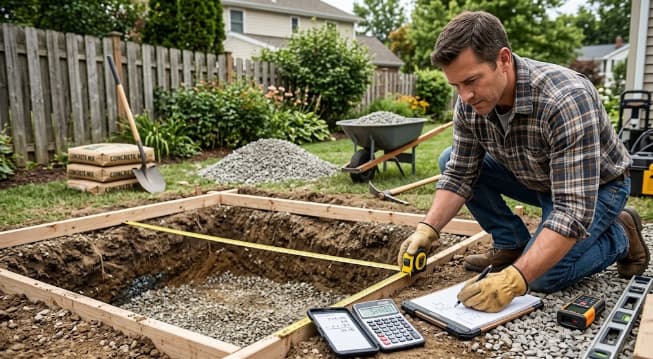
Few units cause as much confusion on a job site as the cubic yard. Contractors, landscapers, and homeowners all rely on it to order concrete, mulch, gravel, soil, and fill dirt, yet the math behind it trips up even experienced professionals. Order too little material and the project stalls halfway through. Order too much and you are paying to haul away and dispose of the excess.
This guide breaks down exactly what a cubic yard is, how to calculate it for rectangular, circular, and irregular spaces, and how to apply the formula to real construction and landscaping scenarios. By the end, you will be able to figure cubic yard measurements confidently for concrete pours, mulch beds, excavation, and waste removal alike.
What Is a Cubic Yard?
A cubic yard is the standard unit of volume used throughout the construction and landscaping industries, particularly when working with bulk materials such as concrete, gravel, soil, sand, or mulch. By definition, one cubic yard is the amount of space contained in a cube measuring 3 feet by 3 feet by 3 feet on every side.
Since each side of that cube measures 3 feet, and 3 x 3 x 3 equals 27, a single cubic yard is equal to 27 cubic feet. That conversion factor, 27, is the single most important number to remember when working with cubic yard calculations, because nearly every formula eventually comes back to dividing a cubic-foot measurement by 27.
It helps to understand what a cubic yard actually looks like in real life. Visualize a cube roughly the size of a large washing machine or a small shed, about waist to chest height on every side. A standard concrete mixer truck typically holds somewhere between 8 and 10 cubic yards per load, which gives a useful sense of scale when planning larger pours.
Cubic Yard vs. Yard: Understanding the Difference
One common point of confusion is the difference between a “yard” and a “cubic yard.” A yard, on its own, is a unit of length equal to 3 feet, used to measure distance in one dimension. A cubic yard is a unit of volume, measuring space in three dimensions at once: length, width, and height. In other words, a yard tells you how far something extends, while a cubic yard tells you how much space or material something occupies. They are related but not interchangeable, and mixing them up is one of the most common estimating errors on a job site.
The Cubic Yard Formula
The core formula for calculating cubic yards is straightforward:
Cubic Yards (yd³) = (Length x Width x Height) / 27
Where length, width, and height are all measured in feet. Because 27 cubic feet equal 1 cubic yard, dividing your total cubic-foot volume by 27 converts the measurement into cubic yards.
This single formula underlies virtually every cubic yard calculation in construction, whether you are figuring concrete yardage for a slab, calculating how much soil is needed to fill a raised bed, or determining how much gravel a driveway base requires.
How to Measure and Calculate Cubic Yards Step by Step
Step 1: Gather the Right Tools
Before calculating cubic yardage, gather a tape measure or measuring wheel, a calculator, and something to record your measurements, whether that is a notepad or a digital estimating tool. For larger or oddly shaped areas, a laser measure or digital planning app can speed up the process and reduce measurement error.
Step 2: Measure the Space
Accurate measurements are the foundation of every reliable cubic yard calculation. Start by measuring the length, width, and height (or depth) of the area in feet.
For a simple rectangular space, the area is calculated as:
Area = Length x Width
For an irregular space, break the total area down into smaller rectangular or square sections, calculate the area of each section individually, and then add them together:
Total Area = Area 1 + Area 2 + Area 3 + …
Step 3: Calculate the Volume
Once you have the area, multiply it by the height or depth of the material to get the volume in cubic feet:
Volume (cubic feet) = Length x Width x Height
Step 4: Convert to Cubic Yards
Finally, divide the total cubic-foot volume by 27 to convert it into cubic yards:
Cubic Yards = Volume (cubic feet) / 27
Following these four steps in order, measuring accurately, calculating area, calculating volume, and converting to cubic yards, keeps the process consistent no matter what material or project you are working on.
Calculating Cubic Yards for Different Shapes
Not every space is a perfect rectangle, so it helps to know how to adapt the basic formula to different shapes.
Rectangular Spaces
This is the simplest case and uses the standard formula directly. For example, if you have a rectangular space measuring 10 feet long, 5 feet wide, and 2 feet deep, you would calculate the volume in cubic feet first (10 x 5 x 2 = 100 cubic feet), then divide by 27 to get approximately 3.7 cubic yards.
Circular Spaces
For circular or cylindrical areas, such as a round planting bed or a cylindrical excavation, a different formula applies, based on the radius rather than the width and length:
Volume = π x radius² x height
Once you have the volume in cubic feet, divide by 27 as usual to convert to cubic yards. For instance, a circular space with a 5-foot radius and a 2-foot depth would require calculating the area of the circle first, multiplying by the depth, and then converting the result to cubic yards.
Irregular Shapes
Irregular spaces are the most challenging to measure accurately. The most reliable approach is to divide the larger area into smaller, more manageable rectangular or triangular sections, calculate the volume of each section separately, and then add the results together. For particularly complex sites, some contractors use digital modeling software or 3D scanning tools to generate a more precise volume calculation, though the manual segmentation method works well for most residential and small commercial projects.
Applying Cubic Yard Calculations to Real Projects
Estimating Cubic Yards for Landscaping
Landscaping projects, particularly mulch, soil, and gravel beds, rely heavily on accurate cubic yard estimates. As a useful rule of thumb, one cubic yard of mulch covers approximately 324 square feet at a 1-inch depth.
For example, imagine a landscaping bed measuring 20 feet by 30 feet that needs a 2-inch layer of mulch. First, calculate the area: 20 x 30 = 600 square feet. Then apply the depth conversion:
Volume (cubic yards) = (Area x Depth in inches) / 324
Volume = (600 x 2) / 324 = approximately 3.7 cubic yards
This same method works for topsoil, compost, and decorative gravel, adjusting the coverage rate depending on the specific material and depth required.
Estimating Cubic Yards for Concrete
Concrete is one of the most common materials estimated in cubic yards, and getting the figure cubic yards of concrete calculation right is critical, since ordering short mid-pour is far more costly than ordering slightly extra.
As a reference point, one cubic yard of concrete covers approximately 81 square feet at a standard 4-inch depth. Suppose a contractor needs to pour a 12-foot by 16-foot slab at 4 inches thick. The calculation works out as follows:
Area = 12 x 16 = 192 square feet
Cubic Yards = (Area x Depth in inches) / 81
Cubic Yards = (192 x 4) / 81 = approximately 9.5 cubic yards
Note that coverage rates shift with slab thickness, so a 6-inch slab will require proportionally more concrete than a 4-inch slab covering the same footprint. Always confirm the intended depth before finalizing a concrete order, since even a small thickness error can throw off the total yardage significantly on a large pour.
Estimating Cubic Yards for Waste Removal
Cubic yard calculations are just as useful for site cleanup and debris removal as they are for new material orders. To estimate a pile of yard waste, branches, or construction debris, treat the pile as a rectangular volume and apply the standard formula.
For example, a debris pile measuring 10 feet long, 15 feet wide, and 3 feet high would be calculated as:
Volume = 10 x 15 x 3 = 450 cubic feet
Cubic Yards = 450 / 27 = approximately 16.7 cubic yards
This figure helps determine dumpster size, hauling costs, and disposal fees before the work even begins.
Why Accurate Cubic Yard Measurements Matter
Precise cubic yard calculations affect nearly every stage of a construction or landscaping project.
Smarter Material Purchasing
Accurate volume calculations prevent both over-ordering and under-ordering. Since bulk materials like concrete, gravel, and soil are typically sold by the cubic yard, knowing the exact quantity needed ensures suppliers deliver the right amount the first time, avoiding costly return trips or project delays.
Better Cost Control
Because so many construction materials are priced per cubic yard, accurate measurement directly controls project cost. Overestimating material needs means paying for volume that never gets used, while underestimating leads to change orders, rush deliveries, and often higher per-unit pricing on a second, smaller order.
More Reliable Scheduling
Knowing exactly how much material a project requires makes it easier to schedule labor, equipment, and deliveries efficiently. This reduces downtime on site and helps keep the overall project timeline on track.
Reduced Waste
Ordering the correct volume of material, rather than rounding up out of caution, reduces leftover waste and disposal costs. This is not only better for the project budget but also supports more sustainable job site practices.
Common Mistakes to Avoid When Calculating Cubic Yards
Even straightforward math can go wrong on a busy job site. A few of the most frequent errors include:
- Forgetting to convert cubic feet to cubic yards. Every volume calculation in feet must be divided by 27 to arrive at the correct cubic yard figure.
- Treating irregular shapes as simple rectangles. Skipping the segmentation step on curved or uneven areas leads to significant volume errors.
- Ignoring material settling or compaction. Loose soil, gravel, and mulch settle over time, so ordering based on loose volume alone can leave a project short once the material compacts.
- Mixing up depth units. Depth is often measured in inches while length and width are measured in feet; forgetting to convert consistently is a common source of calculation errors.
- Rounding too early in multi-step calculations. Rounding intermediate figures before completing the full formula can compound small errors into a meaningfully inaccurate final total.
Useful Cubic Yard Conversion Factors
Understanding how cubic yards relate to other common units makes it easier to double-check your math and communicate clearly with suppliers.
Conversion | Formula |
Cubic feet to cubic yards | Divide cubic feet by 27 |
Cubic yards to cubic feet | Multiply cubic yards by 27 |
Meters to yards | Multiply meters by 1.093613 |
Cubic yards to cubic meters | Multiply cubic yards by 0.764555 |
For example, if a calculation produces 81 cubic feet, dividing by 27 confirms that figure equals exactly 3 cubic yards. Similarly, a measurement of 10 meters converts to roughly 10.94 yards. Always double-check unit conversions before finalizing a material order, since a single misplaced decimal or skipped conversion step can throw off an entire estimate.
Tips for Getting Accurate Cubic Yard Measurements
A few practical habits go a long way toward reducing estimating errors on site. Use a measuring wheel or tape measure rather than pacing off distances by eye, and confirm the area is level before recording height or depth measurements, since sloped ground can distort volume calculations. Account for the specific characteristics of the material being measured; soil and mulch, for instance, settle and compact over time, so it is often worth adding a small buffer to loose-material estimates. Finally, for large or complex sites, breaking the project into smaller, clearly defined sections and calculating each one separately produces far more reliable totals than attempting a single calculation across an irregular footprint.
Frequently Asked Questions
What is a cubic yard?
A cubic yard is a unit of volume equal to the space contained in a cube measuring 3 feet on each side, or 27 cubic feet.
How many cubic feet are in a cubic yard?
There are 27 cubic feet in one cubic yard, since 3 x 3 x 3 equals 27.
How do I figure out cubic yards for concrete?
Calculate the area of the pour in square feet, multiply by the slab depth in feet (or divide by 81 if depth is entered in inches at a standard 4-inch reference), then divide the total by 27 to get cubic yards.
How big is one cubic yard visually?
One cubic yard is roughly the size of a large washing machine or a small shed interior, about a cube measuring 3 feet on every side.
Is a yard the same as a cubic yard?
No. A yard measures length (3 feet), while a cubic yard measures volume (27 cubic feet). They describe different types of measurement entirely.
How many cubic yards does a concrete truck hold?
Most standard concrete mixer trucks carry between 8 and 10 cubic yards per load, though capacity varies by truck size and region.
Final Thoughts
Figuring cubic yard measurements accurately is one of the most practical skills in construction and landscaping estimating, and it comes down to mastering one core formula: multiply length by width by height, then divide by 27. Applying that formula correctly to rectangular, circular, and irregular spaces keeps material orders accurate, project budgets under control, and job sites running on schedule.
If you would rather leave the calculations to professionals who work with these formulas daily, Digital Estimating provides detailed, accurate material takeoffs for concrete, landscaping, excavation, and waste removal projects, so every cubic yard is accounted for before you place an order.