
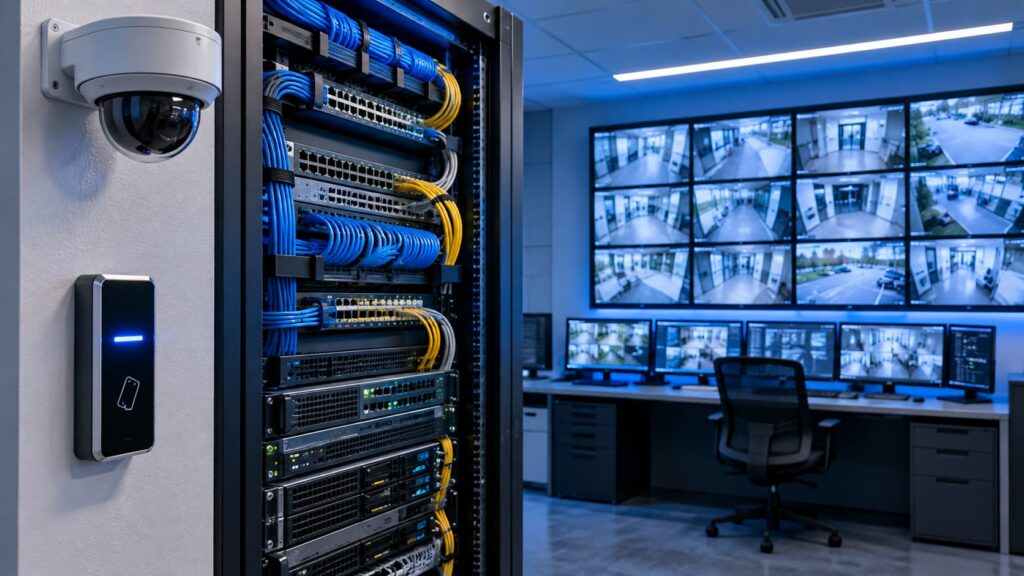
Electronic safety and security estimating is the takeoff and pricing of CSI MasterFormat Division 28 systems — fire detection and alarm, access control, video surveillance, intrusion detection, and electronic monitoring. It sits at the intersection of low-voltage electrical, life-safety code, and IT, which is exactly why it’s one of the easiest scopes to under-bid. This guide covers what belongs in a Division 28 estimate, what moves the number, and the single compliance rule that can get an otherwise-winning bid thrown out.
What Division 28 Actually Includes
“Electronic safety and security” is a defined MasterFormat division, not a loose category. A complete estimate quantifies five system families, each with its own devices, head-end equipment, cabling, programming, and commissioning:
| Division 28 System | What Gets Quantified |
| Access control (28 10 00) | Readers, controllers, electric locks/strikes, REX sensors, credentials, software |
| Video surveillance (28 20 00) | Cameras, NVR/VMS, storage, PoE switches, licensing |
| Intrusion detection (28 30 00) | Motion/glass-break sensors, door contacts, keypads, panels |
| Fire detection & alarm (28 40 00) | Smoke/heat detectors, pull stations, notification appliances, FACP |
| Monitoring & integration | Central-station links, head-end integration, head-end programming |
Each device also carries hidden quantities: cable (by the foot), conduit/pathway, backboxes, power supplies, battery backup, and the labor to terminate, program, and commission. An estimate that prices hardware but skips programming and commissioning is the classic way this scope comes in short.
Fire & Life Safety: Where Code Sets the Scope
Fire detection isn’t a design choice — it’s governed by NFPA 72, the National Fire Alarm and Signaling Code, which dictates device spacing, notification coverage, circuit supervision, and survivability. That code drives device counts directly, so the estimate follows the code, not the floor plan alone. The life-safety stakes are real: NFPA consistently finds that working smoke alarms roughly halve the risk of dying in a reported home fire, which is why fire-alarm scope is non-negotiable and heavily inspected.
The NDAA Section 889 Trap Every Security Estimator Must Price
Here is the compliance rule that separates an experienced security estimator from a general low-voltage bidder — and that no generic estimating page covers. Under Section 889 of the 2019 National Defense Authorization Act, the federal government cannot procure or obtain video surveillance equipment from five named Chinese companies — Hikvision, Dahua, Huawei, Hytera, and ZTE — and, critically, Part B bars the government from contracting with any entity that even *uses* that equipment anywhere in its operations.
The FCC extended the reach, banning new equipment authorizations for these brands in November 2022, a decision upheld on appeal in April 2024, and federal grant recipients are separately barred under 2 CFR 200.216. The practical effect: any project touching federal dollars, a federal contractor, a school with federal funding, or critical infrastructure must specify NDAA-compliant gear.
Note: The estimator’s trap — Hikvision and Dahua are among the world’s largest camera makers, and their hardware is sold under many private-label brands through OEM arrangements. A rebranded camera running a banned chipset does not satisfy Section 889 regardless of the name on the housing. Verify compliance at the chipset level, and price compliant lines (Axis, Hanwha, Avigilon, Verkada, Rhombus) — which typically cost more than the banned-brand baseline the client may have assumed.
Pricing non-compliant gear into a federal-adjacent bid isn’t just a spec error; it can mean contract loss, debarment, or forced rip-and-replace. This single line of due diligence is one of the highest-value things a security estimator does.
What Drives a Division 28 Estimate Up or Down
- Device density and head-end sizing — camera/door counts set hardware, but VMS licensing, storage retention days, and controller capacity scale the back end.
- Cabling and pathway — plenum vs. non-plenum cable, conduit fill, and long runs can rival device cost on large sites.
- Compliance tier — NDAA-compliant and UL-listed equipment carries a premium over commodity gear.
- Labor — termination, programming, and commissioning hours are where estimates most often fall short.
- Integration — tying access control, video, and intrusion into one platform adds programming labor and licensing.
Labor Rates for Security & Fire Alarm Work
Labor is the hardest part of this scope to price from a catalog. Per BLS, security and fire alarm systems installers (SOC 49-2098) earn a national median of about $60,070 a year (~$28.88/hour), ranging from roughly $38,800 at the 10th percentile to $81,150 at the 90th, with about 86,340 employed nationally — and it’s a BLS “Bright Outlook” occupation, meaning demand is outpacing supply and rates are firm. High-cost states run well above the median; California’s median is about $66,010, with the top decile above $101,000.
How to Build a Defensible Security Estimate
- Work from the device schedule and NFPA 72 coverage, not just the architectural plan — code sets fire-device counts.
- Confirm NDAA/FCC compliance before pricing cameras on any federal-adjacent job, and verify at the chipset level.
- Break out programming, commissioning, and licensing as their own lines — never fold them into hardware.
- Separate recurring costs (monitoring, VMS subscriptions, cloud storage) from one-time install so the client sees true total cost of ownership.
- Add retention and scalability assumptions in writing — storage days and future camera count change the bid materially.
Frequently Asked Questions
What is electronic safety and security estimating?
It’s the quantity takeoff and pricing of CSI MasterFormat Division 28 systems — fire alarm, access control, video surveillance, intrusion detection, and monitoring — including devices, cabling, programming, and commissioning.
What is NDAA Section 889 and why does it matter for a bid?
It’s a federal law barring the government and its contractors from buying or using video surveillance from Hikvision, Dahua, Huawei, Hytera, and ZTE. On any federally funded or federally contracted project, specifying banned gear can disqualify the bid or force a rip-and-replace.
What systems fall under Division 28?
Access control, video surveillance, intrusion detection, fire detection and alarm, and electronic monitoring/integration.
How much do security and fire alarm installers cost?
BLS reports a national median around $60,070/year (~$28.88/hour), with high-cost states like California running above $66,000 median and top earners past $101,000.
What standard governs fire alarm estimating?
NFPA 72, the National Fire Alarm and Signaling Code, which sets device spacing, notification coverage, and supervision requirements that drive device counts.