
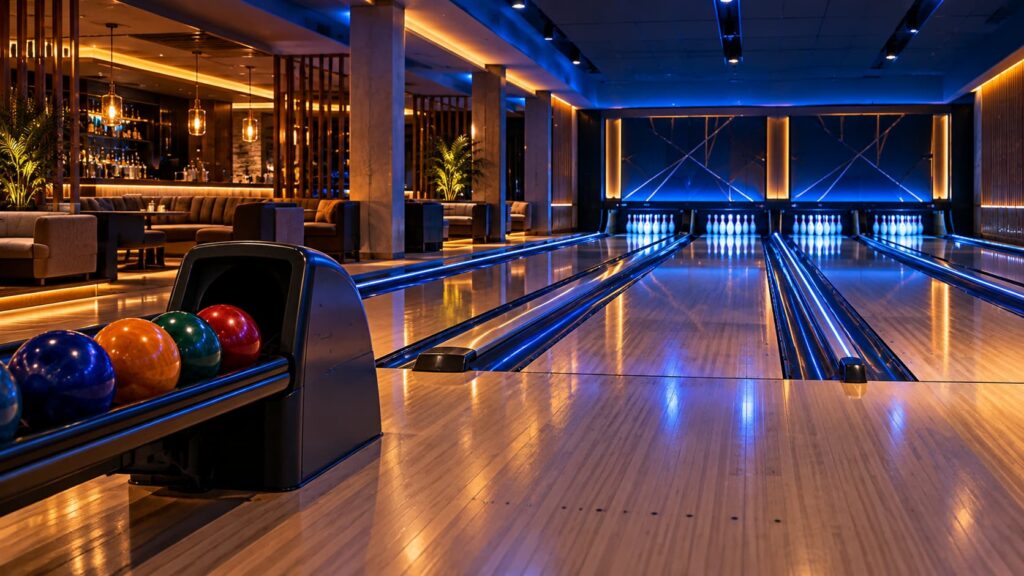
A commercial bowling alley costs $500,000 to $8 million to build in 2026; a home bowling alley ranges from $35,000 to $500,000. The spread comes down to lane count, ground-up vs. conversion, and extras like a bar, arcade, or kitchen. This guide breaks the budget down the way an estimator builds it — line by line — and adds the industry and equipment data that most cost guides leave out.
| Project Type | 2026 Cost Range |
| Mini home bowling lane | $35,000 – $90,000 |
| Single-lane home alley | $75,000 – $175,000 |
| 8-lane commercial alley | $300,000 – $1,000,000 |
| 12-lane commercial alley | $250,000 – $800,000 |
| 24-lane commercial center | $650,000 – $1,800,000+ |
| Large family entertainment center | $2M – $8M+ |
The Industry Reality Behind Your Build Decision
Before you price a single lane, understand the market you’re entering — because the economics have flipped. The U.S. had roughly 12,000 bowling centers in the mid-1960s and about 3,000–3,300 today, with the count still declining around 2% a year per IBISWorld. Industry revenue is roughly $3.8 billion across the sector, and the old league-driven model has faded — leagues once drove about 70% of a center’s business and now produce closer to 40%.
What replaced it is the high-revenue “eatertainment” center. The largest operator, Bowlero (rebranded Lucky Strike Entertainment in December 2024), runs 365+ centers at about 26% of U.S. industry revenue, and its locations average 40 lanes versus the U.S. average of 21. Revenue in a modern center splits roughly 60% bowling services, 20% alcohol, and 15% food — which is why the bar and kitchen aren’t optional add-ons; they’re the model.
Note: For a developer — the winning 2026 concept pairs lanes with food, beverage, and events. A lanes-only center fights a declining revenue pool; a multi-revenue center is where the margin is.
What a Single Bowling Lane Costs
A single lane with equipment and basic installation runs $25,000 to $80,000 — the surface and core mechanicals only, not surrounding construction.
| Item | Estimated Cost |
| Lane surface (wood or synthetic) | $20,000 – $60,000 |
| Pinsetter | $10,000 – $50,000 |
| Ball return system | $3,000 – $8,000 |
| Scoring system | $5,000 – $20,000 |
| Gutters, bumpers & cushion | $1,000 – $4,000 |
| Lane oiling equipment | $2,000 – $6,000 |
A regulation tenpin lane needs about 88–100 ft of length (16-ft approach, 60-ft lane, ~7-ft pin deck and pit, 3.5-ft service aisle) and about 14 ft of width per lane.
String Pinsetters: The Equipment Shift That Changed the Budget
The biggest cost story in new builds is the move to string pinsetters, and it has a specific regulatory trigger most guides miss. The United States Bowling Congress certified string pinsetters as an independent competition category effective August 1, 2023, after a multi-year study — the green light that made them viable for serious play.
Adoption is still early: USBC data showed only about 65 certified centers nationwide had installed approved string pinsetters as of 2024 — roughly 1.7% of certified centers — but momentum is clear, with the approved machine list reaching 10 models by 2026 and a PBA evaluation finding 91% of tested bowlers willing to compete on approved string machines. The cost case is decisive for new boutique builds:
| Pinsetter Type | Cost per Lane | Annual Maintenance/Lane |
| String (cable-based) | $10,000 – $20,000 | $200 – $400 |
| Traditional free-fall (mechanical) | $25,000 – $50,000 | $1,500 – $3,500 |
String pinsetters also install faster, run quieter, and don’t require a certified mechanic — which is why they’ve become the default for new family entertainment centers, with free-fall now mostly reserved for high-volume league houses.
Construction Cost Per Square Foot — and Why Materials Matter
New commercial construction averages $150 to $300 per square foot; renovating an existing box is cheaper at $50 to $200. A 20,000 sq ft ground-up build lands around $3M–$6M for structure alone, which is why many operators retrofit a retail or warehouse shell and cut structural cost roughly in half.
Foundations deserve their own line: bowling needs long, dead-flat lane runs plus reinforced pit and machine areas, typically $8 to $18 per sq ft for slab-on-grade. And those slabs are more expensive than they were — BLS producer prices for concrete products are up about 44% since 2019, with rebar up roughly 16.6% year-over-year under steel tariffs. Lane-flatness tolerances are tight enough that slab variance throws off ball roll, so this is not a line to estimate loosely.
HVAC and humidity control run $15,000–$40,000 per lane on a new build — lane humidity changes how oil behaves and how the ball reacts, so continuous dehumidification and tight climate tolerances are non-negotiable.
8, 12, and 24-Lane Build Costs
- 8-lane: $300,000–$1,000,000 — boutique concepts, sports bars, smaller FECs.
- 12-lane: $250,000–$800,000 (excl. rent/permits) — malls, resorts; duckpin/mini with string pinsetters at the low end.
- 24-lane: $650,000–$1.8M for equipment and fit-out; $2M–$8M with ground-up construction, food & beverage, arcade, and event space.
Permits, Compliance & By-State Variation
Budget $5,000–$30,000 for permits/compliance plus $15,000–$50,000 for ADA work (accessible parking, routes, lane positions, restrooms). Health permits apply for a kitchen/bar, and liquor licensing varies sharply by state. Permitting runs 6–12 months in California and New York versus 2–4 months in Texas and Florida.
| State | Avg. Bowling Alley Construction Cost |
| California | ~$5.5 million |
| New York | ~$5.2 million |
| Texas | ~$4.5 million |
| Florida | ~$4.3 million |
Operating Costs & ROI
Expect monthly fixed overhead of $30,500–$88,000. Facility costs run 40–50% of operating expense and staffing 20–30%. Well-run centers generate $100–$250 per sq ft per year, and a typical new center reaches break-even around 14 months with a working-capital buffer near $943,000. Getting upfront numbers right is the top predictor of surviving year one.
How to Reduce the Cost
- Choose string pinsetters for lower upfront and maintenance cost.
- Retrofit an existing space to cut structural cost by half or more.
- Consider mini or duckpin formats if space or budget is tight.
- Phase amenities — open with core lanes, add the full bar or arcade once revenue is established.
- Get a detailed quantity takeoff before breaking ground to catch scope gaps before they become change orders.
Frequently Asked Questions
What is the average cost per lane for a bowling alley?
$25,000–$80,000 for equipment alone; the Bowling Proprietors’ Association cites a broader fully-fitted-out average closer to $80,000 per lane for a commercial center.
Is the bowling industry growing in 2026?
Revenue is roughly flat-to-declining at about $3.8 billion, and center counts have fallen from ~12,000 in the 1960s to around 3,000 — but high-revenue entertainment centers pairing lanes with food and events are the growth segment.
Why are string pinsetters now standard in new builds?
The USBC certified them for competition effective August 1, 2023, and they cost roughly half as much per lane with a fraction of the annual maintenance and no certified mechanic required.
How long does it take to build a bowling alley?
A new commercial build runs 12–24 months; retrofitting an existing space compresses that to 6–14 months. Order lane equipment early — lead times run 3–4 months.
How much space does a bowling alley need?
Roughly 1,000 sq ft per lane including seating, walkways, and back-of-house; each lane needs about 14 ft of width.