
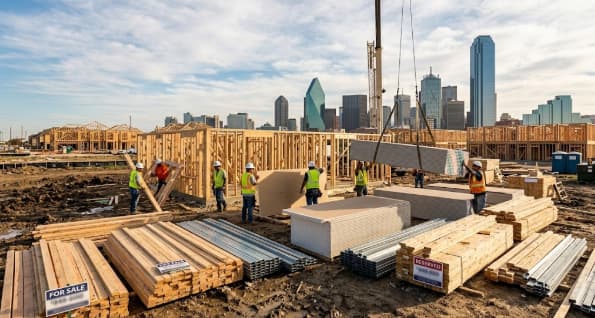
Dallas-Fort Worth has become the busiest construction market in the country, and that boom is now showing up directly on estimators’ bid sheets. Framing crews are booked out for months, drywall hangers are turning down work, and the framing labor cost per square foot in North Texas has climbed faster than almost any other line item on a residential or commercial takeoff. If you’re pricing work in DFW right now, you’re competing against a metro that adds hundreds of new residents a day and a national gypsum supply chain that’s straining to keep pace.
This article breaks down what’s actually driving the run-up in framing and drywall costs across DFW, what the numbers look like today, and how estimators can build more accurate, defensible bids in a market that isn’t slowing down anytime soon.
The Boom Behind the Numbers
North Texas has spent the last decade transforming from an oil-and-cattle economy into one of the most diversified metros in the country. Corporate relocations from Toyota, Charles Schwab, and McKesson brought thousands of high-paying jobs to the region, and that corporate migration triggered a ripple effect across every category of commercial and residential real estate. Industrial and warehouse construction has been especially aggressive, with developers racing to keep up with demand for distribution space in corridors like Alliance, South Dallas, and Grand Prairie.
On the residential side, the numbers are just as dramatic. The Metroplex adds more than 300 new residents every single day, and that population growth is fueling demand for housing, retail, and mixed-use development from Frisco to Mansfield. Anyone tracking dallas fort worth economy news today has seen the same headline repeated for years: DFW keeps topping national lists for job creation, population inflow, and new home starts. Metrostudy has previously ranked DFW the top new-home market in the nation, and nothing in the current dfw economic development news cycle suggests that’s changing.
That kind of sustained growth is good news for builders’ backlogs, but it’s bad news for anyone trying to hold a firm number on framing and drywall. When a region adds this many residents and this much commercial square footage at once, every trade that touches the building envelope gets squeezed at the same time.
Framing Labor: The Cost That’s Moving the Fastest
Framing labor is typically 15% to 20% of total construction cost on a residential build, and it’s also the most regionally volatile line item on any estimate. Nationally, the average residential framing labor rate has climbed to roughly $12.50 per square foot of living area as of early 2026, a 14% year-over-year jump. Texas markets, including DFW and Houston, have historically run below that national average thanks to a large, experienced labor pool and a business-friendly regulatory environment — framing rates in DFW have generally sat in the $8.50 to $12.00 per square foot range, roughly 20% to 30% below coastal markets like California or the Pacific Northwest.
The problem is that DFW’s advantage is shrinking. The same forces pushing national rates higher — an aging workforce, competition from commercial and industrial projects, and rising workers’ comp costs — are hitting North Texas harder than most markets precisely because the region is building so much at once. A framing crew that could once split time between residential subdivisions and light commercial work now has its pick of higher-paying industrial and data center projects, which pulls labor away from home builders and pushes residential framing rates toward the top of the historical Texas range.
A few numbers worth building into your estimating models:
- Framing rate / framing labor cost per square foot in DFW: currently trending toward $10 to $14 per square foot on many residential projects, up from the traditional $8.50 to $10.00 baseline.
- Framing cost per sf on a typical 2,500-square-foot lumber package: roughly $35,000 to $65,000 for materials alone, before labor.
- Complexity premium: an irregular footprint can add 10% to 25% to framing labor, and multiple rooflines add another $8 to $18 per square foot — a critical factor for estimators pricing custom and semi-custom homes in fast-growing suburbs like Frisco, McKinney, and Flower Mound, where larger, more complex floor plans are the norm.
- Commercial wood framing cost per square foot is following a similar trajectory, as light-commercial and multifamily wood-frame projects compete for the same crews as single-family builders.
- Roof framing labor cost per square foot has also risen, partly because pre-engineered trusses — now standard on most DFW builds — still require skilled installation crews that are in short supply.
The average cost to frame house projects in DFW today reflects all of these pressures stacked together: tighter labor supply, rising wages, and more design complexity per square foot than the market saw five years ago. Estimators who are still anchoring bids to 2022 or 2023 framing rates are very likely underbidding this scope.
Drywall and Gypsum: A Global Supply Squeeze Meets a Local Boom
Framing isn’t the only assembly under pressure. The drywall and gypsum supply chain is dealing with its own version of the same problem, and it’s playing out at a global scale before it ever reaches a DFW job site.
Recent market research projects the global drywall market growing from roughly $62 billion in 2026 to nearly $99 billion by 2035, a compound annual growth rate above 5%. That’s not a niche uptick — it reflects sustained new construction, renovation activity, and rising demand for higher-performance wall assemblies worldwide. The plasterboard market and the broader dry construction market are both being reshaped by the same trends: contractors want lighter boards, faster installation, and better fire, moisture, and acoustic performance, and manufacturers are racing to deliver all of that while raw material and freight costs stay elevated.
Labor is the biggest cost lever inside that number. Industry estimates put labor at up to 42% of total drywall installation cost in North America, which means any regional labor shortage — like the one DFW is experiencing across nearly every trade — translates almost directly into higher installed drywall pricing. Manufacturers are responding with lightweight boards (now roughly 27% of North American sales volume, up from 19% in 2019) and prefabricated panel systems that can cut on-site labor by more than 20%, but those products come with their own cost premium and haven’t fully worked their way into the mainstream residential supply chain yet.
For DFW specifically, this national and global pressure lands on top of a market that’s already absorbing enormous construction volume. Drywall crews, like framing crews, are being pulled toward the projects that pay the most and offer the most predictable schedules — often commercial and multifamily work — which tightens availability and raises rates for residential and light-commercial jobs. Add in DFW-specific factors like longer specialty material lead times (commonly 6 to 14 weeks in 2026) and rising energy-code requirements that call for more insulation and air-sealing detail around drywall assemblies, and it’s easy to see why interior finish budgets are creeping up right alongside framing.
What This Means for a DFW Estimate Today
Put the framing and drywall trends together and a clear picture emerges: on a typical 2026 DFW build, materials now account for roughly 40% to 48% of total budget and labor another 38% to 45%, with framing and drywall representing two of the largest single components inside those categories. A few practical implications for estimators:
Stop using flat regional averages. DFW is not one market. Dallas and Fort Worth core-city permitting is more complex and often more expensive than outer suburbs, and framing complexity in fast-growth cities like Frisco or Flower Mound runs meaningfully higher than in more established Arlington or Fort Worth neighborhoods. A framing cost per sq ft that works for one submarket can easily miss by 15% or more in another.
Price complexity separately from square footage. Multiple rooflines, long spans, and irregular footprints are now some of the most expensive variables in a DFW estimate, often adding more to the bottom line than raw square footage does. Estimators should be pricing these as distinct line items rather than folding them into a blended per-square-foot number.
Build in escalation and lead-time contingency. With specialty material lead times running 6 to 14 weeks and skilled labor wages still climbing 6% to 9% year over year, a bid held too long without an escalation clause is a bid that’s already out of date by the time construction starts.
Watch the commercial pipeline, not just residential. Because framing and drywall crews move fluidly between residential, multifamily, and commercial work in a hot market, dallas economy news and dfw economy news about industrial and office development matter just as much to a homebuilder’s labor costs as anything happening in the residential market itself.
How Estimators Can Stay Ahead of the Curve
The good news is that none of this requires guesswork if your data is current. A few habits separate estimators who stay profitable in a rising-cost market from those who get burned by it:
Re-verify framing and drywall unit costs on a rolling basis, not annually. In a market moving this fast, a rate sheet updated in January can already be stale by summer. Pulling current lumber, gypsum, and labor pricing before every major bid — rather than relying on a standing internal database — catches swings before they show up as a loss.
Separate labor and material escalation in your line items. Framing and drywall costs are rising for two different reasons: material and supply-chain pressure on one side, labor scarcity on the other. Blending them into a single per-square-foot number makes it harder to explain a bid revision to a client and harder to spot which side of the cost is actually moving.
Track submarket-level permitting and demand data. Cities like Dallas and Fort Worth carry heavier permitting and inspection loads than outer suburbs, and that affects both project timelines and the price crews charge to hold a schedule. Estimators working across multiple DFW submarkets should keep separate benchmarks for core cities versus fast-growing suburbs rather than applying one metro-wide average.
Loop in a specialist when volume outpaces internal capacity. As DFW’s construction volume keeps climbing, in-house estimating teams are increasingly leaning on outside estimating support to keep bid turnaround fast without sacrificing accuracy on fast-moving line items like framing and drywall. A second set of eyes on current market rates is often the difference between a competitive bid and a costly one.
The Bottom Line
DFW’s growth boom is exactly the kind of good problem that keeps builders busy and keeps skilled crews employed — but it’s also rewriting the cost assumptions that a lot of estimators are still working from. Framing labor, once one of the more predictable and affordable line items in a Texas build, is now one of the fastest-moving. Drywall, propped up by a genuinely global supply and demand shift, is following the same path. The estimators who adjust their models now, rather than reacting after a bid comes in short, are the ones who’ll keep winning work in this market without eating the difference on change orders.
If your takeoffs are still built around pre-boom framing and drywall rates, it’s worth a second look before your next bid goes out the door.