
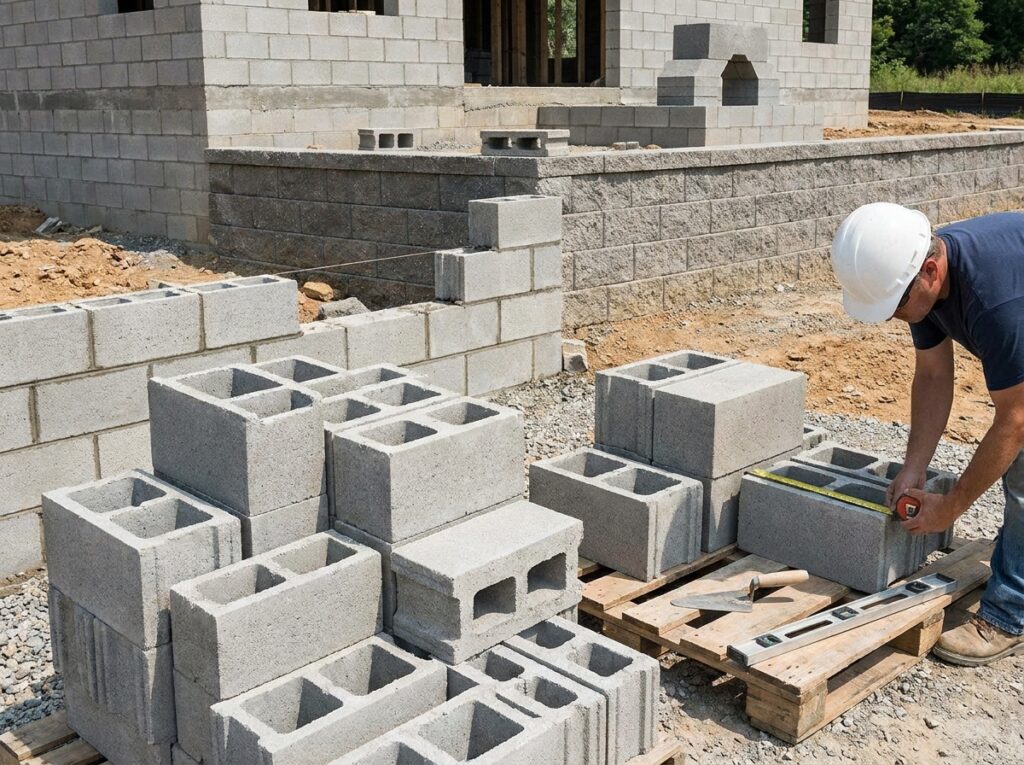
Concrete masonry blocks (CMUs) are among the most widely used building materials in residential, commercial, and industrial construction. Their strength, durability, and versatility make them ideal for everything from foundations and retaining walls to multi-story structures.
Because CMU blocks come in a variety of sizes and shapes, understanding their dimensions is essential when planning a project, estimating material quantities, or selecting the right block for a specific application.
In this guide, we’ll explore standard concrete block dimensions, specialty block types, their benefits, and how to choose the right size for your construction project.
Understanding Standard Concrete Block Sizes
Concrete masonry blocks are manufactured in several standard dimensions to meet different structural requirements.
8″ x 8″ x 16″ Blocks (200 x 200 x 400 mm)
This is the most commonly used concrete block size in construction. It is suitable for:
- Residential walls
- Commercial buildings
- Foundation walls
- Load-bearing structures
- Partition walls
Its balanced size and strength make it a popular choice for both contractors and masons.
8″ x 8″ x 24″ Blocks (200 x 200 x 600 mm)
These longer blocks help reduce the number of joints required during installation, making wall construction faster. They are often used for:
- Basement walls
- Retaining walls
- Landscaping projects
- Low-rise structures
12″ x 8″ x 16″ Blocks (300 x 200 x 400 mm)
These wider blocks provide additional structural support and are commonly used in:
- Reinforced walls
- Stem walls
- Multi-story buildings
- Heavy-load applications
Their increased width improves stability and makes reinforcement easier.
Specialty Concrete Blocks and Their Applications
In addition to standard rectangular blocks, manufacturers offer specialty CMUs designed for specific construction needs.
Corner Blocks
Corner blocks feature an L-shaped design that simplifies the construction of wall intersections and corners.
Common benefits include:
- Reduced cutting on-site
- Better structural connections
- Faster installation
Utility Blocks
Utility blocks contain preformed openings that allow electrical conduits, plumbing lines, and other utilities to pass through walls more easily.
These blocks help save labor time and reduce modifications during construction.
Hollow Blocks
Hollow-core blocks are lighter than solid blocks and use less concrete during manufacturing.
Advantages include:
- Lower material costs
- Easier handling
- Space for reinforcement and grouting
- Improved thermal performance
Split-Face and Ground-Face Blocks
These architectural blocks offer decorative finishes while maintaining structural performance.
They are frequently used for:
- Exterior facades
- Landscape walls
- Commercial buildings
- Architectural accents
Caps and Sills
Precast concrete caps and sills are used to finish wall tops, window openings, and other exposed surfaces, creating a clean and professional appearance.
Why Contractors Prefer Concrete Masonry Blocks
CMU blocks continue to be a preferred building material because they offer several important advantages.
Exceptional Durability
Concrete blocks can withstand harsh weather, moisture, impact, and long-term wear, making them ideal for permanent structures.
Fire Resistance
Concrete masonry provides excellent fire protection, helping improve building safety and meet code requirements.
Structural Strength
CMUs are capable of supporting significant loads, making them suitable for load-bearing walls and multi-story construction.
Faster Construction
Their modular design allows crews to install walls quickly and efficiently, reducing labor costs and project timelines.
Minimal Material Waste
Because blocks are manufactured to precise dimensions, material waste is often lower than with many other construction methods.
Design Flexibility
CMUs are available in various sizes, textures, finishes, and colors, allowing builders to meet both structural and architectural requirements.
How to Choose the Right Block Size
Selecting the correct block dimensions is an important step in ensuring structural performance and cost efficiency.
Consider the following factors:
Wall Height
Shorter walls often perform well with standard 8-inch blocks, while taller walls may require wider or reinforced units.
Structural Loads
The weight that a wall must support will influence block thickness and reinforcement requirements.
Reinforcement Needs
Some projects require hollow blocks that can accommodate steel reinforcement and grout for added strength.
Utility Installation
If plumbing or electrical systems must run through the wall, utility blocks can simplify installation.
Compatibility with Other Materials
Block dimensions should align with brick veneers, precast components, framing systems, and other building materials to ensure a smooth construction process.
For complex structures, consulting a structural engineer can help determine the most appropriate block size and reinforcement strategy.
Alternative and Metric Block Dimensions
In addition to standard imperial sizes, many projects use metric concrete blocks.
Common metric dimensions include:
- 190 x 90 x 190 mm
- 190 x 190 x 390 mm
- 200 x 200 x 600 mm
- 200 x 200 x 1000 mm
These sizes are commonly used in regions that follow metric construction standards.
Manufacturers may also produce custom blocks for specialized projects such as:
- Sound barrier walls
- Curved walls
- Circular foundations
- Architectural features
- Highway infrastructure
Custom dimensions allow contractors to meet unique design and engineering requirements while maintaining construction efficiency.
Final Thoughts
Concrete masonry blocks remain one of the most reliable and cost-effective materials in modern construction. Their variety of sizes, shapes, and finishes allows builders to tackle everything from simple foundation work to large commercial structures.
Understanding CMU dimensions is essential for accurate material takeoffs, project planning, and cost estimation. Choosing the right block size not only improves construction efficiency but also contributes to the long-term performance of the structure.
At Digital Estimating, we help contractors, builders, and developers make informed decisions through accurate quantity takeoffs and professional construction estimating services. Whether you’re planning a residential build or a large commercial project, understanding concrete masonry block sizes is an important step toward project success.