
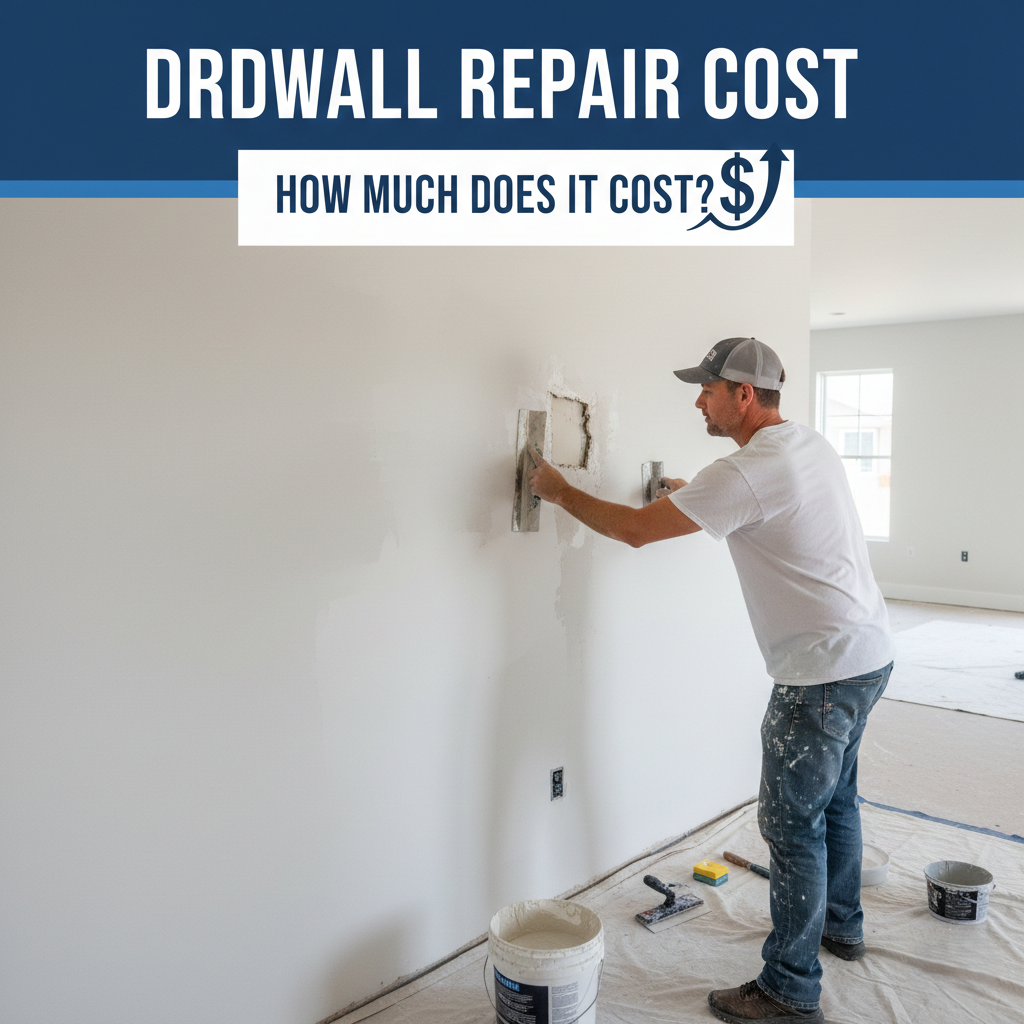
Quick Answer: Drywall Repair Costs
Measure | Cost |
National average repair | $609 |
Most jobs fall between | $295 and $925 |
Contractor minimum job fee | $350 to $650+ |
Small hole, standalone call | $300 to $500 |
Large hole | $500 to $800+ |
Crack repair | $350 to $1,000+ |
Ceiling repair | $350 to $1,500+ |
Water damage | $500 to $2,500+ |
Labor per hour | $60 to $150 |
Drywall damage is something nearly every homeowner deals with. A doorknob through a wall, cracks from settling, a ceiling stain from a plumbing leak. All common, all needing proper repair.
But drywall repair pricing confuses people more than almost any other home service, because a $30 patch kit and a $500 invoice can describe the exact same hole. The reason has nothing to do with the hole.
The Minimum Job Fee Explains Almost Everything
Most drywall contractors charge a minimum job fee of $350 to $650, and many handymen carry minimums of $150 to $300.
This is the single most important number in drywall repair pricing, and it is why a one-square-foot repair and a six-square-foot repair often cost nearly the same.
Here is what a contractor actually spends on a “small” repair:
- Travel to and from your home, twice
- Setup, dust containment, and protection of floors and furniture
- Cutting, backing, patching, and first compound coat
- Return visit after 12+ hours of drying for the second coat
- Sanding, texture matching, cleanup
The hole is 20 minutes of that. Everything around it is the cost.
What This Means for Your Budget
Scenario | What you pay |
Standalone service call for one small hole | The minimum, $350 to $650 |
Same hole bundled with other repairs | $75 to $150 for that item |
Same hole, DIY | $20 to $40 in materials |
The practical takeaway: never call a contractor out for one small hole. Walk the house, list every nail pop, dent, crack, and scuff, and have them addressed in a single visit. You are paying the minimum either way, so fill it.
Average Drywall Repair Cost
The national average for professional drywall repair is $609, with most jobs landing between $295 and $925, based on HomeAdvisor project data.
That average covers a wide spread. A bundled nail-pop touch-up sits far below it. A water-damaged ceiling section sits well above.
Repair type | Standalone service call | Bundled with other repairs |
Nail holes, small dents (under 1″) | Minimum applies | $20 to $75 each |
Small hole (under 4″) | $300 to $500 | $75 to $150 |
Medium hole (4″ to 12″) | $400 to $650 | $150 to $400 |
Large hole (12″+, needs backing) | $500 to $800+ | $300 to $650 |
Hairline crack | $350 to $550 | $75 to $200 |
Seam crack requiring re-tape | $350 to $1,000+ | $150 to $500 |
Corner bead damage | $350 to $700 | $150 to $450 |
Small ceiling patch | $350 to $650 | $200 to $450 |
Ceiling section replacement | $650 to $1,500+ | $500 to $1,200 |
Water damage, contained | $500 to $1,200 | — |
Water damage, extensive | $1,200 to $2,500+ | — |
Full sheet replacement | $250 to $500 per sheet | — |
Drywall Repair Cost Per Square Foot
Square-foot pricing on drywall repair runs backwards from what most people expect. The smaller the repair, the higher the effective rate, because fixed costs get spread over less area.
Repair size | Effective cost per sq ft |
Under 10 sq ft | $75 to $100 |
10 to 25 sq ft | $60 to $85 |
25 to 100 sq ft | $50 to $75 |
Over 100 sq ft (multi-room, full sheets) | $3 to $8 |
A 2-square-foot doorknob hole works out to roughly $175 per square foot at a $350 minimum. A 400-square-foot basement re-drywall runs $3 to $8 per square foot, because at that scale the job stops being a repair and starts being an installation.
Anyone quoting a flat per-square-foot rate for a small repair is either misunderstanding the trade or about to surprise you with a minimum charge. Ask for a flat job price on anything under 25 square feet.
Drywall Hole Repair Cost
Holes are the most common service call, and cost scales with what sits behind the drywall as much as with hole size.
Under 4 inches. Doorknobs, picture hangers, furniture bumps. Self-adhesive mesh patch, two to three compound coats, sand, texture. $300 to $500 as a standalone call.
4 to 12 inches. Too large for a mesh patch. Requires cutting a clean square, installing backing board or furring strips, fitting a new drywall piece, taping all four edges, and three coats. $400 to $650.
Over 12 inches. May span or expose studs. Often requires framing work, and increasingly likely to involve electrical or plumbing behind the wall. $500 to $800+.
Two techniques worth knowing by name, because seeing them on a quote tells you the contractor knows the trade:
- California patch (also called a butterfly patch): a drywall plug with the paper backing left intact as a built-in taping flange. Fast, strong, and no backing board required on mid-size holes.
- Backing board method: furring strips screwed behind the opening to support a new drywall plug. Standard for larger repairs.
Drywall Crack Repair Cost
Crack repair runs $350 to $1,000+, and most contractors charge less per crack when several are done together.
Crack type | Cost |
Hairline, cosmetic | $350 to $550 |
Seam or joint crack requiring re-tape | $350 to $1,000+ |
Ceiling crack | $400 to $1,200+ |
Multiple cracks, same visit | $75 to $250 each after the first |
Fix the Cause Before the Crack
This is the most important advice on this page. Some drywall cracks are a symptom, not the problem.
Common causes:
- House settling. Normal in the first two to three years of new construction. Usually cosmetic.
- Thermal and humidity movement. Seasonal expansion and contraction. Usually recurring but minor.
- Improper installation. Insufficient fasteners, poor seam placement, or joints landing in the wrong location.
- Truss uplift. Cracks appearing at the ceiling-to-wall junction that open in winter and close in summer. A framing behavior, not a drywall failure, and it needs a different fix.
- Foundation movement. Stair-step cracks, cracks above door frames, doors that stop latching, or the same crack reopening after every repair.
If a crack reopens in the same place after repair, stop repairing it. Recurring cracks in one location point to a structural cause. Foundation repair runs anywhere from $250 for a hairline crack to $12,000 or more for serious issues, and patching drywall over an unresolved foundation problem is money spent twice.
Homes in expansive clay soil regions, including much of Texas, Oklahoma, and the Front Range, see this pattern seasonally.
Ceiling Drywall Repair Cost
Ceiling repairs run $350 to $1,500 or more, consistently higher than the equivalent wall repair.
Ceiling repair | Cost |
Small patch or crack | $350 to $650 |
Medium section | $650 to $1,000 |
Large section replacement | $1,000 to $1,500+ |
Water-damaged ceiling | $700 to $2,500+ |
Popcorn texture matching | Add $150 to $400 |
Ceilings cost more for four reasons: overhead work is slower and more fatiguing, it usually requires two people or staging, gravity works against the compound, and ceiling seams sit under raking light where every imperfection shows.
Popcorn ceilings in homes built before 1980 may contain asbestos. Do not sand, scrape, or disturb them without testing. Asbestos testing runs $250 to $850, and abatement runs $5 to $20 per square foot. This applies to old joint compound as well, which was commonly asbestos-containing before the late 1970s.
Drywall Water Damage Repair Cost
Water damage is the most expensive category because saturated drywall cannot be patched. It has to come out.
Scenario | Cost |
Contained, single-area damage | $500 to $1,200 |
Moderate, multiple sections | $1,200 to $2,000 |
Extensive, multi-room | $2,000 to $3,000+ |
With mold remediation | Add $500 to $15,000 |
The full process: locate and stop the source, cut out saturated material well past the visible staining, dry the framing and cavity with fans and dehumidifiers, apply antimicrobial treatment, replace insulation, install new drywall, tape, three compound coats, texture match, prime, and paint.
Always fix the source first. Plumbers charge $45 to $150+ per hour. Repairing drywall over an active leak guarantees you pay for the same repair twice.
Insurance Coverage
Most homeowners policies cover sudden and accidental water damage, such as a burst pipe or an appliance failure. Most exclude gradual damage from a slow leak, poor maintenance, or long-term seepage. Mold coverage is frequently capped or excluded entirely.
Two practical notes. Document everything with photographs before any work begins. And check your deductible against the repair estimate first, since a $500 to $1,200 repair against a $1,000 deductible is not worth a claim.
Labor Costs and Who to Hire
Labor represents 50 to 75 percent of a drywall repair total. Materials on a small patch cost under $30.
Professional | Hourly rate | Best for |
Handyman | $50 to $80 | Small holes, minor cracks, simple patches |
Drywall contractor | $60 to $100+ | Larger repairs, ceilings, texture matching |
Painter | Varies | Minor patching bundled into a paint job |
Restoration contractor | $100 to $150 | Water damage, mold, insurance work |
Foundation specialist | Varies | Recurring structural cracks |
Choose by finish difficulty, not by hole size. A handyman handles a closet patch fine. A living room wall with knockdown texture under a large window needs someone who matches texture for a living, because that repair will be visible in raking light forever.
Look for contractors who are members of the Association of the Wall and Ceiling Industry (AWCI). Bureau of Labor Statistics Occupational Employment and Wage Statistics data for SOC 47-2081, Drywall and Ceiling Tile Installers, is the underlying benchmark for regional labor rates.
Finishing, Texture, and Paint Costs
The patch is half the job. Blending it into the surrounding surface is the other half, and it is where most quotes differ.
Finishing item | Cost |
Tape, mud, and finish | $1.50 to $3.50 per sq ft |
Texture application | $0.80 to $2.00 per sq ft |
Paint matching surcharge | $125+ |
Priming and painting the repair | $150 to $500 |
Interior painting, full wall or room | $2 to $8 per sq ft |
Texture Matching by Type
Texture | Difficulty | Notes |
Orange peel | Easiest | Aerosol texture cans work well for small areas |
Knockdown | Moderate | Requires timing and technique to match |
Smooth (Level 5) | Hard | Any imperfection shows under raking light |
Skip trowel / hand troweled | Hardest | Skilled hand application, hard to match |
Popcorn | Hard | Plus asbestos risk in pre-1980 homes |
Finish levels follow GA-214, the Gypsum Association standard. Most residential walls are Level 4. Level 5, meaning a full skim coat, is used where critical lighting or gloss paint would reveal seams, and it is significantly harder to patch invisibly.
Paint almost never matches perfectly on a patch. Even with the original can, aging, UV exposure, and sheen differences show. Expect to repaint corner to corner on the affected wall for an invisible result, which is why contractors add $125 or more for paint matching and why full-wall repainting is often the cheaper path to a good outcome.
Additional Costs Discovered Mid-Repair
Opening a wall reveals things. These are the most common:
Discovered issue | Cost |
Foundation repair | $250 to $12,000+ |
Mold removal | $500 to $15,000 |
Insulation replacement | $1.00 to $4.50 per sq ft |
Electrical work | $50 to $130+ per hour, $100 to $200 minimum |
Plumbing repair | $45 to $150+ per hour |
Popcorn ceiling removal | $1 to $6 per sq ft |
Asbestos testing | $250 to $850 |
Asbestos abatement | $5 to $20 per sq ft |
Pest or termite damage | $250 to $3,000+ |
Ask any contractor up front: what happens if you find additional damage once the wall is open? A good answer includes stopping work, documenting, and pricing the change before proceeding. A vague answer is a red flag.
How Long Does Drywall Repair Take?
Repair | Active work time | Total elapsed |
Small hole | 1 to 2 hours | 1 to 2 days |
Medium hole | 2 to 3 hours | 2 days |
Large hole | 2 to 5 hours | 2 to 3 days |
Ceiling section | 4 to 8 hours | 2 to 4 days |
Water damage | 1 to 3 days | 3 to 7 days |
Elapsed time always exceeds work time, because joint compound needs 12 or more hours to dry between coats and a proper repair takes three coats. This is why contractors return across multiple days for what looks like an hour of work, and why the minimum job fee exists.
Setting-type compound, sometimes called hot mud, cures chemically rather than by evaporation and can compress a three-day repair into one. It costs more and is harder to sand, but it is worth asking about on a schedule-critical job.
Repair or Replace?
Repair makes sense | Replace makes sense |
Isolated holes and dents | Damage exceeding roughly 60% of the wall |
Cosmetic cracks with a known cause | Widespread cracking across the surface |
Contained water damage | Extensive or repeated water damage |
Single-area impact damage | Sagging or delaminating panels |
Texture matching is achievable | Multiple patches already visible |
Once a wall carries several visible patches, replacing the full sheet often costs less than the accumulated repairs and always looks better. A full sheet replacement runs $250 to $500 installed and finished.
If recurring cracks trace back to foundation movement, address the foundation before any drywall work. Otherwise you are on a maintenance treadmill.
DIY vs Hiring a Professional
Factor | DIY | Professional |
Small hole | $20 to $40 | $300 to $500 standalone |
Medium hole | $30 to $70 | $400 to $650 |
Tools and supplies | $50 to $150 | Included |
Time | 2 to 3 sessions across 2 days | 1 to 2 days |
Texture matching | Difficult | Included |
Finish quality | Variable | Consistent |
DIY Material Costs
Item | Cost |
Self-adhesive mesh patch kit | $10 to $25 |
Joint compound (1 gallon) | $10 to $25 |
Mesh or paper tape | $5 to $10 |
Putty knife set | $10 to $25 |
Sanding sponge or block | $5 to $10 |
Drywall sheet | $10 to $20 |
Aerosol texture can | $10 to $20 |
Primer (quart) | $10 to $20 |
DIY works for nail holes, dents under an inch, small holes in low-visibility areas like closets and garages, and smooth or orange-peel walls you are repainting anyway.
Hire a professional for ceiling work, any water damage, holes over six inches, knockdown or hand-troweled texture, damage of unknown cause, homes built before 1980 with popcorn ceilings, and anywhere in a main living space where the repair will sit under natural light.
The most common DIY failure is not the patch. It is the texture and the paint, where an otherwise sound repair announces itself from across the room.
Regional Cost Differences
Region | Typical repair cost |
South Central (TX, OK, AR, LA) | $250 to $700 |
Southeast (GA, AL, SC, TN) | $275 to $750 |
Midwest (OH, IN, IA, KS, MO) | $300 to $800 |
Mountain West (CO, UT, AZ, NV) | $350 to $900 |
Mid-Atlantic (VA, MD, PA, NJ) | $400 to $950 |
Northeast (NY, MA, CT, NH) | $450 to $1,100 |
West Coast (CA, WA, OR) | $475 to $1,200 |
Urban markets carry higher labor rates but more competing contractors, which keeps pricing competitive. Rural markets often price higher than wages alone would suggest, because of travel surcharges and fewer competing crews.
How to Reduce Drywall Repair Costs
- Bundle everything into one visit. The highest-leverage move on this entire page. Walk the whole house and list every defect before calling.
- Handle the cosmetic items yourself. Nail holes and small dents in closets and low-visibility areas are genuinely DIY-friendly.
- Combine with a paint job. Painters often handle minor patching as part of the work, and you avoid a separate mobilization.
- Fix the cause first. Plumbing leaks, foundation movement, and roof issues will undo the repair.
- Accept full-wall repaint on visible repairs. It usually beats paying for repeated attempts at an invisible paint match.
- Get three quotes on anything over $1,000, and avoid the lowest bid on visible-area work where finish quality is the entire deliverable.
- Ask about setting-type compound if the schedule matters.
Commercial and Multi-Family Drywall Repair
Everything above covers single-family residential. Commercial and multi-family repair operates on different terms entirely.
Multi-family turn work is volume business: unit turnover repairs on a fixed schedule, punch list completion across dozens or hundreds of units, and per-unit pricing where a small error compounds across the whole property. Property managers price these as a program rather than a service call, which removes the minimum job fee dynamic entirely.
Commercial repair adds requirements that never appear in residential work: fire-rated assembly restoration where a penetration compromises a UL-listed design, IBC Chapter 7 compliance on rated partitions, occupied-space work requiring dust containment and negative air, after-hours scheduling in retail and medical settings, and documentation for insurance restoration claims.
Insurance restoration in particular is its own discipline, requiring scope documentation, adjuster coordination, and pricing that stands up to review.
When to Use Professional Construction Estimating Services
Drywall and interior finish contractors face a structural squeeze. Revenue depends on bid volume, but estimating capacity is capped by the hours available to whoever prices the work, usually the owner, usually after hours.
Construction estimating services remove that ceiling. Rather than declining bid invitations or rushing a takeoff at midnight, contractors send drawings to a dedicated estimating team and receive a priced, itemized deliverable on a fixed turnaround.
What Construction Takeoff Services Deliver
Construction takeoff services produce the measured quantities every bid rests on. For a drywall and interior finish scope, a complete takeoff includes:
- Gypsum board quantities by thickness, type, and finish level, separated by location
- Fire-rated assembly quantities mapped to UL design numbers
- Metal or wood framing linear footage, gauge, and spacing
- Taping, compound, and corner bead quantities with documented waste factors
- Texture application areas by pattern type
- Insulation quantities by assembly and R-value
- Repair and patch scopes quantified by area and finish level on renovation work
- Access and staging requirements flagged by ceiling height
- Dust containment and protection quantities on occupied-space work
Construction estimation takeoff services extend that by attaching current regional labor and material pricing to those quantities, producing a bid-ready cost model rather than a raw quantity sheet.
Why Contractors Outsource Estimating Services
Cost. A full-time in-house estimator carries a loaded cost well into six figures once salary, benefits, takeoff software licensing, and overhead are counted. When contractors outsource estimating services, that fixed cost becomes a variable per-project cost that scales with bid volume rather than sitting idle in slow quarters.
Speed. Bid windows keep shrinking. A dedicated team working parallel scopes returns a complete takeoff in days, letting a contractor respond to more invitations without adding headcount.
Accuracy. Estimators who do nothing but takeoffs catch what a working contractor pricing a job at 11pm will miss: the Type X requirement buried in the specification, the ceiling height change that turns a ladder job into staging, the finish level upgrade on one elevation. On repair and renovation scopes especially, where conditions vary unit to unit, quantity discipline is what separates a profitable program from a change-order argument.
Commercial Construction Estimating Services
Commercial construction estimating services address scopes where the specification carries the risk. Drywall and interior finish scopes we routinely estimate include:
- Multi-family turn and renovation programs
- Apartment and condominium new construction
- Medical and dental facilities with impact-resistant and lead-lined assemblies
- Retail and restaurant tenant improvements
- Educational and institutional buildings
- Hospitality renovations
- Insurance restoration and reconstruction
Each is priced from a drawing set read alongside the specification, not measured wall by wall in isolation.
How Digital Estimating Handles Drywall Takeoffs
Digital Estimating provides construction estimating and takeoff services nationwide from our Houston headquarters, supporting contractors, developers, architects, and suppliers.
Our drywall and interior finish estimating process:
- Drawing and specification review. Architectural and structural sheets read against the finish schedule and fire-rated assembly requirements, with conflicts flagged before they become change orders.
- Digital takeoff. On-screen measurement with color-coded, auditable markups you can verify against the drawings line by line.
- Regional pricing. Labor and material rates applied by market, not by national average.
- Itemized deliverable. Excel and PDF output formatted to your bid structure, with assumptions, inclusions, and exclusions stated explicitly.
- Bid support. Clarification and revision through the bid window.
We provide dedicated drywall estimating services and coordinate drywall takeoffs alongside related trades including interior finishes, painting, insulation, and framing.
For new installation rather than repair, see our guide to the cost to install drywall in Texas.
How to Get an Accurate Drywall Repair Quote
A comparable quote states all of the following:
- Flat job price for repairs under 25 square feet, not a per-square-foot rate
- Minimum job fee, stated explicitly
- Number of compound coats and expected number of visits
- Texture type being matched and the method used
- Whether priming and painting are included, and to what extent
- Paint matching surcharge, if any
- What happens if additional damage is found once the wall is open
- Dust containment and protection scope
- Cleanup and debris disposal
- Warranty on the repair, particularly against cracking recurrence
Questions to Ask
- Are you licensed and insured for this work?
- What is your minimum job fee?
- How many visits will this take, and across how many days?
- What texture is on my wall, and how will you match it?
- Is priming and painting included, or separate?
- Will the repair be invisible, or should I expect to repaint the wall?
- What if you find water damage, mold, or wiring behind the wall?
- Do you guarantee the repair against cracking, and for how long?
- Can I bundle other small repairs into this visit?
Frequently Asked Questions
How much does drywall repair cost in 2026?
The national average is $609, with most jobs between $295 and $925. A small hole runs $300 to $500 as a standalone service call, a crack $350 to $1,000, and a ceiling repair $350 to $1,500 or more.
Why does a small hole cost so much to repair?
Because of the minimum job fee, typically $350 to $650. Travel, setup, dust containment, three compound coats with 12+ hour dry times between them, and a return visit cost nearly the same whether the hole is one square foot or six. The hole itself is about 20 minutes of the work.
How can I reduce the cost of a small repair?
Bundle it. Walk the whole house, list every nail pop, dent, crack, and scuff, and have them all addressed in one visit. You are paying the minimum regardless, so fill it. Bundled small repairs run $75 to $150 each instead of $350 to $650.
What is the drywall repair cost per square foot?
It runs inversely to size. Under 10 square feet, the effective rate is $75 to $100 per square foot. At 10 to 25 square feet it drops to $60 to $85, and at 25 to 100 square feet to $50 to $75. Only above roughly 100 square feet does it reach the $3 to $8 range people expect.
How much does it cost to repair a hole in drywall?
$300 to $500 for holes under 4 inches, $400 to $650 for 4 to 12 inches, and $500 to $800+ for larger holes needing backing board or framing work.
How much does ceiling drywall repair cost?
$350 to $1,500 or more. Ceilings cost more than walls because overhead work is slower, often needs two people or staging, and ceiling seams sit under raking light where imperfections show.
How much does drywall water damage repair cost?
$500 to $1,200 for contained damage, up to $3,000 or more for extensive multi-room damage. Mold remediation adds $500 to $15,000. Always fix the water source before repairing the drywall.
Does homeowners insurance cover drywall repair?
Sudden and accidental damage such as a burst pipe is typically covered. Gradual damage from a slow leak or deferred maintenance typically is not, and mold coverage is often capped or excluded. Photograph everything before work begins, and check your deductible against the estimate before filing.
Why does my drywall keep cracking in the same place?
Recurring cracks in one location point to a structural cause, usually foundation movement or truss uplift, not a drywall failure. Repairing the surface repeatedly without addressing the cause wastes money. Foundation repair ranges from $250 for a hairline crack to $12,000 or more.
What is truss uplift?
Ceiling-to-wall cracks that open in winter and close in summer, caused by roof trusses flexing with seasonal humidity changes. It is a framing behavior rather than a drywall defect and requires a different repair approach, usually crown molding or a floating corner detail rather than compound.
When should I replace drywall instead of repairing it?
When damage exceeds roughly 60% of the wall area, when cracking is widespread, when panels sag or delaminate, when water damage is extensive or repeated, or when a wall already carries several visible patches. Full sheet replacement runs $250 to $500 installed and finished.
Can I repair drywall myself?
Yes for nail holes, dents under an inch, and small holes in low-visibility areas on smooth or orange-peel walls. Materials run $20 to $40. Hire a pro for ceilings, water damage, holes over six inches, knockdown or hand-troweled texture, and any main living space. The usual DIY failure is not the patch, it is the texture and paint blend.
How long does drywall repair take?
One to two hours of active work for a small hole, but one to two days elapsed because compound needs 12+ hours to dry between three coats. Large holes take two to five hours of work across two to three days. Water damage takes three to seven days.
Does drywall repair include painting?
Usually not. Confirm explicitly. Priming and painting the repair adds $150 to $500, and contractors often charge $125 or more for paint matching. Expect that an invisible result usually requires repainting the full wall corner to corner.
Is my popcorn ceiling dangerous to repair?
If your home was built before 1980, the popcorn texture and the joint compound may contain asbestos. Do not sand, scrape, or disturb it without testing. Testing runs $250 to $850, and abatement runs $5 to $20 per square foot.
Should I hire a handyman or a drywall contractor?
Handymen at $50 to $80 per hour handle small holes, minor cracks, and simple patches. Drywall contractors at $60 to $100+ handle larger repairs, ceilings, and texture matching. Choose by finish difficulty rather than hole size. A knockdown-textured living room wall under a window needs a specialist regardless of how small the hole is.
How much of drywall repair cost is labor?
50 to 75 percent. Materials on a small patch cost under $30. Nearly everything you pay for is time, travel, and the dry-time cycle.
What do construction takeoff services cost?
Pricing depends on scope, drawing complexity, and turnaround. Most drywall takeoffs are priced per project rather than hourly. Contact us for a quote on your drawing set.
Methodology and Sources
Figures in this guide are triangulated from:
- HomeAdvisor and Angi aggregated project cost data for national averages and ranges
- Bureau of Labor Statistics Occupational Employment and Wage Statistics, SOC 47-2081 (Drywall and Ceiling Tile Installers)
- GA-214, the Gypsum Association standard for levels of gypsum board finish
- Digital Estimating’s own 2026 drywall takeoff and bid sampling across residential, commercial, and multi-family projects
All figures are budget-planning estimates. Individual quotes vary by damage extent, texture, accessibility, and local market. Always obtain written itemized quotes, and identify the cause of damage before scheduling repair.
Final Thoughts
Drywall repair costs come down to three things: the minimum job fee, the finish difficulty, and whether the damage has an underlying cause. Most homeowners pay $300 to $600 for a standard interior repair, against a national average of $609.
The most expensive mistake is not overpaying for a patch. It is calling a contractor out for one small hole when you could have bundled six, or repairing the same crack four times without ever asking why it keeps coming back.
If you are a contractor bidding drywall or interior finish work and need the quantities verified before you commit a number, that is what we do.