
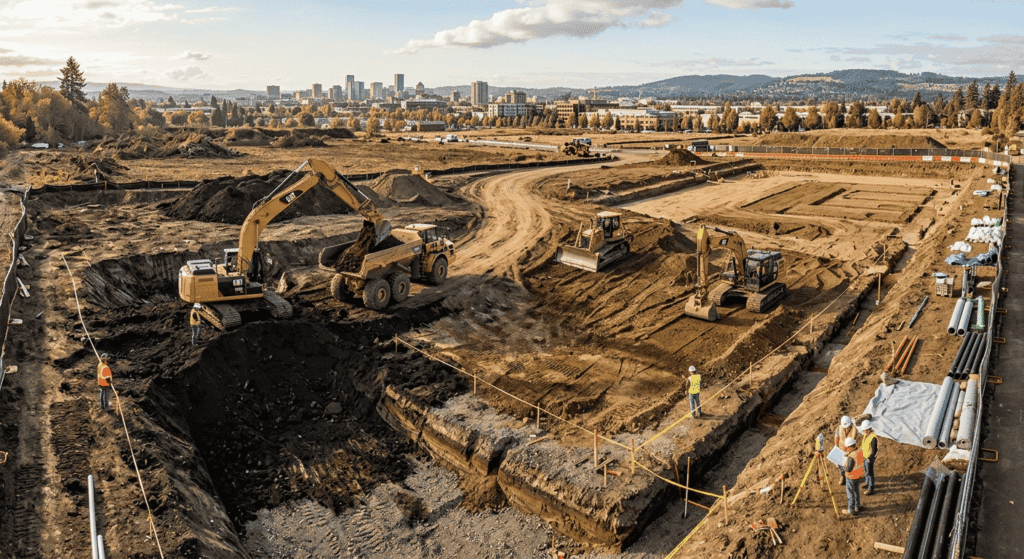
Every building, from a backyard shed to a high-rise, starts the same way — with a hole in the ground. Excavation in construction is the process of removing earth, rock, and other material to prepare a site for foundations, utilities, and everything that gets built on top of them. It’s easy to overlook because it happens before anything visibly “building-shaped” appears, but getting it wrong is one of the fastest ways to derail a project’s budget, timeline, and safety record.
This guide walks through exactly how to excavate a construction site the right way — from planning and permits through equipment selection, digging, and utility trenching — so you know what a proper excavation site process actually involves before the first bucket of dirt moves.
What Is Excavation in Construction?
Excavation in building construction refers to the controlled removal of soil, rock, and other material to create the space a structure needs — whether that’s a shallow trench for a footing, a full basement dig, or a graded pad for a slab-on-grade foundation. It’s distinct from excavation for mining, which removes material because the material itself (ore, coal, aggregate) is the goal. Construction excavation is about shaping the ground to receive a structure, not extracting the material for its own value — though the equipment involved (excavators, loaders, haul trucks) often overlaps between the two industries.
Done correctly, excavation sets the stage for a stable foundation, properly routed utilities, and a site graded to shed water away from the building. Done poorly, it leads to foundation settlement, utility strikes, and safety incidents that can shut a project down entirely.
Step 1: Site Planning and Excavation Preparation
Nothing gets dug until the planning is done. Site excavation planning is what keeps the physical digging phase fast, safe, and free of expensive surprises.
Permits and clearances. Most jurisdictions require a permit before any significant excavation begins, and zoning restrictions may limit depth, boundary setbacks, or timing. Check with local authorities early — permit delays are one of the most common causes of a stalled project start date.
Site survey. A professional survey establishes exact property lines, identifies obstacles like trees, rock outcroppings, or existing structures, and helps determine the excavation route, depth, and slope the foundation design requires.
Utility locating. Before any equipment touches the ground, underground water, gas, electrical, and sewer lines need to be identified and marked — typically through a local utility locating service or a call-before-you-dig hotline. Striking a buried line isn’t just costly; it can be genuinely dangerous.
Soil assessment. Soil type drives nearly every other decision on the job. Soft, workable soil digs quickly with standard equipment; rocky or dense clay soil may require specialized attachments, additional time, and a different equipment plan entirely. A geotechnical assessment is worth the upfront cost on any project where foundation depth or soil stability is uncertain.
Step 2: Choosing the Right Excavation Equipment
Equipment selection depends on project scale, soil conditions, and how much precision the job demands.
Excavators are the workhorses of most construction excavation — versatile machines that dig, lift, and move earth, with interchangeable attachments (buckets, hydraulic hammers, grapples) that adapt them to different soil conditions and depths. They’re the go-to choice for high-volume digging and deeper excavation work.
Backhoes are smaller and more maneuverable, well-suited to trenching, utility work, and smaller foundation digs where a full-size excavator would be overkill or couldn’t access the space.
Bulldozers move large volumes of earth quickly and are typically used for grading and leveling — both before excavation starts (to prep the working surface) and after (to clear debris and finish-grade the site).
Skid-steer loaders handle smaller trenching jobs, debris clearing, and material relocation, particularly in tight or narrow areas where larger equipment can’t maneuver.
Trenchers are purpose-built for digging long, narrow trenches — most commonly for utility installation — using a continuous digging chain to reach a consistent depth efficiently.
Some projects call for a mix of these — a bulldozer to clear and rough-grade, an excavator for the main dig, and a trencher for utility runs — rather than a single machine handling the whole job.
Step 3: Executing the Site Excavation
With planning complete and equipment on site, the actual excavation follows a fairly consistent sequence, regardless of project size.
Clear the site. Remove debris, vegetation, and any obstructions using a bulldozer or skid-steer loader. A clean working surface prevents equipment damage and keeps the dig on schedule.
Mark the excavation boundaries. Using the survey data and site plans, stake out or spray-paint the exact areas to be excavated. Accurate marking prevents digging in the wrong location and protects nearby structures or utilities from accidental damage.
Begin digging. For large areas, start with bulk soil removal using an excavator or backhoe, then switch to more precise work — grading foundation trenches to exact depth and slope — as the dig progresses. Smaller machines like backhoes and skid-steers generally work best in incremental passes rather than large single cuts.
Foundation excavation depth is dictated by the structural design — it depends on soil type, building size, and the foundation type being installed (a shallow slab needs far less depth than a full basement or deep footing system).
Monitor soil conditions throughout. Soft or loose soil raises real risk of wall collapse as the excavation deepens. Hard or rocky soil may require switching to heavier equipment, like a hydraulic hammer attachment, to break through efficiently. Either way, conditions should be checked continuously, not just assumed from the initial soil assessment.
Check excavation stability. As depth increases — particularly past roughly 2m excavation depth, a common threshold where cave-in risk rises sharply — the sides of the cut need regular inspection for slumping or instability. Shoring with timber, trench boxes, or other bracing is standard practice for deeper excavations, and is often a legal requirement under workplace safety regulations once a trench passes a certain depth.
Excavate for utilities. Trenches for water, gas, sewer, and electrical lines need to be dug to the specific depth and width required by local code and utility standards. This work typically happens after the main structural excavation, once the foundation footprint is established.
Excavation Safety Essentials
Excavation is consistently one of the higher-risk phases of any construction project, and most incidents trace back to a small set of preventable causes:
- Cave-ins are the leading cause of excavation fatalities — proper sloping, benching, or shoring is non-negotiable on any trench deep enough to pose a collapse risk.
- Struck-by hazards from swinging equipment or falling material require clear exclusion zones and consistent spotter use.
- Utility strikes from unmarked or improperly located lines can cause anything from a service outage to a serious injury — which is exactly why utility locating happens before digging begins, not during it.
- Water accumulation in an open excavation weakens soil stability and needs to be pumped out and monitored, particularly after rain.
A qualified excavation contractor builds these checks into the daily workflow rather than treating safety as a separate afterthought.
What Excavating Contractors Actually Do
Beyond running equipment, excavating contractors typically manage the full scope of ground-level site prep: pulling permits, coordinating utility locates, assessing soil conditions, planning cut-and-fill grading, executing the dig itself, shoring unstable trenches, backfilling and compacting after foundation and utility work is complete, and finish-grading the site for drainage. On larger commercial or mechanical excavation projects, this also includes coordinating with structural engineers and other trades so the excavation schedule lines up with foundation pours, utility installation, and inspection windows — since a poorly sequenced dig can hold up every trade that follows it.
Estimating and Planning Your Excavation
Excavation cost and timeline depend heavily on soil type, excavation depth and volume, site accessibility, and whether utility trenching is bundled into the same scope. Rocky or unstable soil, deep foundations, and tight urban lots with limited equipment access all push both cost and time upward compared to a straightforward, accessible, soft-soil site.
Because so much of that cost is driven by site-specific conditions rather than a flat rate, an accurate excavation estimate — built around your actual soil report, site survey, and foundation design — is far more useful for budgeting than a general per-square-foot number.
Frequently Asked Questions
What is excavation in construction?
It’s the process of removing soil, rock, and other material from a site to prepare it for foundations, basements, utilities, or grading — the essential first physical step of nearly every building project.
How deep does a construction excavation typically go?
It depends entirely on the foundation type and soil conditions. A slab-on-grade foundation may need only shallow excavation, while a full basement or deep footing system can require digging well past 2m, at which point shoring and stability monitoring become standard practice.
What do excavating contractors do besides dig?
A full-scope excavation contractor handles permitting, utility locating, soil assessment, equipment selection, the excavation itself, trench shoring, backfilling, compaction, and final site grading — essentially everything between “raw land” and “ready for foundation work.”
How is construction excavation different from mining excavation?
Construction excavation removes material to create space for a structure; the excavated material itself typically isn’t the goal. Mining excavation removes material because the material — ore, aggregate, coal — is the valuable product being extracted. The equipment used often overlaps, but the objective and scale are different.
What equipment is used for excavation in construction?
Excavators for bulk digging and deep work, backhoes for smaller and more precise jobs, bulldozers for grading and clearing, skid-steer loaders for tight spaces, and trenchers for utility line installation — with most mid-size projects using a combination rather than a single machine.
Final Thoughts
Excavation might happen before anything visibly resembling a building appears, but it sets the foundation — literally — for everything that follows. Getting the planning right (permits, surveys, utility locates, soil assessment), choosing the correct equipment for the site’s conditions, and executing the dig with proper safety and stability monitoring is what keeps a project on schedule and prevents costly rework once foundation work begins.
If you’re planning a new build and want an excavation estimate grounded in your actual site conditions rather than a generic average, Digital Estimating can put together a detailed cost and scope breakdown before equipment ever shows up on site.