
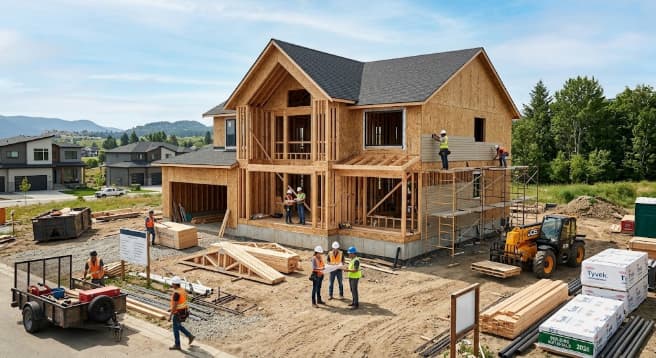
If you have ever asked yourself “how much does it cost to build a house,” you already know the answer is rarely a single number. Costs shift depending on where you build, how big your home is, what materials you choose, and who you hire. Still, homeowners need a realistic starting point before they talk to a lender, a designer, or a contractor.
In 2026, the average cost to build a house in the United States falls somewhere between $150,000 and $600,000, with most standard single-family homes landing in the $280,000 to $400,000 range once land is excluded. On a per-square-foot basis, most homeowners should plan for $130 to $250 per square foot for a standard build, with luxury or custom homes climbing well past $400 per square foot in high-cost markets.
This guide walks through the full cost breakdown, what drives the price up or down, regional differences, hidden expenses homeowners often miss, and practical ways to keep your project on budget.
Average Cost to Build a House in 2026
For a typical 2,000-square-foot home built on a prepared lot, most homeowners can expect a total construction cost between $280,000 and $420,000, excluding land. That figure covers site work, foundation, framing, mechanical systems, and standard finishes.
Three variables explain almost all of the difference between the low end and the high end of that range:
- Location. Labor rates, permit fees, and material transport costs vary enormously between states and even between neighboring cities.
- Size and layout. Larger homes cost more in total but often less per square foot, since fixed costs like the foundation and roof are spread across more space.
- Finish level. The gap between builder-grade fixtures and high-end custom finishes can swing a budget by tens of thousands of dollars.
Land is a separate line item entirely. Depending on the market, a buildable lot can cost anywhere from a few thousand dollars in a rural area to well over $200,000 in a competitive urban market.
Cost to Build a House Per Square Foot
Cost per square foot is the metric most homeowners use to compare projects, but it is easy to misread. It typically reflects the shell, systems, and standard finishes of the structure itself, not land, site prep, or upgrades.
Build Quality | Cost Per Square Foot | Typical Total (2,000 sq ft) |
Basic / Entry-Level | $110 – $160 | $220,000 – $320,000 |
Mid-Range Custom | $160 – $230 | $320,000 – $460,000 |
High-End / Luxury | $230 – $450+ | $460,000 – $900,000+ |
A smaller home almost always costs more per square foot than a larger one, because expensive fixed elements such as the kitchen, bathrooms, foundation, and roof do not shrink proportionally with square footage. A 1,200-square-foot home can easily run $180 to $220 per square foot, while a 3,000-square-foot home with similar finishes might land closer to $140 to $170 per square foot.
Cost to Build a House by Size
Homeowners frequently ask how much it costs to build a house of a specific size, whether that’s a compact starter home or a larger family layout. Here is a general range across common home sizes.
Home Size | Notes | |
500 sq. ft. | $60,000 – $110,000 | Small footprint, but per-square-foot cost is high |
1,000 sq. ft. | $120,000 – $200,000 | Common for starter homes or ADUs |
1,500 sq. ft. | $195,000 – $320,000 | Popular size for first-time builders |
2,000 sq. ft. | $280,000 – $420,000 | National mid-range benchmark |
2,500 sq. ft. | $340,000 – $520,000 | Common for growing families |
3,000 sq. ft. | $390,000 – $600,000 | Larger custom or two-story builds |
These figures assume standard site conditions and mid-range finishes. Difficult terrain, remote lots, or premium materials can push any of these ranges significantly higher.
Detailed Cost Breakdown: Where the Money Actually Goes
Understanding the phases of construction helps explain why the total cost adds up the way it does. Most residential builds break down into four major stages.
1. Pre-Construction (Soft Costs)
Before a single shovel hits the ground, homeowners pay for architectural drawings, engineering, permits, and a site survey. These soft costs typically run $10,000 to $30,000 and are essential for avoiding code violations or redesigns later in the project.
2. The Structural Shell
This phase covers excavation, foundation, framing, and roofing, the part of the house that makes it weathertight. Combined, these elements commonly account for $60,000 to $110,000 of a mid-sized build, depending on foundation type and roof complexity.
3. Mechanical Systems
Plumbing, electrical, and HVAC installation bring the home to life. Together, these systems typically cost $30,000 to $55,000. Cutting corners here is one of the most expensive mistakes a homeowner can make, since mechanical failures are costly to fix once walls are closed up.
4. Interior Finishes
Drywall, paint, flooring, cabinetry, and fixtures make up the finishing phase, and it is often where budgets swing the most. Depending on material choices, finishes alone can range from $40,000 to well over $150,000.
What Drives Home Construction Costs in 2026?
Several forces are keeping construction prices elevated this year, even as inflation has cooled from its 2022 peak.
- Labor shortages. Skilled trades, particularly electricians, plumbers, and HVAC installers, remain in short supply nationwide, which keeps labor cost to build a house trending upward year over year.
- Material price volatility. Lumber and concrete prices have largely stabilized, but steel and specialty materials remain sensitive to tariffs and supply chain disruptions.
- Permit and regulatory complexity. Local building codes, energy efficiency requirements, and inspection schedules vary widely and directly affect timelines and soft costs.
- Site conditions. Sloped lots, poor soil, or limited access can add thousands of dollars in excavation, grading, and foundation work before framing even begins.
Construction Costs by State and Region
Location remains one of the single biggest factors in any home construction cost estimate, often accounting for 30 to 40 percent of the total price difference between two otherwise identical homes.
Region | Typical Cost Per Sq. Ft. | Cost Drivers |
West Coast (CA, WA, OR) | $180 – $400+ | High labor costs, strict codes, limited land |
Mountain West (CO, UT, AZ) | $150 – $320 | Terrain, seismic and snow-load requirements |
Midwest (OH, IN, MO, IA) | $110 – $200 | Lower labor and land costs |
South Central (TX, OK, AR) | $110 – $220 | Competitive labor market, lower regulation |
Southeast (GA, NC, SC, FL) | $115 – $250 | Hurricane codes raise coastal costs |
Northeast (NY, NJ, MA) | $175 – $400+ | High land value, union labor, dense permitting |
Generally speaking, the cheapest states to build a house cluster in the rural Midwest and South Central regions, where land, labor, and permitting costs are all comparatively low. The most expensive states to build in tend to be coastal, land-constrained markets like California, Hawaii, and parts of the Northeast.
Hidden Costs Homeowners Often Miss
A construction quote rarely covers everything. These commonly overlooked expenses can add 10 to 25 percent to a project’s final price:
- Landscaping and grading: $5,000 – $25,000
- Driveways and walkways: $4,000 – $15,000
- Utility hookups and impact fees: $5,000 – $25,000+
- Window treatments: $2,000 – $6,000
- Appliances: $3,000 – $10,000
- Temporary housing during construction: $800 – $3,000 per month
- Builder’s risk insurance: 1 – 4 percent of total project cost
Because of this, most estimators recommend setting aside a contingency fund of 10 to 20 percent of the total budget to absorb unexpected costs without derailing the project.
Build vs. Buy: Which Costs Less in 2026?
In most U.S. markets, buying an existing home is still cheaper upfront than building a new one. However, a new build offers full customization, modern energy efficiency, and far fewer near-term repair costs.
Factor | Building New | Buying Existing |
Upfront Cost | Higher | Often lower |
Customization | Full control | Limited to what’s available |
Energy Efficiency | Built to current codes | Often outdated |
Timeline | 8 – 14 months | 30 – 90 days |
Hidden Repairs | Minimal, everything is new | Higher risk of aging systems |
The right choice ultimately depends on timeline, budget flexibility, and how much a homeowner values customization over speed.
How to Lower Your Home Construction Costs
Building on budget does not mean building cheap. A few practical strategies can meaningfully reduce total spend without sacrificing quality:
- Simplify the design. A rectangular footprint with a straightforward roofline is significantly cheaper to frame than a home with complex angles.
- Get multiple bids. Collecting at least three quotes per trade helps homeowners avoid overpaying and identify red flags early.
- Buy your own fixtures. Sourcing lighting, hardware, and appliances directly during sales can avoid contractor markups.
- Choose semi-custom cabinetry. Modular or semi-custom cabinets can achieve a similar look to fully custom work at a fraction of the price.
- Lock in materials early. Ordering long-lead items like custom windows or HVAC equipment as soon as permits are approved helps avoid delays and price increases.
Financing a New Home Build
Because construction loans function differently from a standard mortgage, it helps to understand the main options before requesting quotes.
- Construction-to-Permanent Loan: Funds are released in stages as work is completed, then the loan converts into a standard mortgage once the home is finished.
- Construction-Only Loan: A short-term loan paid off at completion, followed by a separate mortgage closing.
- FHA and VA Construction Loans: Government-backed options with lower down payment requirements for qualifying borrowers.
- Owner-Builder Loan: For homeowners acting as their own general contractor, though lenders typically require proof of prior construction experience.
Because construction loans carry more risk for lenders, interest rates are typically higher than a standard mortgage until the loan converts.
Frequently Asked Questions
How much does it cost to build a house per square foot in 2026?
Most standard builds fall between $130 and $250 per square foot, with luxury custom homes exceeding $400 per square foot in high-cost markets.
What is the average cost to build a house in 2025 vs 2026?
Costs have continued to rise modestly year over year, with 2026 averages running a few percentage points above 2025 due to ongoing labor shortages and material price pressure.
Is it cheaper to build a house yourself?
Acting as your own general contractor can reduce costs by eliminating markup, but it requires significant time, construction knowledge, and risk tolerance. Most first-time builders still save money and avoid costly mistakes by hiring a licensed general contractor.
What state is the cheapest to build a house in?
States in the rural Midwest and South Central U.S., such as Iowa, Oklahoma, Arkansas, and Mississippi, typically offer the lowest construction costs per square foot.
How long does it take to build a house?
Most standard homes take 8 to 14 months from permit approval to completion, though large custom builds can take longer depending on design complexity and local permitting timelines.
Can I build a house for under $200,000 in 2026?
Yes, but it generally requires a smaller footprint, a lower-cost state, and a builder-grade finish package with minimal customization.
Final Thoughts
Every home construction cost estimate depends on the same core variables: location, size, finish level, and site conditions. While national averages give homeowners a useful starting point, the only way to get an accurate number for a specific project is through a detailed, itemized estimate based on real plans and local pricing.
Digital Estimating helps homeowners and contractors put together precise construction cost breakdowns, from foundation to finishes, so every phase of the build is accounted for before the first bid is signed. Getting the numbers right before construction starts is still the single best way to protect your budget and avoid costly surprises later.