
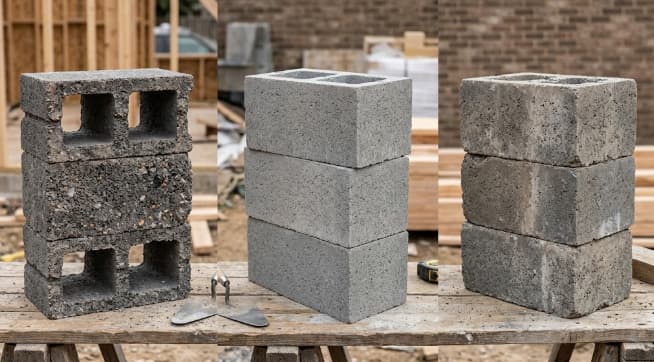
Walk onto almost any job site or ask a homeowner what they’re building with, and you’ll hear “cement block,” “cinder block,” and “concrete block” used as if they’re three names for the same thing. They’re not. Each term describes a masonry unit with a different composition, strength profile, weight, cost, and best use — and mixing them up can put the wrong material into a structural wall.
Getting this right matters before the first block goes down. Whether you’re pricing a retaining wall, a commercial foundation, or a simple garden partition, this guide breaks down each block type, compares them side by side, and walks through exactly what a full block wall costs to build in 2026 — per square foot, per linear foot, and by region.
Why the Confusion Exists in the First Place
The industry itself has never been consistent with terminology. “Cement block” is a casual, consumer-facing term — most people use it to describe any standard masonry block, even though cement is only one ingredient, not the finished product. “Cinder block” is an older industry term rooted in a manufacturing process that’s largely disappeared. “Concrete block,” or more precisely a concrete masonry unit (CMU), is the accurate engineering term used in building codes and structural specs.
All three describe rectangular masonry units used for walls and structures, but their composition and structural performance differ enough that swapping one for another in the wrong application can compromise a build.
What Is a Cement Block?
A cement block, as the term is commonly used, is a masonry unit made primarily from portland cement, sand, fine aggregate, and water, cured — often via steam curing — after being poured into molds. Technically, “cement block” is a bit of a misnomer, since cement is an ingredient, not a finished product; the term rarely appears in engineering or code documentation.
In practice, when someone says cement block, they usually mean a standard block used for smaller residential or landscaping work: garden walls, decorative partitions, and non-load-bearing interior dividers. These blocks typically carry lower compressive strength than structural CMUs, which makes them fine for low-stress applications but wrong for anything load-bearing.
What Is a Cinder Block?
Cinder blocks trace back to industrial waste reuse. For much of the 20th century, manufacturers used coal cinders — a byproduct of burning coal — as the aggregate in masonry block. As coal use declined, manufacturers shifted to fly ash and eventually to standard mineral aggregates. What gets called a “cinder block” today is usually a lightweight CMU or leftover older stock, not an actual cinder-aggregate block.
Cinder blocks, original or modern lightweight versions, aren’t designed for load-bearing use. Their lower density makes them lighter and easier to handle, which suits garden beds, low retaining walls, sheds, and other non-structural projects. Putting real structural load on a cinder block is where problems start — these units generally lack the compressive strength and moisture resistance to safely carry vertical loads.
What Is a Concrete Block (CMU)?
Concrete masonry units are the industry standard for structural masonry. They’re made from portland cement, water, and aggregates such as gravel, sand, or crushed stone, with high compression and steam curing producing consistent, high compressive strength.
CMUs dominate modern construction because they’re engineered, tested, and code-compliant in a way cement blocks and cinder blocks typically aren’t. You’ll find them specified in commercial foundations, structural walls, retaining structures, fire-rated assemblies, and load-bearing walls across residential and commercial projects. They’re heavier and denser than the other two categories — and that added density is exactly what gives them their structural edge.
Side-by-Side Comparison
| Category | Cement Block | Cinder Block | Concrete Block (CMU) |
|---|---|---|---|
| Composition | Cement, sand, fine aggregate | Coal cinders or fly ash, cement | Portland cement, gravel, sand, crushed stone |
| Density | Medium | Low | High |
| Approx. weight (8x8x16) | 26–28 lbs | 20–28 lbs | 30–35 lbs |
| Compressive strength | 1,500–2,500 psi | 700–1,800 psi | 1,900–3,500 psi |
| Durability | Moderate | Lower | High |
| Fire resistance | Moderate | Moderate | Excellent |
| Moisture resistance | Moderate | Lower | High |
| Cost per block (2026) | $1.50 – $2.50 | $1.20 – $2.10 | $1.75 – $4.00 |
| Typical lifespan | 50–70 years | 30–50 years | 75–100+ years |
| Best use | Partitions, landscaping | Garden walls, sheds | Foundations, structural walls |
Strength and Structural Performance
Block strength matters most in three scenarios: foundation walls, where soil and hydrostatic pressure demand high compression resistance; load-bearing walls, which carry live and dead loads from the structure above; and retaining walls taller than about four feet, where lateral earth pressure increases sharply.
Concrete CMUs win outright here, testing between 1,900 and 3,500 psi depending on specification — genuine engineered load-bearing capability. Cinder blocks typically range from 700 to 1,800 psi, enough for low-load applications but unsuitable for foundations or multi-story structural walls. Using cinder block in a load-bearing role isn’t just a poor engineering choice — in most jurisdictions, it’s a building code violation.
Durability and Lifespan
Concrete CMUs absorb noticeably less water than cinder blocks, which means less freeze-thaw cracking in cold-climate regions. Cinder blocks, particularly older stock, absorb moisture readily; once water enters and freezes, it expands and gradually fractures the block matrix, showing visible degradation over 10 to 20 freeze-thaw cycles. For exterior applications in hard-winter regions, CMUs are almost always the better long-term choice, even at a higher upfront cost.
Full Cost of a Block Wall: Per Square Foot and Per Linear Foot (2026)
Beyond the per-unit block price, most homeowners and contractors want the full installed wall cost. A complete block wall — cinder or concrete — costs $14 to $32 per square foot installed, or roughly $45 to $95 per linear foot for a standard 6-foot-tall wall, once materials, labor, footings, and rebar are included.
Cost per linear foot by wall height:
| Wall Height | Cost Per Linear Foot |
|---|---|
| 4 feet | $30 – $55 |
| 6 feet | $45 – $95 |
| 8 feet | $65 – $130 |
| 10 feet (retaining) | $95 – $190 |
Cost per square foot by component:
| Cost Component | Cost Per Sq. Ft. |
|---|---|
| Materials (blocks, mortar, rebar) | $6 – $11 |
| Labor | $7 – $15 |
| Footing/foundation | $2 – $5 |
| Finish (paint, stucco, veneer) | $1 – $6 |
| Total installed | $14 – $32 |
Cost by wall type/finish:
| Wall Type | Cost Per Sq. Ft. |
|---|---|
| Plain/unfinished block | $14 – $19 |
| Painted/parged finish | $17 – $23 |
| Stucco finish | $19 – $26 |
| Split-face decorative block | $22 – $30 |
| Stone or brick veneer over block | $28 – $40+ |
| Reinforced retaining wall | $24 – $38 |
Cost by region:
| Region | Avg. Cost Per Sq. Ft. |
|---|---|
| Northeast (NY, MA, NJ) | $20 – $34 |
| West Coast (CA, WA, OR) | $22 – $36 |
| Southwest (AZ, NV, TX) | $16 – $27 |
| Southeast (FL, GA, NC) | $15 – $26 |
| Midwest (OH, IL, MI) | $14 – $24 |
| Rural/inland nationwide | $12 – $20 |
Location alone can shift total cost by 20–35%, driven by labor rates, permitting, wind/seismic code compliance, and material transport distance. Timing matters too: building in peak spring/summer season (April–August) typically runs 10–20% higher than fall or winter work, when mason crews have more availability and suppliers offer better pricing.
Weight and Handling
A cinder block weighs roughly 20 to 28 pounds, while a standard CMU weighs closer to 30 to 35 pounds. Across a wall installation involving 400 blocks, that difference can exceed 3,000–4,000 pounds total — which directly affects labor rates, crew fatigue, and project timeline. Lighter cinder block can genuinely cut labor cost on non-structural work like garden walls and decorative partitions; for structural jobs, performance should outweigh any labor savings from a lighter unit.
Fire Resistance and Safety
All three block types are non-combustible. But certified fire-rated performance differs: concrete CMUs, installed at the correct thickness and configuration, meet recognized fire-resistance ratings for commercial applications such as party walls, stairwell enclosures, mechanical rooms, and exit corridors. Cinder blocks and standard cement blocks can contribute to basic fire separation in light residential construction, but generally don’t meet the same certified ratings without additional treatment.
Maintenance and Long-Term Cost
Block walls cost roughly $0.50–$2 per square foot per year in long-term upkeep — mainly resealing, repainting, and occasional mortar repair — which is why they typically beat wood fencing on total cost of ownership over 20–30 years despite a higher upfront price.
| Maintenance Task | Frequency | Cost |
|---|---|---|
| Resealing/waterproofing | Every 5–7 years | $1 – $2.50 per sq. ft. |
| Repainting | Every 5–8 years | $1.50 – $3 per sq. ft. |
| Mortar joint repair | As needed | $8 – $20 per linear ft. |
| Crack repair | As needed | $150 – $600 per repair |
Block walls resist rot, termites, and fire damage entirely, which helps them win on total cost of ownership against wood fencing over the long run.
How Block Walls Compare to Other Fencing and Wall Materials
| Alternative | Cost | Lifespan |
|---|---|---|
| Wood fence | $20 – $45 per linear ft. | 15–20 years |
| Vinyl fence | $25 – $50 per linear ft. | 20–30 years |
| Chain-link fence | $12 – $25 per linear ft. | 15–20 years |
| Poured concrete wall | $20 – $40 per sq. ft. | 50+ years |
| Brick wall | $25 – $45 per sq. ft. | 50–100 years |
| Precast concrete panels | $30 – $55 per sq. ft. | 40–50 years |
| Cinder/concrete block wall | $14 – $32 per sq. ft. | 50+ years |
Block walls typically land in the middle of this range on upfront cost but win on durability and fire resistance, especially against any wood-based option.
Best Applications for Each Block Type
| Project Type | Best Block | Why |
|---|---|---|
| Foundation wall | CMU | Load-bearing, moisture-resistant |
| Exterior load-bearing wall | CMU | Structural code compliance |
| Retaining wall (over 3–4 ft) | CMU | Handles lateral load resistance |
| Retaining wall (under 3 ft) | Cinder block | Lightweight, cost-effective |
| Interior partition | Cement block | Non-structural, easy to work with |
| Garden bed or landscape wall | Cinder block | Low cost, lightweight |
| Fire-rated wall | CMU | Meets certified fire performance standards |
| Decorative perimeter | Cement block | Aesthetic flexibility, low load |
When you’re genuinely unsure which block fits your project, the safer default is almost always the concrete masonry unit.
How to Calculate Your Own Block Wall Cost
- Measure total wall area — length x height gives the square footage that drives every material and labor calculation.
- Calculate block count — a standard 8x8x16 block covers about 0.89 sq. ft. once mortar joints are factored in; divide total square footage by 0.89 for a base block count.
- Add footing volume — multiply footing width x depth x wall length, then divide by 27 to get cubic yards of concrete.
- Add rebar and mortar — base quantities on local code spacing for vertical and horizontal reinforcement.
- Price labor separately — use regional hourly or per-square-foot labor rates rather than bundling with material cost, so quotes are easier to compare.
- Build in a 10–15% contingency — covers waste, breakage, and unexpected site conditions.
Because manual takeoffs are easy to get wrong on anything beyond a small wall, most contractors outsource this process to a dedicated construction estimating partner for a detailed material list, labor breakdown, and cost report.
Expert Tips for Choosing the Right Block
- Match the block to your climate first. In freeze-thaw regions like the Midwest, Northeast, and mountain states, CMUs are typically the only sound choice for exterior work.
- Verify local building codes early. Some jurisdictions require minimum CMU standards for load-bearing work; others permit lighter block in specific non-structural categories.
- Factor labor into your material choice. Lighter blocks allow faster laying rates on non-structural work; heavier CMUs require more rest cycles on large installations.
- Put the spec in writing. Because terms get mixed up so often at the supply counter, specify CMU grade and compressive strength directly on the purchase order.
Frequently Asked Questions
Are cement blocks and concrete blocks the same thing?
Not exactly. “Cement block” is a casual term often used for a standard CMU, but cement is just one ingredient in the mix, not a precise engineering classification.
Which block is strongest: cement, cinder, or concrete?
Concrete masonry units, typically testing 1,900–3,500 psi — well above cinder blocks and standard cement blocks.
How much does a block wall cost per linear foot?
Roughly $45–$95 per linear foot for a standard 6-foot wall, or $30–$190 depending on height and finish.
How much does a concrete block wall cost to repair?
Mortar joint repair runs $8–$20 per linear foot; a full crack repair typically costs $150–$600 per section, depending on severity and access.
Can cinder blocks be used for load-bearing walls?
Generally no. Using cinder block for load-bearing work without engineering approval is a common code violation in most jurisdictions.
Which block type is cheapest?
Cinder blocks usually carry the lowest upfront cost per unit. Factoring in lifespan and failure risk in structural settings, concrete CMUs typically deliver better long-term value.
Final Thoughts
Cement blocks, cinder blocks, and concrete blocks aren’t interchangeable names for the same material. Each carries a different composition, strength profile, lifespan, and code-compliance standard, and choosing the wrong one for a structural application can turn a routine project into an expensive rework.
For decorative or non-structural work, lighter and less expensive block gets the job done. For anything structural — foundations, load-bearing walls, taller retaining structures — concrete masonry units are the right call every time. Getting the material spec right from the start protects your budget and keeps the project code-compliant.
If you’re planning a masonry project and want an accurate breakdown of materials, labor, and cost before work begins, Digital Estimating helps contractors and homeowners get detailed, code-informed estimates so the right block ends up in the right wall the first time. For more on block composition, sizing, and weight, see our companion guide, What Are Cinder Blocks