
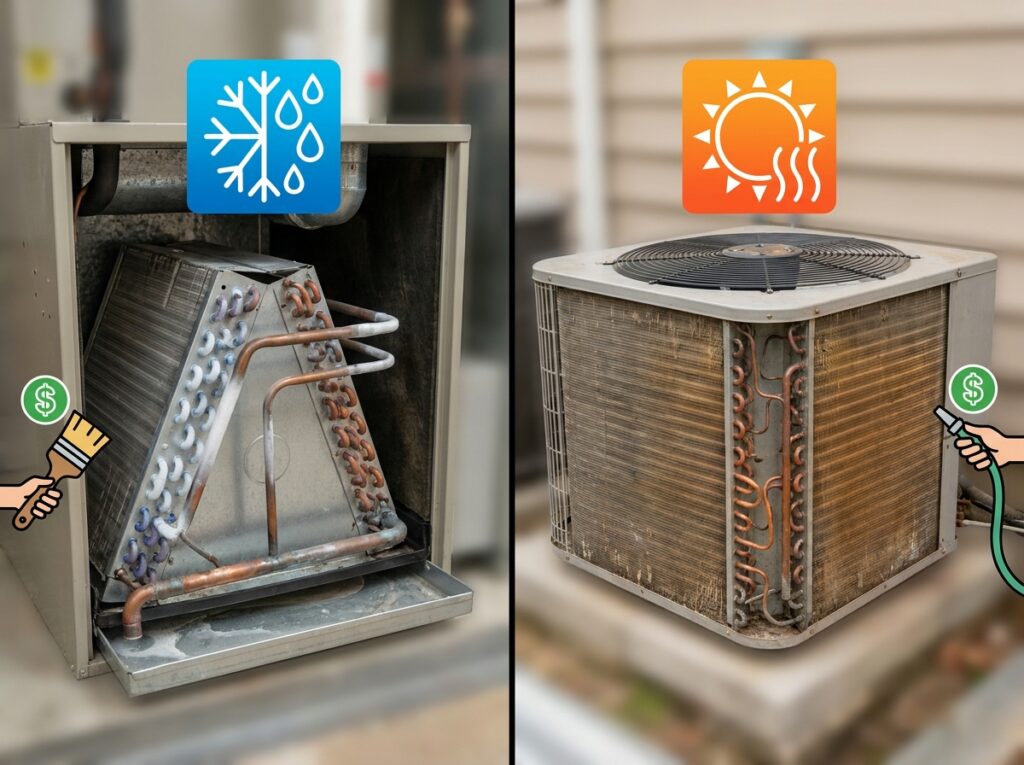
If you’re researching HVAC systems, you’ve likely come across the terms evaporator coil and condenser coil. While both are essential components of an air conditioning or heat pump system, they perform very different jobs.
Understanding the difference between an evaporator coil and a condenser coil can help homeowners, contractors, and property managers make better decisions about maintenance, repairs, and replacement costs. It can also help you identify potential issues before they lead to expensive breakdowns.
In this guide, we’ll explain how each coil works, compare their functions, break down replacement costs, and share maintenance tips that can extend the life of your HVAC system.
What Is the Difference Between an Evaporator Coil and a Condenser Coil?
Although evaporator and condenser coils work together as part of the refrigeration cycle, they are located in different parts of the HVAC system and perform opposite functions.
Evaporator Coil
The evaporator coil is the indoor component of an HVAC system. It’s typically installed inside the air handler, furnace, or indoor unit of a ductless mini-split system.
Its primary job is to absorb heat from the air inside your home or building.
Main Functions of an Evaporator Coil
- Absorbs heat from indoor air
- Cools the air before it circulates through the building
- Removes excess humidity from the air
- Converts refrigerant from a liquid state into a gas as heat is absorbed
As warm indoor air passes over the coil, the refrigerant inside absorbs the heat. The cooled air is then distributed throughout the building, creating a comfortable indoor environment.
Condenser Coil
The condenser coil is located in the outdoor unit of the HVAC system.
After the evaporator coil absorbs heat from inside the building, that heat must be released somewhere. The condenser coil is responsible for transferring the collected heat outdoors.
Main Functions of a Condenser Coil
- Releases heat absorbed from inside the building
- Converts refrigerant gas back into liquid form
- Uses outdoor air to cool the refrigerant
- Completes the refrigeration cycle
Without a properly functioning condenser coil, your HVAC system cannot effectively remove heat from the building.
How Do Evaporator and Condenser Coils Work Together?
Think of the evaporator coil and condenser coil as a team. One collects heat, and the other releases it.
Here’s how the process works:
Step 1: Indoor Air Is Pulled Into the System
The HVAC fan draws warm indoor air across the evaporator coil.
Step 2: Heat Is Absorbed
The refrigerant inside the evaporator coil absorbs heat from the air, causing the refrigerant to change from a liquid into a gas.
Step 3: Refrigerant Travels to the Compressor
The heated refrigerant moves through insulated refrigerant lines to the compressor.
Step 4: Pressure Increases
The compressor increases the refrigerant’s pressure and temperature.
Step 5: Heat Is Released Outdoors
The hot refrigerant enters the condenser coil, where outdoor air removes the heat.
Step 6: Refrigerant Returns to Liquid Form
As heat leaves the refrigerant, it condenses back into a liquid.
Step 7: The Cycle Repeats
The cooled liquid refrigerant returns to the evaporator coil, and the process starts again.
This continuous cycle is what keeps your home or building comfortable throughout the year.
Evaporator Coil Replacement Costs
Over time, evaporator coils can develop leaks, corrosion, or performance issues that require replacement.
Average Evaporator Coil Replacement Cost
System Type | |
Standard HVAC System | $600 – $3,700 |
Mini-Split System | $1,900 – $2,300 |
Heat Pump System | $2,100 – $2,500 |
The final price depends on system size, accessibility, refrigerant type, and labor costs in your area.
Cost by HVAC System Size
System Size | Typical Cost |
1.5–2 Ton | $600 – $1,400 |
3 Ton | $800 – $1,800 |
4–5 Ton | $1,600 – $2,400 |
Larger systems require larger coils, which naturally increases replacement costs.
Factors That Affect Evaporator Coil Costs
Several variables can influence the total cost of replacement.
Coil Design
Different coil configurations come with different price points.
- A-Coils: Most common and generally the most affordable.
- N-Coils and Z-Coils: Typically 15%–25% more expensive due to improved efficiency.
- Slab Coils: Compact and often the least expensive option.
Cased vs. Uncased Coils
Cased Coils
Cased coils are enclosed in a protective housing, making installation easier.
Around $1,000
Uncased Coils
Uncased coils usually cost less but require more installation time and precision.
Average cost:
Around $800
HVAC System Type
The type of HVAC system can also impact installation costs.
System Type | Cost Range |
Gas Furnace Systems | $630 – $2,310 |
Heat Pump & Electric Systems | $870 – $3,700 |
Heat pump systems often require more labor and additional components, resulting in higher replacement costs.
Condenser Coil Replacement Costs
When a condenser coil becomes damaged or severely corroded, replacement may be necessary.
Average Condenser Coil Replacement Cost
Component | Cost Range |
Condenser Coil Only | $900 – $2,300 |
Complete Outdoor Condenser Unit | $1,200 – $4,200 |
In some cases, replacing the entire outdoor unit may be more cost-effective than replacing the coil alone.
HVAC Labor Costs
Labor is a major factor in HVAC repair and replacement projects.
Most HVAC technicians charge between:
$75 and $150 per hour
depending on location and system complexity.
Typical Installation Times
Service | Estimated Labor Time |
Evaporator Coil Replacement | 2–4 Hours |
Condenser Coil Replacement | 4–8 Hours |
Systems that are difficult to access may require additional labor time.
Coil Cleaning and Maintenance Costs
Regular maintenance can significantly reduce the likelihood of costly repairs and system failures.
Professional Coil Cleaning Costs
Service | Cost Range |
Evaporator Coil Cleaning | $100 – $400 |
Condenser Coil Cleaning | $75 – $230 |
Cleaning Both Coils | $175 – $900 |
Cleaning costs vary depending on the level of dirt buildup and system accessibility.
Deep Cleaning Services
Heavily contaminated coils may require specialized cleaning methods.
Acid Wash Cleaning
Typical cost:
$300 – $350
Severe Dirt and Debris Removal
For coils requiring extensive manual cleaning and scrubbing, expect to pay:
$300 or more
How Preventive Maintenance Saves Money
Many HVAC companies offer annual maintenance plans that include:
- Routine coil cleaning
- Air filter replacement
- System inspections
- Priority scheduling
- Discounted repair rates
Preventive maintenance is often far less expensive than emergency repairs or premature system replacement.
Benefits of Keeping Coils Clean
Proper coil maintenance can:
- Reduce energy consumption by up to 30%
- Improve HVAC performance
- Extend equipment lifespan by 3–5 years
- Reduce the risk of major repairs
- Improve indoor air quality
- Lower monthly utility bills
A clean HVAC system operates more efficiently and experiences less wear and tear over time.
Which Coil Is More Important?
Many homeowners ask whether the evaporator coil or condenser coil is more important.
The truth is that both components are equally essential.
The evaporator coil absorbs heat from inside the building, while the condenser coil releases that heat outdoors. If either coil fails, the entire cooling process is affected, reducing system performance and comfort.
Rather than focusing on one component over the other, regular inspection and maintenance of both coils is the best way to ensure reliable HVAC performance.
Final Thoughts
When comparing evaporator coil vs condenser coil, it’s important to remember that both play critical roles in the HVAC cooling cycle. The evaporator coil removes heat from indoor air, while the condenser coil releases that heat outside.
Understanding how these components work, what replacement costs to expect, and how regular maintenance affects system performance can help you avoid costly breakdowns and extend the life of your HVAC equipment.
Routine cleaning, annual inspections, and timely repairs can significantly improve efficiency, lower operating costs, and help you get the most value from your heating and cooling system for years to come.