
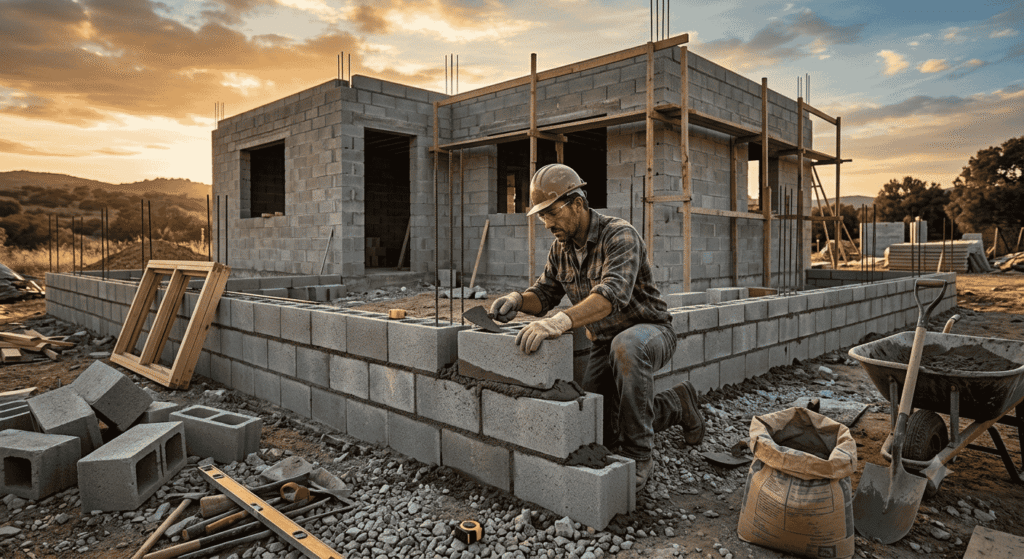
Concrete block construction has a reputation for being nearly indestructible — fire-resistant, pest-proof, and built to outlast almost anything the weather throws at it. That durability is part of why more owner-builders are seriously asking whether building a concrete block house themselves is realistic, instead of just handing the whole project to a general contractor.
The one question that never gets a straight answer online is the most practical one: how many hours does it actually take? Forum threads throw around guesses, but there’s rarely a real breakdown. This guide gives you that breakdown — a realistic hour count by project phase, the variables that swing those numbers up or down, and where cinder block house construction cost tends to land depending on how much of the labor you take on yourself.
What Actually Determines Your Timeline
Before any hour estimate means anything, you need to understand what’s driving it. A handful of variables explain almost all of the variance between a fast build and a slow one.
House size and layout. This is the obvious one — more square footage means more block, more concrete, more labor hours, full stop. A second story doesn’t just add floor area either; it adds scaffolding, material hoisting, and structural complexity that slows everything down.
Your own skill level. If you’ve never laid a course of block before, expect your early walls to take noticeably longer than your later ones — and expect some rework. Someone with masonry experience moves at a very different pace than a total beginner working from YouTube videos.
Crew size. Building solo is possible, but it’s slow, and certain tasks (setting long block courses plumb, moving heavy lintels) are genuinely difficult for one person. A small 2-person crew typically runs $45–$60 per hour combined, which adds real cost — but it can cut total build time dramatically.
Equipment access. A block saw, a concrete mixer, rebar benders, and a plate compactor aren’t optional extras — they’re the difference between an efficient build and an exhausting one. Renting this equipment from a local supplier or an equipment yard is almost always cheaper than buying it outright for a single project.
Weather. Rain doesn’t just slow you down logistically — it actively damages fresh concrete work. Moisture during curing can cause dusting, scaling, and surface cracking, and wet conditions make moving and setting block noticeably harder. Regions with unpredictable weather should build in real schedule buffer.
Permits and inspections. Most jurisdictions require a building permit before you pour a foundation, and inspection delays are common when paperwork is incomplete. If you’re filing as an owner-builder, get every document in order before you submit, since incomplete applications are one of the most common causes of holdups.
Phase-by-Phase Time Breakdown
Here’s roughly how the hours break down for a modest 500-square-foot concrete block structure, based on typical DIY and small-crew build timelines.
Site preparation and layout – Clearing debris, vegetation, and topsoil, then digging and staking the layout, generally takes 16 to 24 hours for a 500 sq ft footprint. Sites with heavy vegetation or uneven grading push toward the higher end.
Foundation pouring and curing – Setting rebar and pouring the footing and slab is physically demanding, precision-dependent work. Expect 50 to 60 hours of active labor, followed by 7 to 10 days of curing time before the foundation reaches enough strength to build on. That curing window doesn’t require your labor, but it does sit on your calendar.
Concrete block wall construction – This is where most of your hours go. A single 10-foot by 6-foot wall section can take 300 to 400 hours depending on layout complexity, block pattern, and how many openings (windows, doors) interrupt the courses.
Roof framing and installation – Rafters, ridge boards, sheathing, and drip edge work typically runs 60 to 80 hours for a standard roof design; more complex rooflines add time on top of that.
Interior walls and finishing – Drywall and simpler finishes move quickly; exposed stone, plaster, and polished concrete take considerably longer. Budget 80 to 120 hours for a standard finish package.
Total Hours by Experience Level (500 sq ft home)
Phase | Beginner | Intermediate | Experienced |
Site Preparation & Layout | 24–30 hrs | 16–24 hrs | 14–16 hrs |
Foundation & Curing (active labor) | 55–65 hrs | 50–60 hrs | 40–55 hrs |
Block Wall Construction | 400–450 hrs | 300–400 hrs | 300–330 hrs |
Roof Framing & Installation | 65–90 hrs | 60–80 hrs | 50–60 hrs |
Interior Walls & Finishes | 90–120 hrs | 80–100 hrs | 70–80 hrs |
Estimated Total | 634–755 hrs | 506–664 hrs | 474–541 hrs |
These are working ranges rather than guarantees — every lot, climate, and design has its own quirks. For a number you can actually plan a budget around, a construction estimating service can model your specific square footage, design, and region.
Total Hours by House Size and Crew Size
Home Size | Solo Build | 2-Person Crew | 4-Person Crew |
800 sq ft | 700–1,000 hrs | 500–700 hrs | 400–500 hrs |
1,000 sq ft | 1,000–1,200 hrs | 600–800 hrs | 500–700 hrs |
1,200 sq ft | 1,300+ hrs | 750–900 hrs | 600–800 hrs |
The pattern is consistent: doubling your crew doesn’t cut your timeline in half, but it gets close, especially on wall construction where an extra set of hands speeds up nearly every task.
Cinder Block House Construction Cost: What to Expect
Hours are only half the planning picture — the other half is what a concrete block home construction cost actually looks like once materials, permits, and any hired labor are factored in.
- A finished concrete block home typically costs $150,000 to $250,000, depending on size, finish level, and region. Doing the block work and framing yourself primarily saves on labor, not materials.
- Individual concrete blocks run roughly $2 to $10 each, depending on size, density, and whether they’re standard or architectural-grade.
- Hiring a small crew to speed up wall construction adds $45–$60 per hour for a 2-person team — a cost that needs to be weighed against how much your own time is worth and how quickly you need the house closed in.
Materials shortfalls are one of the most common (and most avoidable) reasons a build stalls out mid-project. Under-ordering block, rebar, or mortar means a delivery delay right when your crew is standing around waiting — which is exactly the kind of gap a proper material takeoff and estimate is built to prevent.
Ways to Cut Down Your Build Time
Plan before you break ground. A detailed phase-by-phase plan, with permits and documentation already in hand, prevents the single biggest source of delay: stopping mid-project to wait on paperwork or figure out the next step.
Rent equipment instead of buying it. A concrete mixer alone can run into the thousands of dollars to purchase outright, plus lead time to have it delivered. Renting from a local supplier or an estimating and equipment partner gets you working faster for a fraction of the cost.
Bring in help, even part-time. You don’t need a full crew — a friend with masonry experience, or a couple of part-time laborers for the heaviest days (foundation pour, long wall runs), can meaningfully shorten your total hours.
Use prefabricated components where it makes sense. Pre-cast lintels, trusses, and other factory-built elements delivered ready for assembly cut out entire categories of on-site labor.
Mistakes That Blow Up Your Timeline
Poor planning. Scheduling and planning failures are behind the majority of construction delays industry-wide, and a concrete block build is no exception — mismanaged permits, unclear framework plans, and missing documentation are the usual culprits for a self-build specifically.
Underestimating material quantities. Running short on block, mortar, or rebar mid-wall means a stalled crew and a delivery wait. An accurate material estimate up front avoids this entirely.
Ignoring weather risk. A large share of construction delays trace back to weather. If you’re building in a humid or storm-prone region, check forecasts regularly and cover fresh block work and mortar joints with plastic sheeting ahead of rain to protect cure quality.
Cutting corners on tools and safety. Underpowered or unsafe equipment doesn’t just slow you down — it creates real risk to the structure’s integrity and can trigger costly delays if an inspector flags the work.
Frequently Asked Questions
How long does it take to build a concrete block house yourself?
For a modest 500 sq ft structure, plan on roughly 475–755 total labor hours depending on your experience level, with larger homes (800–1,200 sq ft) running from several hundred to well over a thousand hours depending on crew size.
How much does it cost to build a concrete block house?
Most finished concrete block homes fall between $150,000 and $250,000. Doing your own labor mainly saves on wages, not on materials — and it comes with a real time and skill trade-off.
What is the average cinder block house construction cost per block?
Individual blocks typically run $2 to $10 each in the US, depending on size and quality grade.
Can a construction estimating company help with a DIY concrete block build?
Yes. An estimating team can model your specific home size, design, and location to produce an accurate material list and labor-hour projection — which is far more reliable than general online ranges, and can help you avoid the material shortfalls that cause most mid-project delays.
Final Thoughts
There’s no single number for how many hours it takes to build a concrete block house yourself — it depends on your size, skill level, crew, tools, and a fair amount of luck with the weather. But with a realistic phase-by-phase timeline and an honest look at cinder block house construction costs going in, you can plan a build that stays on schedule instead of dragging on for an extra season.
If you want numbers built around your actual lot, design, and location rather than general ranges, Digital Estimating can put together a detailed material and labor estimate before you break ground — so your budget and your timeline are both grounded in reality from day one.