
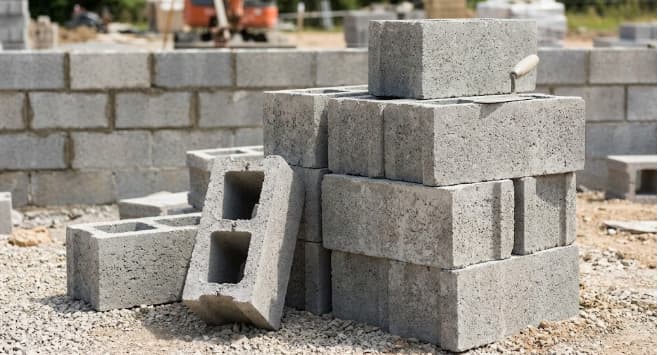
If you’ve ever walked past a construction site, a retaining wall, or an older garage, you’ve seen cinder blocks in action. They’re one of the most recognizable building materials in North America, yet most people can’t say exactly what a cinder block is made of, how tall or long a standard block actually is, or what a cinder block costs in 2026.
This guide covers everything: composition, dimensions, weight, current pricing, common uses, and how cinder blocks stack up against concrete masonry units (CMUs). Whether you’re a homeowner pricing a garden wall, a contractor bidding a job, or an estimator building a material takeoff, you’ll walk away with a clear, accurate picture of what a cinder block actually is — and what it costs to build with one.
What Is a Cinder Block?
A cinder block is a rectangular masonry unit with one or more hollow cores, traditionally made by mixing portland cement, water, and coal cinders — the ash left over from burning coal. The hollow cores cut down the block’s weight, make it easier to handle on site, and give rebar or utility lines a path to run through.
Here’s the part that trips people up: genuine cinder-based blocks are rarely manufactured anymore. Most of what gets called a “cinder block” today is actually a concrete masonry unit (CMU), made from portland cement, water, and mineral aggregates like sand, gravel, or crushed stone instead of coal cinders. Coal cinders largely disappeared from block production because cleaner aggregates produce a stronger, more consistent unit — and because coal-fired power generation itself has declined.
So when someone asks “what is a cinder block,” the honest answer is that the name outlived the material. In everyday conversation, supply orders, and even some contracts, cinder block and concrete block get used interchangeably, even though they’re technically different products with different strength ratings and different price points.
What Are Cinder Blocks Made Of?
- Portland cement — the binder that holds the mix together and gives the block its structural integrity once cured.
- Water — activates the cement and starts the hardening reaction.
- Aggregate — provides bulk and strength. In an original cinder block, this was coal cinders or fly ash. In a modern concrete block, it’s sand, gravel, or crushed stone.
- Additives — recycled concrete or fly ash byproducts are sometimes blended in for cost or sustainability reasons.
The aggregate type and ratio directly control the compressive strength, weight, and water absorption of the finished block — which is exactly why builders shouldn’t assume every “cinder block” performs the same way.
How Are Cinder Blocks Manufactured?
- Batching and mixing — cement, aggregate, and water are precisely measured and combined in industrial mixers.
- Molding — the wet mixture is fed into steel molds that shape the block and form its hollow cores.
- Compaction — mechanical pressure and vibration remove trapped air and increase density and compressive strength.
- Curing — molded units move into a curing chamber, often an autoclave, where controlled heat and moisture bring the block to full strength.
ASTM C90 governs testing for concrete masonry units, covering dimensional tolerance, compressive strength, and absorption limits — the standard most suppliers and inspectors reference.
Cinder Block Size: How Tall, How Wide, How Long Is a Cinder Block?
The most common question buyers ask is simply how big a cinder block is. The industry-standard nominal size is 8 inches tall x 8 inches wide x 16 inches long, though the actual measured size runs slightly smaller — typically around 7-5/8″ x 7-5/8″ x 15-5/8″ — to leave room for a 3/8-inch mortar joint.
| Block Type | Nominal Size | Typical Use |
|---|---|---|
| Standard stretcher block | 8″ x 8″ x 16″ | Straight wall runs |
| Corner block | 8″ x 8″ x 16″ (flat face) | Clean, finished corners |
| Half block | 8″ x 8″ x 8″ | Staggering joints, finishing wall ends |
| Lintel/U-block | 8″ x 8″ x 16″ (U-channel) | Holds rebar and poured concrete over doors/windows |
| Partition block | 4″ x 8″ x 16″ or 6″ x 8″ x 16″ | Non-structural interior walls |
So how tall is a cinder block in inches? Eight inches nominal, front to back and top to bottom, with a 16-inch length — the same footprint used across nearly every U.S. block wall calculation. Getting the block size wrong by even half an inch on a takeoff can throw off an entire wall quantity, which is one reason contractors lean on a professional masonry estimating service for anything beyond a small DIY job.
How Much Does a Cinder Block Weigh?
Weight matters for anyone planning to move, lift, or truck a large quantity of block. A standard 8x8x16 hollow concrete block typically weighs between 28 and 35 pounds, depending on aggregate density. Lightweight blocks made with expanded shale, clay, or slate run closer to 25–28 pounds, while dense normal-weight block made with sand and gravel aggregate can hit 38–43 pounds.
This difference shows up fast on a job site. Lighter blocks install faster and reduce labor costs, but they can trade off some strength and sound insulation compared to denser units — a trade-off worth flagging before you commit to a supplier.
How Much Do Cinder Blocks Cost in 2026?
Pricing varies by region, supplier, and block type, but as a general guide:
| Block Size | Price of Cinder Block (per unit) |
|---|---|
| 4x8x16 (partition) | $1.30 – $1.90 |
| 6x8x16 | $1.50 – $2.20 |
| 8x8x16 (standard) | $1.75 – $2.60 |
| 10x8x16 | $2.15 – $3.10 |
| 12x8x16 | $2.60 – $3.75 |
| Corner/decorative/high-strength | $2.50 – $4.50+ |
At big-box retailers, cinder block price at Home Depot and similar stores typically lands in the $1.60–$2.50 range for a standard 8x8x16 CMU, though local yards can beat that on bulk pallet orders. A standard pallet usually holds 90–96 blocks, so buying by the pallet is one of the more reliable ways to find cheap cinder blocks for a larger project.
Cost per block is only part of the picture. A full project budget also needs to account for:
- Mortar and grout
- Rebar and vertical reinforcement
- Footing and foundation work
- Delivery and site handling
- Labor for laying and finishing the wall
Once you add labor and footings, a full cinder block wall typically runs $14–$32 per square foot installed, or roughly $45–$95 per linear foot for a standard 6-foot wall. For a deeper breakdown of that full installed cost — including regional pricing, wall-type pricing, and a step-by-step calculation method — see our companion guide on concrete and cinder block wall cost comparisons.
Key Benefits of Cinder Blocks
Durability. Once properly cured and installed, concrete masonry units resist compression, weather exposure, and general wear far better than most alternative materials, especially when paired with correct reinforcement and footing design.
Cost-effectiveness. Compared to poured concrete or brick, cinder blocks are relatively inexpensive to produce and buy. Their larger unit size also means fewer pieces are needed to cover the same wall area, which speeds up installation and trims labor hours.
Fire resistance. Because the primary ingredients — cement and mineral aggregate — are non-combustible, cinder blocks don’t burn, warp, or lose structural integrity under high heat the way wood framing can.
Sound and thermal insulation. The hollow cores trap air pockets that provide a degree of natural thermal and sound insulation. Filling the cores with insulation or rigid foam boosts the R-value of a cinder block wall considerably above an unfilled block, which matters for anyone asking about the r-value of a cinder block wall for an occupied structure.
Ease of installation. The lightweight, uniform shape lets crews work quickly without heavy machinery, and blocks can be cut, drilled, or shaped on site with standard masonry tools.
Disadvantages of Cinder Blocks
- Lower strength than solid concrete blocks. Traditional cinder-based units generally test between 1,000 and 1,500 psi compressive strength, well below the 1,900–3,000+ psi typical of standard concrete blocks — which is why most jurisdictions no longer allow true cinder block in structural or load-bearing work.
- Moisture absorption. The porous composition lets water seep in over time, which can lead to cracking in freeze-thaw climates unless the wall is properly sealed and drained.
- Limited use in seismic zones. Lightweight, low-strength units generally aren’t recommended for higher seismic design categories without added reinforcement.
- Handling on denser units. Heavier, normal-weight blocks need more labor and sometimes equipment to move and set.
Common Uses of Cinder Blocks and CMUs
Residential construction. CMUs show up in foundation walls, garage walls, shed bases, perimeter fences, and utility enclosures. Many mid-century homes used true cinder block for foundations and basement walls, which is a big reason the term has stuck around in everyday language — and why cinder block basement wall repair remains a common search among older-home owners.
Landscaping projects. Blocks are widely used for retaining walls, raised garden beds, seating walls, and planter boxes. Lightweight cinder-style block still makes practical sense here, since these applications rarely carry significant structural load.
Commercial and industrial work. CMUs handle warehouse walls, interior partitions, equipment rooms, and site enclosures, where fire resistance and durability matter as much as upfront cost.
Cinder Block Wall Repair: What to Expect
Cinder block walls are durable, but not maintenance-free. Common repair triggers include cracked mortar joints, spalling from freeze-thaw cycles, and bowing on retaining walls with poor drainage. Typical repair costs:
| Repair Task | Frequency | Typical Cost |
|---|---|---|
| Mortar joint repair | As needed | $8 – $20 per linear ft. |
| Crack repair (patch/epoxy injection) | As needed | $150 – $600 per repair |
| Resealing/waterproofing | Every 5–7 years | $1 – $2.50 per sq. ft. |
| Repainting | Every 5–8 years | $1.50 – $3 per sq. ft. |
Catching cracking or bowing early is almost always cheaper than a full section rebuild, so a yearly walk-around inspection is worth the ten minutes it takes.
How to Choose the Right Block for Your Project
- Identify the load requirement. Structural or load-bearing walls need standard concrete block, not lightweight cinder units.
- Consider your climate. In freeze-thaw regions, prioritize denser, lower-absorption block to reduce cracking risk.
- Confirm size and shape. Match standard stretcher, corner, half, and lintel blocks to your specific wall layout.
- Check compressive strength and quality. Look for consistent dimensions, a smooth finish, and strength ratings that meet ASTM C90.
- Verify local building codes. Some jurisdictions restrict or prohibit true cinder block in structural applications, so confirm requirements before ordering.
Frequently Asked Questions
What is a cinder block made of?
Traditionally, portland cement, water, and coal cinders or fly ash. Most blocks sold today are concrete masonry units made with cement, water, and mineral aggregates such as sand and gravel.
How tall is a cinder block?
The standard nominal size is 8 inches tall, 8 inches wide, and 16 inches long, with actual measured dimensions running slightly smaller to allow for mortar joints.
How much is a cinder block?
A standard 8x8x16 block runs roughly $1.75–$2.60 at most suppliers, with home-improvement retailers landing in a similar $1.60–$2.60 range depending on region and stock.
How much does a cinder block weigh?
A standard 8x8x16 hollow block typically weighs between 25 and 43 pounds, depending on whether it’s a lightweight or normal-weight mix.
Are cinder blocks strong enough for structural work?
Generally, no. Traditional cinder blocks lack the compressive strength for foundations or load-bearing walls, which is why standard concrete blocks (CMUs) are used instead in modern construction.
Where do you get cinder blocks?
Concrete masonry units are widely available through building material suppliers, masonry yards, and major home improvement retailers, though true cinder-aggregate block is harder to find today.
Can you get cinder blocks for free?
Occasionally, through classifieds, demolition sites, or construction leftovers — but free block is usually mismatched in size, age, or condition, so verify strength and dimensions before using it in anything structural.
Final Thoughts
Cinder blocks earned their reputation as a reliable, affordable building material decades ago, and while the modern version of the product has evolved into the concrete masonry unit, the name has stuck. Knowing the real difference between historic cinder block and today’s CMU — along with accurate numbers on size, weight, and cost — helps homeowners and contractors avoid costly mistakes before the first block is laid.
If you’re planning a project involving masonry walls, foundations, or retaining structures, getting an accurate material takeoff before you buy is one of the easiest ways to control costs and avoid delays. Digital Estimating helps contractors and builders put together precise, code-compliant estimates so every block, bag of mortar, and piece of rebar is accounted for before the job starts. For the full cost breakdown by wall type, height, and region, see our Cement Block vs Cinder Block vs Concrete Block comparison.